
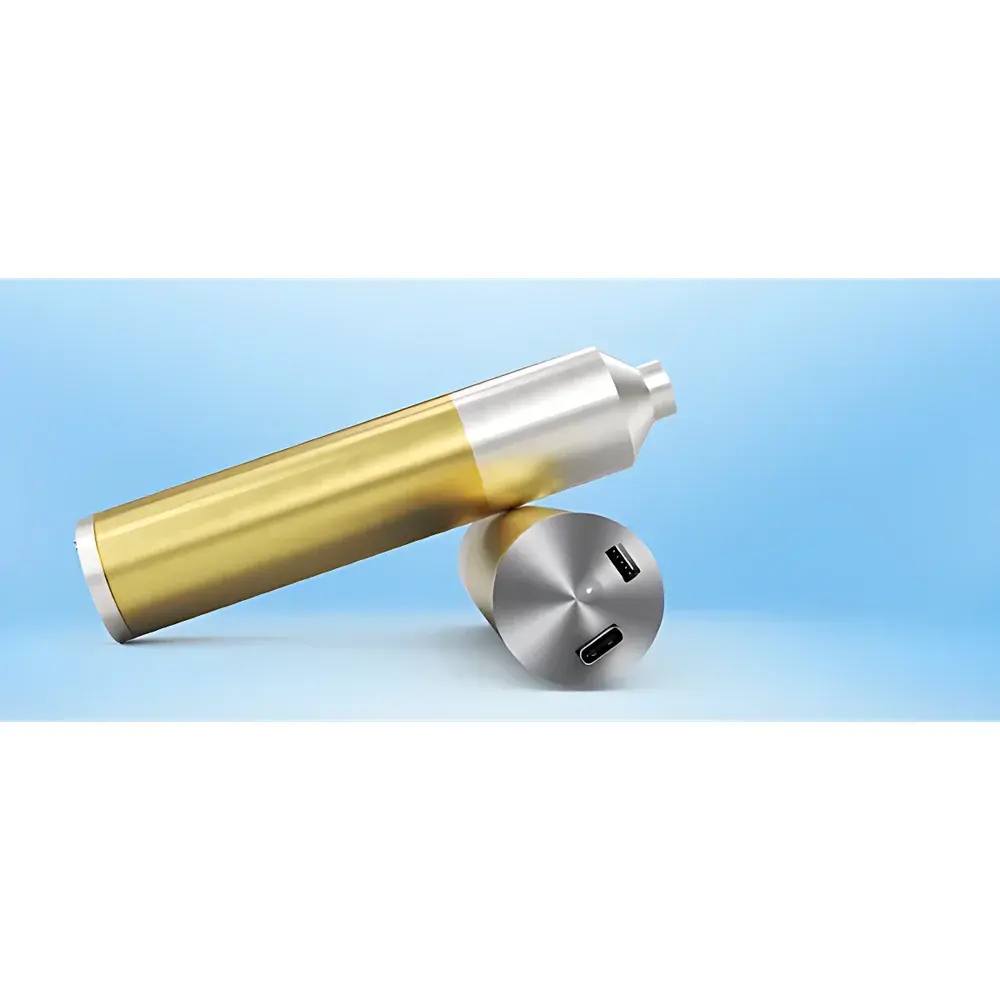
Amptek Starlight Series XRT-450 Microfocus X-ray Source
| Brand | Amptek |
|---|---|
| Origin | USA |
| Model | XRT-450 |
| Target Anode | Ag (customizable) |
| Window | Be, 125 µm |
| Focal Spot Size | <150 µm FWHM |
| Beam Divergence | 120° |
| Operating Voltage | 5–50 kV |
| Max Tube Current | 250 µA |
| Max Output Power | 6 W |
| Input Voltage | 20 VDC |
| HV Polarity | Anode Grounded |
| Cooling | Conduction or Convection |
| Mounting | Threaded Nozzle |
| Weight | 400 g |
| Operating Temperature | –10 °C to +50 °C |
| Radiation Shielding Compliance | IEC 62495 |
| RoHS Compliance | RoHS3 |
| Warranty | 2 years or 4000 operating hours |
Overview
The Amptek Starlight Series XRT-450 is a microfocus transmission-type X-ray source engineered specifically for OEM integration into portable, benchtop, and laboratory-grade X-ray fluorescence (XRF) systems. Unlike conventional thermionic X-ray tubes that rely on heated tungsten filaments, the XRT-450 employs a photoemissive cathode—illuminated by an integrated UV LED—to generate electron emission. This optical excitation mechanism eliminates thermal drift, filament degradation, and warm-up delays, resulting in exceptional long-term stability, reproducible beam positioning, and extended operational lifetime (up to 2× that of filament-based sources). With a nominal focal spot size of <150 µm FWHM, a symmetric 120° beam divergence, and a beryllium exit window (125 µm thick), the XRT-450 delivers high-brightness, low-divergence X-ray output across a tunable 5–50 kV energy range. Its compact metal-ceramic architecture (400 g), low-power 20 VDC input, and conduction/convection-compatible thermal design make it ideal for space-constrained, battery-operated, or embedded instrumentation platforms—including handheld XRF analyzers, µXRF mapping systems, process monitoring sensors, and academic research rigs.
Key Features
- Photoemissive cathode technology: Enables cold-cathode operation with zero filament burnout risk and sub-millisecond response time
- Stable focal spot positioning: Optical alignment ensures consistent beam centroid location over lifetime—critical for quantitative XRF calibration and spatial resolution
- Extended service life: Rated for ≥4000 hours or 2 years—reducing total cost of ownership for high-duty-cycle OEM instruments
- Compact metal-ceramic construction: Hermetically sealed gas-filled tube with threaded nozzle mounting interface (M30×1.5) for robust mechanical integration
- Flexible voltage and current control: Independent regulation of kV (5–50) and µA (up to 250) enables precise excitation optimization per sample matrix and detector configuration
- Compliant radiation design: Meets IEC 62495 requirements for occupational exposure; requires external shielding per local regulatory mandates (e.g., FDA 21 CFR 1020.40, EU Directive 2013/59/Euratom)
Sample Compatibility & Compliance
The XRT-450 is compatible with a broad spectrum of sample types—from powdered geological specimens and alloy coupons to thin-film coatings and biological tissues—when integrated into properly shielded XRF systems. Its Ag anode provides strong characteristic lines at 22.1 keV (Kα) and 25.0 keV (Kβ), well-suited for excitation of elements from Na (Z=11) through U (Z=92). Custom anodes (e.g., Rh, Mo, Cu) are available upon request to optimize sensitivity for specific elemental ranges. The device conforms to RoHS3 (Directive (EU) 2015/863) and carries CE marking under the Electromagnetic Compatibility (EMC) and Low Voltage Directives. While not a standalone instrument, its integration into final equipment must satisfy applicable national and regional radiation safety standards—including ANSI N43.3 (USA), IEC 61010-1 (safety), and ISO/IEC 17025 traceability requirements for accredited testing laboratories.
Software & Data Management
As a component-level source, the XRT-450 does not include embedded firmware or user-facing software. It interfaces via analog control signals (0–10 V for kV, 0–5 V for current) and digital status lines (HV enable, fault flag, interlock), enabling seamless integration with third-party OEM controller boards and spectrometer acquisition engines. For systems requiring audit-ready operation, Amptek recommends coupling the XRT-450 with controllers supporting IEC 62304-compliant firmware and 21 CFR Part 11–compliant data logging—particularly in regulated environments such as pharmaceutical QA/QC or environmental compliance labs. Real-time parameter telemetry (voltage, current, temperature, uptime) can be routed into centralized LIMS or MES platforms via RS-485 or CAN bus extensions.
Applications
- Handheld XRF analyzers for field-based mining exploration, scrap metal sorting, and RoHS/WEEE screening
- Benchtop ED-XRF systems used in metallurgy, cement, and ceramics quality control
- Micro-XRF mapping platforms for semiconductor failure analysis, art conservation, and geological thin-section imaging
- In-line process analyzers for continuous monitoring of coating thickness, plating uniformity, and catalyst composition
- Academic and national lab setups for fundamental studies in X-ray optics, detector calibration, and synchrotron beamline emulation
FAQ
Is the XRT-450 certified as a complete radiation-emitting product?
No. It is a component-level X-ray source intended solely for integration into fully engineered, type-approved analytical instruments. End-product OEMs bear full responsibility for system-level radiation safety certification.
Can the XRT-450 be operated continuously at 6 W?
Yes—within specified thermal limits. Sustained 6 W operation requires adequate heat sinking (≥0.5°C/W thermal resistance) and ambient temperatures ≤+40°C. Derating is recommended above this threshold.
Does Amptek provide driver electronics or HV power supplies?
Amptek offers reference design schematics and evaluation modules (e.g., PX5 series controllers), but final power supply selection and EMC filtering remain the OEM’s responsibility.
What maintenance is required during its service life?
None—no consumables, no vacuum pumping, no filament replacement. The gas-filled tube is sealed and non-replaceable; however, field-repairable units are available under warranty for verified electronic or mechanical faults.
How does optical cathode excitation improve measurement reproducibility?
By eliminating thermal hysteresis and cathode geometry change over time, photoemission yields <0.3% relative standard deviation in tube current over 100-hour stability tests—enabling drift-free quantification without frequent recalibration.





