
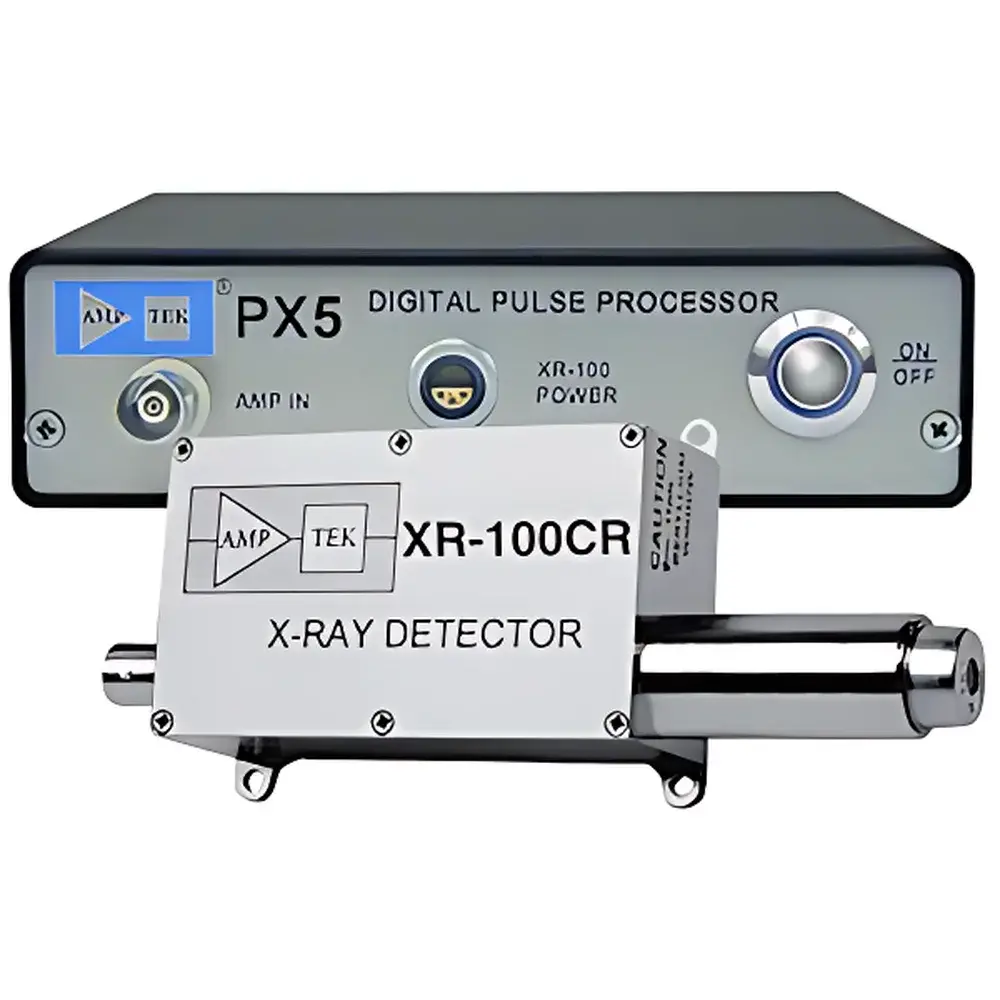
Amptek XR-100CR Silicon PIN X-ray Detector
| Brand | Amptek |
|---|---|
| Origin | USA |
| Model | XR-100CR |
| Detector Type | Si-PIN |
| Active Area | 6–25 mm² |
| Thickness | 300 or 500 µm |
| Be Window | 12.5 or 25 µm |
| Energy Resolution | 145–230 eV FWHM (@ 5.9 keV, ⁵⁵Fe) |
| Cooling | Two-stage thermoelectric (TEC), operating temp ≈ −55 °C |
| Power Consumption | <1 W |
| Housing | TO-8 hermetic package |
| Compliance | UL 61010-1:2004, CAN/CSA-C22.2 No. 61010-1:2004, TUV Certified (CU 72072412 01) |
Overview
The Amptek XR-100CR is a high-performance, compact silicon PIN photodiode X-ray detector engineered for precision energy-dispersive X-ray spectroscopy (EDS) in laboratory, field, and space-constrained applications. Unlike conventional cryogenic detectors requiring liquid nitrogen, the XR-100CR employs a two-stage thermoelectric cooler (TEC) to maintain the silicon sensor at approximately −55 °C—enabling low leakage current, high bias voltage (100–200 V), and optimal charge collection efficiency. This solid-state architecture eliminates cryogen handling while delivering sub-230 eV energy resolution at the Mn Kα line (5.9 keV), measured as full width at half maximum (FWHM). The detector operates on the principle of photoelectric absorption in silicon: incident X-ray photons generate electron-hole pairs proportional to their energy (3.62 eV per pair), with signal amplitude digitized via a charge-sensitive preamplifier and pulse processor. Its hermetically sealed TO-8 package—featuring a thin beryllium entrance window (12.5 or 25 µm)—ensures transmission down to ~1 keV while maintaining vacuum compatibility (down to 10⁻⁸ Torr). Validated in NASA’s Mars Pathfinder mission, the XR-100CR demonstrates proven reliability under extreme thermal cycling, radiation exposure, and long-duration autonomous operation.
Key Features
- Silicon PIN photodiode detector with selectable active area (6–25 mm²) and thickness (300 or 500 µm) for optimized low- or mid-energy response
- Integrated two-stage thermoelectric cooling system enabling stable −55 °C operation without liquid nitrogen or mechanical compressors
- On-sensor temperature monitoring diode with real-time readout (via PX5 software in Kelvin or PX2CR analog output)
- Hermetic TO-8 metal can housing with ultra-thin Be window (0.3–7.5 µm optional) for soft X-ray transmission and environmental isolation
- Multi-layer collimator integrated into detector assembly to suppress edge effects and improve peak-to-background ratio
- Charge-sensitive preamplifier with active feedback reset—eliminating reset transistor noise and enhancing energy resolution
- Total system power draw <1 W; compatible with battery-powered and portable OEM platforms
- UL 61010-1 and CSA C22.2 No. 61010-1 certified for safety in laboratory and industrial environments
Sample Compatibility & Compliance
The XR-100CR supports direct detection of X-rays from 1 keV to 150 keV, with intrinsic detection efficiency governed by Be window transmission (dominant below 3 keV) and silicon absorption depth (dominant above 9 keV). It is compatible with ambient air, inert gas, vacuum (10⁻⁸ Torr), and controlled atmosphere setups—enabling integration into benchtop XRF, handheld analyzers, synchrotron beamlines, and planetary rovers. For vacuum applications, two configurations are supported: (i) full in-vacuum mounting with CF flange feedthroughs and conductive heat sinking, or (ii) external mounting with vacuum-compatible extension kits (e.g., EXV9). All configurations comply with GLP and GMP data integrity expectations when paired with PX5, which provides audit-trail-capable firmware logging and timestamped spectral acquisition. The system meets ASTM E1301 (XRF qualitative analysis), ISO 3497 (metal coating thickness), and IEC 62321-5 (RoHS screening) measurement prerequisites through appropriate calibration and matrix correction protocols.
Software & Data Management
The XR-100CR is designed for seamless integration with Amptek’s PX5 digital pulse processor—a single-board module providing programmable shaping time (0.2–100 µs), multi-channel scaling (up to 8192 channels), real-time dead-time correction, and full spectral acquisition control via USB 2.0. PX5 firmware supports IEEE 1278-compliant metadata embedding (detector ID, HV, temperature, live time) and exports spectra in standard formats (.spe, .csv, .mca) compatible with commercial quantification engines including AXIL, QXAS, and Amptek’s XRF-FP software. Temperature stabilization achieves thermal drift <20 ppm/°C, ensuring gain stability over extended acquisitions. For regulated environments, PX5 supports optional 21 CFR Part 11 compliance modules—including electronic signatures, user access tiers, and immutable audit logs—when deployed with validated LIMS or ELN systems. Raw pulse height data is accessible for custom algorithm development, facilitating OEM integration into proprietary analytical platforms.
Applications
- Energy-dispersive X-ray fluorescence (EDXRF) for elemental analysis in geology, metallurgy, and environmental monitoring
- RoHS and WEEE compliance screening of electronics, plastics, and consumer goods
- Portable and handheld XRF analyzers for on-site mining, scrap sorting, and heritage conservation
- OEM integration into particle-induced X-ray emission (PIXE), muon-induced X-ray spectroscopy (MIXS), and synchrotron endstations
- Nuclear medicine instrumentation including gamma camera calibration and radioisotope assay
- Space-qualified instrumentation for planetary surface composition analysis (e.g., Mars Pathfinder, Perseverance rover heritage)
- In-line process control for thin-film coating thickness and composition verification in semiconductor manufacturing
- Academic research in atomic physics, radiation detection, and detector physics education
FAQ
What is the typical energy resolution specification for the XR-100CR?
The XR-100CR achieves 145–230 eV FWHM at 5.9 keV (⁵⁵Fe), depending on detector geometry (area/thickness) and pulse shaping time selected in the PX5 processor.
Does the XR-100CR require liquid nitrogen cooling?
No. It uses a solid-state two-stage thermoelectric cooler and operates continuously at −55 °C without cryogens.
Can the XR-100CR be used in vacuum environments?
Yes—it is rated for operation from atmospheric pressure down to 10⁻⁸ Torr, with configuration options for internal or external vacuum mounting.
What is the role of the Be window thickness in performance?
Thinner Be windows (e.g., 12.5 µm) increase transmission below 2 keV but reduce mechanical robustness; thicker windows (25 µm) improve durability while attenuating soft X-rays.
Is temperature feedback control mandatory for stable operation?
Not for general lab use—performance remains stable within ±3 °C over the −20 °C to +40 °C ambient range. However, closed-loop active temperature control (ATC) is recommended for handheld or high-precision OEM deployments.
How is the detector powered and interfaced?
It uses a 6-pin LEMO connector (ERA.1S.306.CLL) supplying ±9 V preamp power, 100–200 V detector bias, and 0–4 V TEC drive, with BNC output for analog pulse signals.
What certifications does the XR-100CR hold?
TUV-certified (CU 72072412 01) to UL 61010-1:2004 and CAN/CSA-C22.2 No. 61010-1:2004 for electrical safety in measurement and control equipment.





