
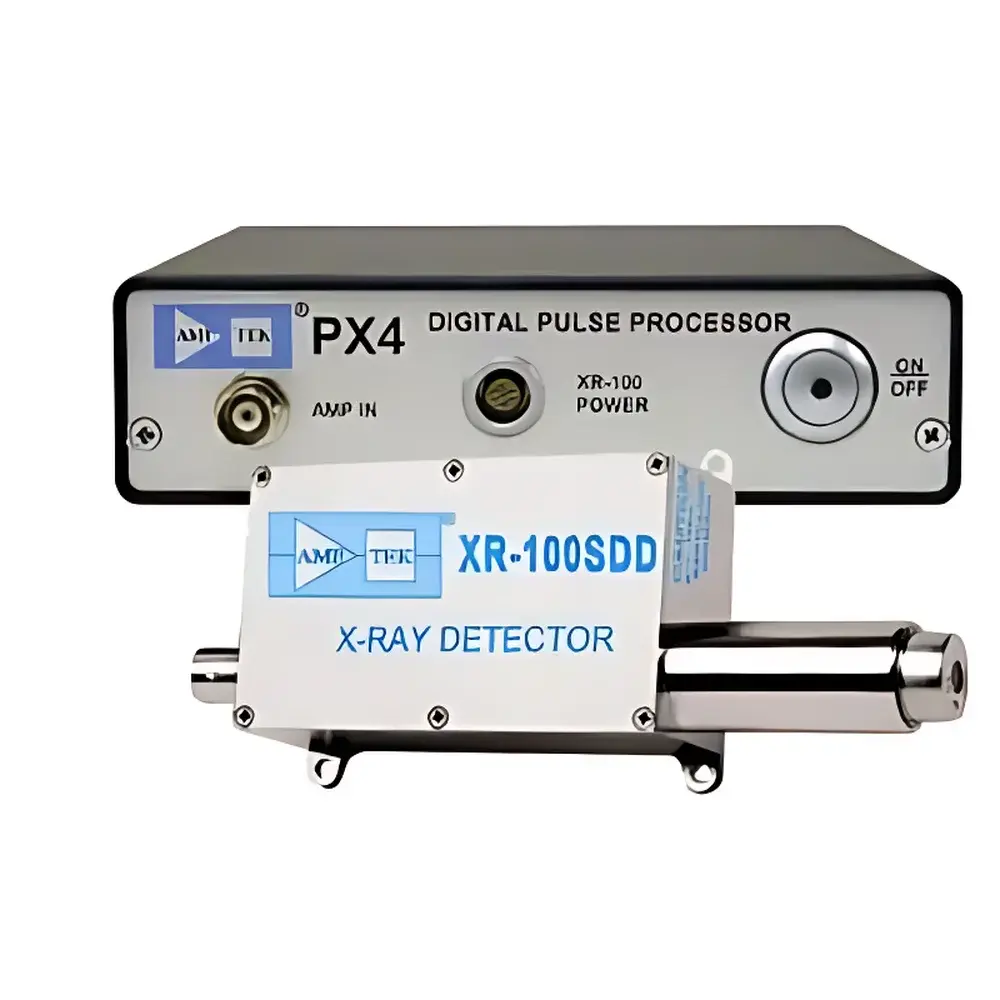
Amptek XR-100SDD Silicon Drift Detector (SDD)
| Brand | Amptek |
|---|---|
| Model | XR-100SDD |
| Detector Type | Silicon Drift Detector (SDD) |
| Active Area | 25 mm² |
| Silicon Thickness | 500 µm |
| Energy Resolution @ 5.9 keV (⁵⁵Fe) | 125–140 eV FWHM |
| Max Count Rate | 500,000 cps |
| Peak-to-Background Ratio | 8200:1 |
| Be Window Thickness | 12.5 µm |
| Operating Temperature | 0°C to +50°C |
| Power Consumption | <1 W |
| Weight | 125 g |
| Dimensions | 7.6 × 4.4 × 2.9 cm |
| Warranty | 1 year |
| Typical Lifetime | 5–10 years |
Overview
The Amptek XR-100SDD is a high-performance silicon drift detector (SDD) engineered for precision X-ray spectroscopy in compact, low-power analytical systems. Based on the fundamental principle of charge collection in a laterally drifted electric field within a high-purity silicon substrate, the XR-100SDD delivers exceptional energy resolution and count-rate capability without cryogenic cooling. Unlike traditional Si(Li) detectors requiring liquid nitrogen, this SDD operates at thermoelectrically stabilized temperatures near room temperature—enabling integration into portable, benchtop, and OEM instrumentation platforms where size, power efficiency, and reliability are critical. Its TO-8 hermetic package ensures mechanical and electrical compatibility with legacy Amptek signal chains, including preamplifiers, shaping amplifiers, and digital pulse processors.
Key Features
- High-resolution spectroscopy: 125–140 eV full width at half maximum (FWHM) at 5.9 keV (⁵⁵Fe), optimized for elemental identification in energy-dispersive X-ray fluorescence (EDXRF) and electron probe microanalysis (EPMA).
- Ultra-high count-rate capability: Stable operation up to 500,000 counts per second (cps), minimizing spectral distortion and dead-time losses in high-flux applications.
- Enhanced signal-to-background performance: Peak-to-background ratio of 8200:1 (5.9 keV vs. 2 keV region), supporting reliable detection of trace elements in complex matrices.
- Low-noise, custom charge-sensitive preamplifier: Integrated Amptek reset-type preamp with gain stability better than 20 ppm/°C, ensuring long-term calibration integrity under thermal variation.
- Robust mechanical design: Hermetically sealed TO-8 package (7.6 × 4.4 × 2.9 cm; 125 g) with 12.5 µm beryllium entrance window—optimized for transmission of soft X-rays down to ~1 keV while maintaining vacuum integrity.
- No liquid nitrogen required: Thermoelectric cooling enables rapid start-up, continuous operation, and field-deployable use without consumables or infrastructure dependency.
Sample Compatibility & Compliance
The XR-100SDD is compatible with solid, powdered, and thin-film samples commonly analyzed in EDXRF, micro-XRF, and X-ray diffraction (XRD) systems. Its 25 mm² active area and 500 µm silicon thickness provide balanced sensitivity across the 1–30 keV range, with peak quantum efficiency exceeding 90% above 3 keV. The internal multilayer collimator minimizes off-axis scatter, improving spectral fidelity during quantitative analysis. The detector complies with IEC 61000-6-3 (EMC emissions) and meets RoHS Directive 2011/65/EU requirements. While not certified as a medical device, its performance characteristics align with ASTM E1361 (Standard Guide for X-Ray Spectrometry) and ISO 21043-2 (XRF instrumentation specifications), supporting GLP-compliant data acquisition when integrated into validated instrument platforms.
Software & Data Management
The XR-100SDD interfaces seamlessly with Amptek’s DP5 digital pulse processor and associated software suites—including PMCA (Portable Multi-Channel Analyzer) and DPPMCA—for real-time spectrum acquisition, peak deconvolution, and quantitative calibration. Raw pulse height data is timestamped and stored in standard binary or ASCII formats (e.g., .chn, .spc), enabling traceability and post-processing in third-party tools such as PyMCA, AXIL, or commercial QA/QC packages. When deployed in regulated environments, the system supports audit-trail-enabled data logging when paired with compliant host software meeting FDA 21 CFR Part 11 requirements for electronic records and signatures.
Applications
- Handheld and portable XRF analyzers for alloy verification, mining exploration, and environmental soil screening.
- Benchtop EDXRF systems for quality control in electronics manufacturing (e.g., RoHS/WEEE compliance testing).
- Lab-based micro-XRF mapping systems for geological sample characterization and cultural heritage artifact analysis.
- OEM integration into synchrotron beamline end-stations requiring compact, high-throughput X-ray detection.
- Space-qualified variants (upon customization) for planetary surface composition analysis using miniaturized spectrometers.
FAQ
Does the XR-100SDD require liquid nitrogen cooling?
No. It uses thermoelectric (Peltier) cooling and operates stably at ambient temperatures between 0°C and +50°C.
What is the typical energy resolution specification, and how is it measured?
Energy resolution is specified as 125–140 eV FWHM at 5.9 keV using a ⁵⁵Fe radioactive source under standard operating conditions (2 µs peaking time, 20°C base temperature).
Can the detector be used in vacuum or inert gas environments?
Yes—the TO-8 package is hermetically sealed and rated for operation in vacuum (<10⁻³ Torr) or dry nitrogen/purge gas atmospheres.
Is firmware or driver support available for custom data acquisition systems?
Amptek provides open-source USB and SPI communication protocols, Linux/Windows SDKs, and hardware reference designs for OEM integration.
How does the XR-100SDD compare to earlier Amptek SDD models like the XR-100T?
The XR-100SDD offers improved count-rate handling, lower electronic noise, and tighter energy resolution tolerance—while retaining identical mechanical and electrical footprints for drop-in replacement.
Related Products





