
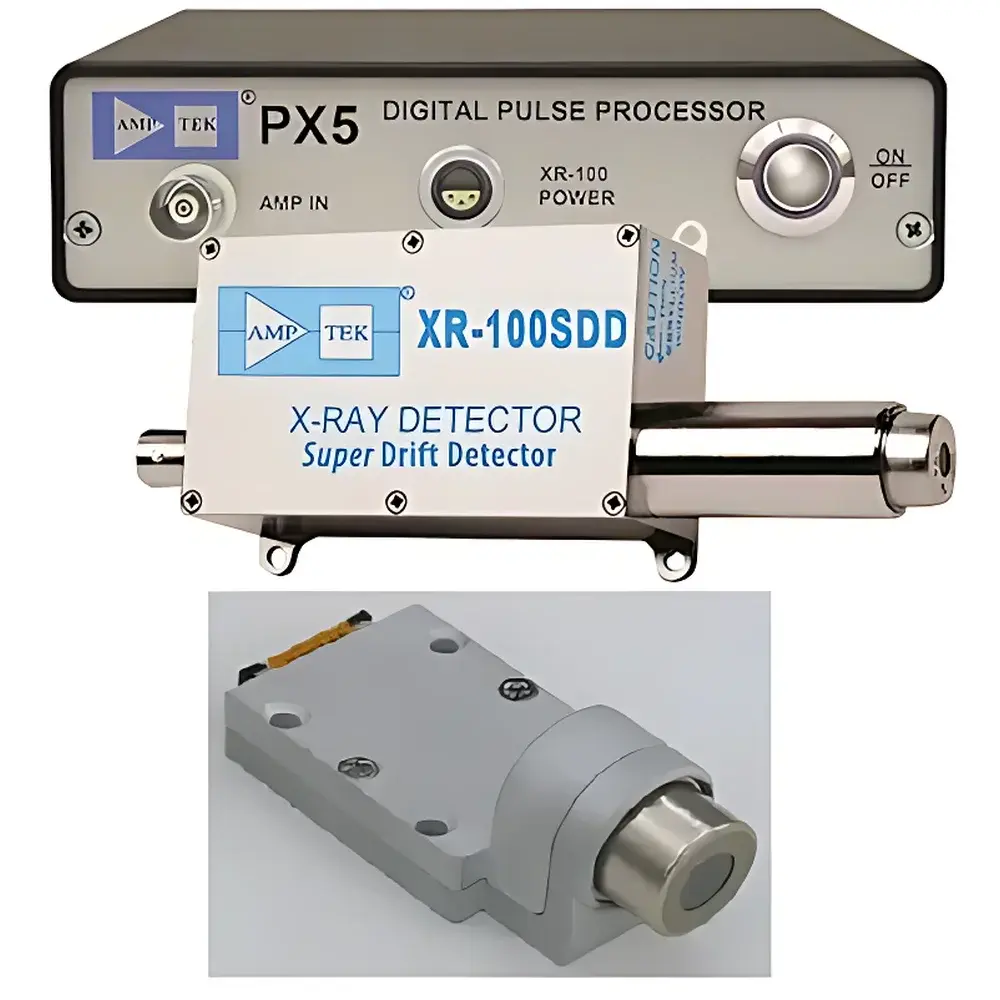
Amptek XR-100SDD Silicon Drift Detector (SDD) for X-ray Spectroscopy
| Brand | Amptek |
|---|---|
| Origin | USA |
| Model | XR-100SDD |
| Detector Type | Silicon Drift Detector (SDD) |
| Active Area | 25 mm² |
| Thickness | 500 µm |
| Energy Resolution | 125 eV FWHM @ 5.9 keV (11.2 µs peaking time) |
| Max Count Rate | 500,000 cps |
| Peak-to-Background Ratio | 20,000:1 (5.9 keV / 1 keV) |
| Be Window Thickness | 12.5 µm (0.5 mil) |
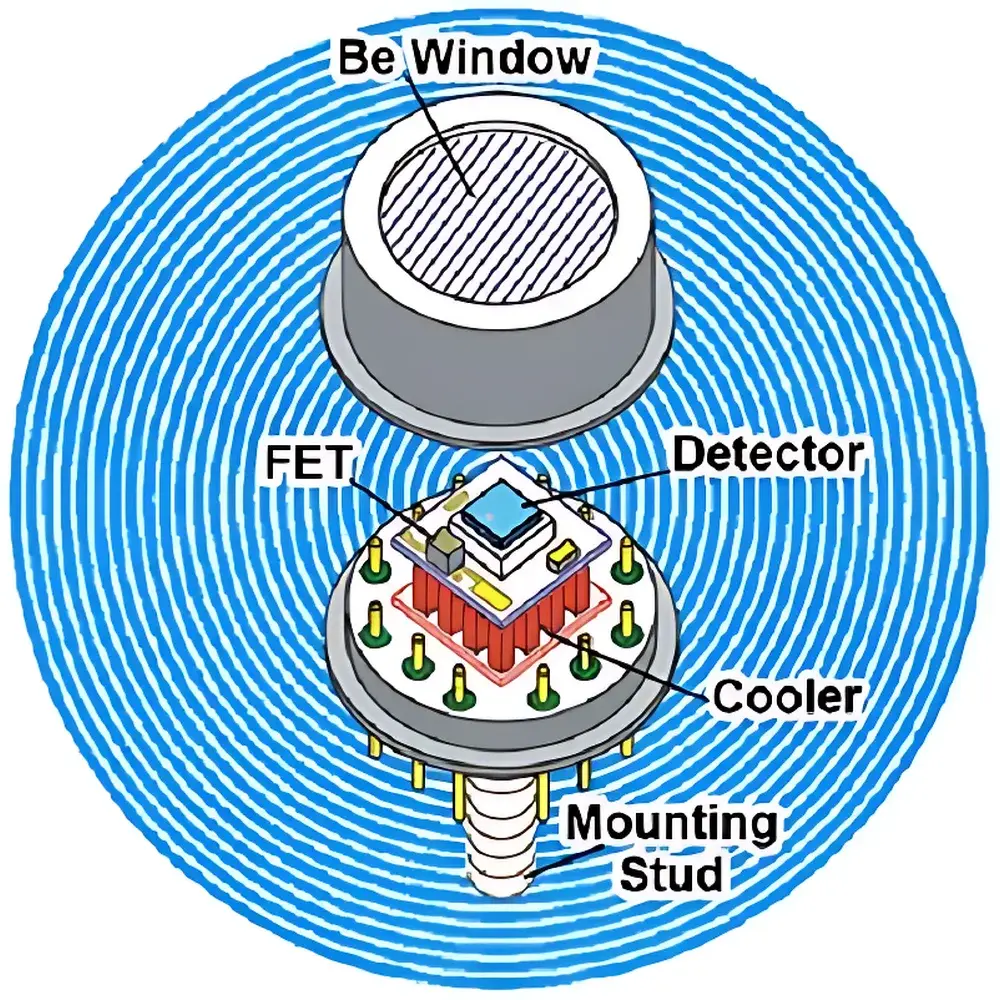
| Cooling Method | Two-stage thermoelectric (Peltier), no liquid nitrogen required |
| Operating Temperature | ~250 K (−23 °C) |
| Housing | TO-8 metal can |
| Compliance | UL 61010-1:2004, CAN/CSA-C22.2 No. 61010-1:2004, TUV Certified (CU 72072412 02) |
Overview
The Amptek XR-100SDD is a high-performance silicon drift detector (SDD) engineered for precision X-ray energy-dispersive spectroscopy (EDS or EDXRF) in laboratory, industrial, and OEM instrumentation. Unlike conventional Si-PIN diodes, the XR-100SDD employs a monolithic, single-electrode SDD architecture with integrated field-effect transistor (FET) and closed-loop temperature control—enabling low-noise, high-speed charge collection at stable cryogenic operating temperatures (~250 K). Its operation is based on lateral charge drift under an applied electric field across a high-resistivity silicon bulk, minimizing capacitance and thus electronic noise. This physical principle allows the XR-100SDD to achieve superior energy resolution (125 eV FWHM at 5.9 keV, Mn-Kα) while sustaining count rates up to 500,000 counts per second (cps)—a performance envelope unattainable with traditional Si-PIN detectors of equivalent active area.
Key Features
- Ultra-low energy resolution: 125 eV FWHM at 5.9 keV (Mn-Kα) with 11.2 µs peaking time; configurable trade-offs between resolution and throughput (e.g., 155 eV @ 0.8 µs for rapid analysis)
- High peak-to-background ratio of 20,000:1 (5.9 keV / 1 keV), critical for trace-element detection in complex matrices
- Thermoelectric cooling only—no liquid nitrogen or mechanical cryocoolers required—reducing system footprint, power consumption (<1 W total), and operational complexity
- Integrated multi-layer collimator (ML) to suppress edge effects and parasitic low-energy signals, improving spectral fidelity and quantitative accuracy
- Robust TO-8 hermetic package with 12.5 µm beryllium entrance window, optimized for soft X-ray transmission (down to ~1 keV) while maintaining vacuum compatibility (10⁻⁸ Torr)
- Onboard temperature sensor with Kelvin-scale readout via compatible electronics (e.g., PX5, X-123SDD), enabling real-time thermal monitoring and stability verification
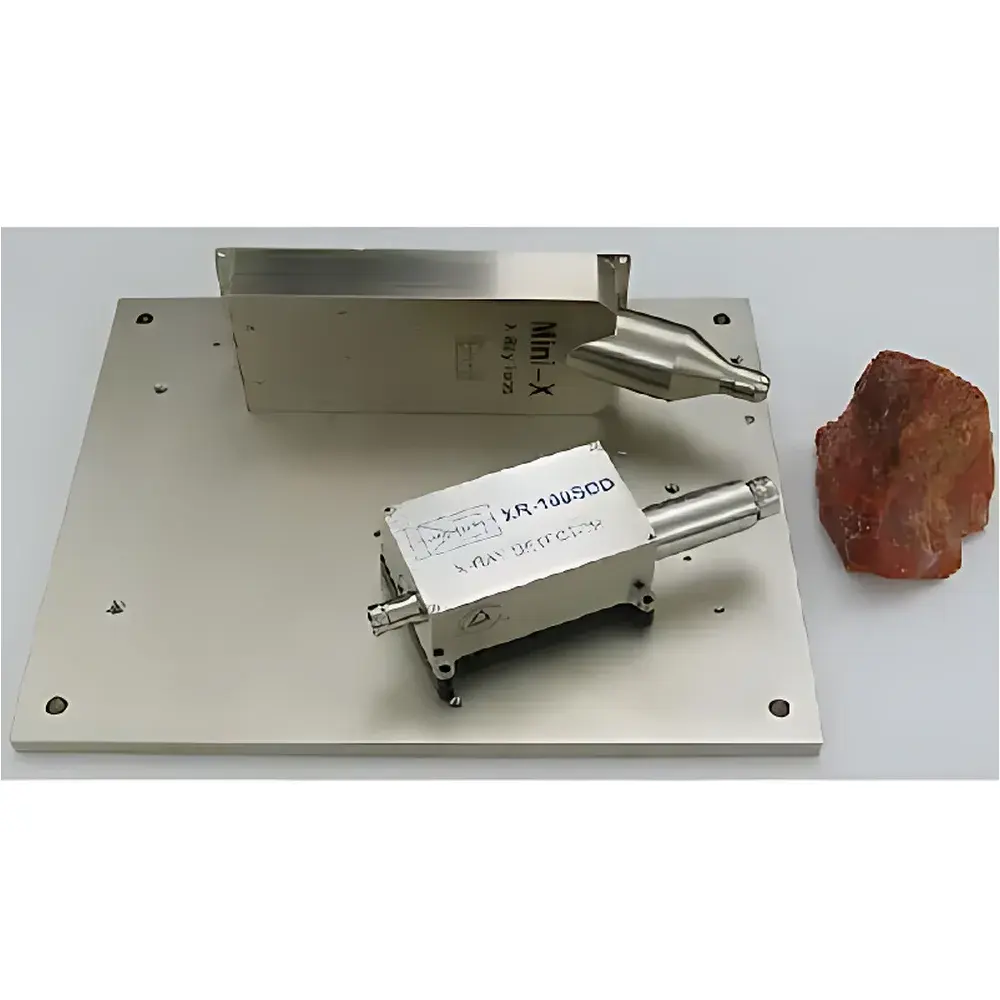
- Designed for seamless integration into OEM platforms—including handheld XRF analyzers, benchtop spectrometers, synchrotron beamlines, and process-control systems
Sample Compatibility & Compliance
The XR-100SDD supports direct measurement of solid, powdered, and liquid samples in ambient air, He-purged, or high-vacuum environments (10⁻⁸ Torr to atmospheric pressure). Its thin Be window permits efficient detection of light elements (Na, Mg, Al, Si, P, S, Cl) without vacuum chamber constraints—ideal for RoHS/WEEE compliance screening and geological or environmental sample analysis. For ultra-high-sensitivity applications requiring sub-keV response (e.g., C, N, O), optional ultra-thin polymer windows or vacuum-compatible extended-length configurations (e.g., EXV9 feedthrough assembly) are available. The detector complies with IEC/EN 61010-1 safety standards (UL 61010-1:2004, CSA C22.2 No. 61010-1:2004) and carries TÜV certification (CU 72072412 02). While not inherently GLP/GMP-certified, its stable gain (<20 ppm/°C drift), audit-ready temperature logging, and deterministic pulse processing make it suitable for regulated environments when paired with compliant digital signal processors (e.g., DP5-based X-123SDD with 21 CFR Part 11–capable firmware).
Software & Data Management
The XR-100SDD operates as a core sensing element within Amptek’s modular X-ray spectrometry ecosystem. When paired with the PX5 digital pulse processor or the fully integrated X-123SDD spectrometer, users gain access to real-time spectrum acquisition, automatic peak identification, and quantitative analysis using fundamental parameters (FP) algorithms (e.g., XRF-FP software). All firmware supports timestamped spectral metadata, hardware-triggered acquisition, and full audit trails—including detector temperature, bias voltage, and live count rate logs. Raw MCA data is exported in standard formats (e.g., .spe, .cnf) compatible with third-party tools such as PyMca, AXIL, or commercial QA/QC suites. For OEM integration, Amptek provides comprehensive SDKs (C/C++, Python) and register-level documentation to support custom host software development and embedded control.
Applications
- X-ray fluorescence (XRF) analysis for elemental composition in metals, alloys, catalysts, soils, and polymers
- Regulatory testing for restricted substances (Pb, Cd, Hg, Cr⁶⁺, Br) per EU RoHS/WEEE directives and China GB/T 33352–2016
- In-line process monitoring in metallurgy, cement production, and battery material synthesis
- Academic and national lab research in synchrotron radiation facilities, where high count-rate capability enables time-resolved XRF mapping
- Portable/handheld analyzers for field-deployable geochemical prospecting, scrap metal sorting, and cultural heritage artifact authentication
- Micro-XRF and TXRF systems requiring compact, low-power, high-resolution detection without cryogenic infrastructure
FAQ
Does the XR-100SDD require liquid nitrogen cooling?
No. It uses two-stage thermoelectric (Peltier) cooling to maintain ~250 K operation—eliminating LN₂ dependency while delivering competitive resolution and count-rate performance.
What is the recommended bias voltage range?
The detector requires a stable negative high voltage between −90 V and −150 V. Voltage regulation must be better than ±0.1% to prevent resolution degradation or damage.
Can the XR-100SDD operate in vacuum?
Yes—it is rated for continuous operation from 10⁻⁸ Torr to ambient pressure. Vacuum integration options include internal mounting with CF-flange feedthroughs or external mounting with vacuum-compatible extension tubes (e.g., EXV9).
How does the built-in collimator improve spectral quality?
The multi-layer collimator restricts incident X-rays to the detector’s central active volume, suppressing incomplete charge collection events from edge regions that cause low-energy tailing and false peaks.
Is the XR-100SDD compatible with existing Si-PIN electronics?
Not directly. It requires negative HV bias and produces positive-polarity output pulses—opposite polarity to most Si-PIN systems. Use only Amptek-recommended power supplies (e.g., PX5 configured for negative HV output) to avoid permanent damage.
What is the expected operational lifetime?
Typical service life exceeds 5–10 years under normal operating conditions (0–50 °C ambient, 10 years) is supported in dry nitrogen or desiccated environments.
Related Products






