
Amptek XR-100SDD Silicon Drift Detector (SDD) for X-ray Spectroscopy
| Brand | Amptek |
|---|---|
| Origin | USA |
| Model | XR-100SDD |
| Detector Type | Silicon Drift Detector (SDD) |
| Active Area | 25 mm² |
| Thickness | 500 µm |
| Energy Resolution | 125 eV FWHM @ 5.9 keV (11.2 µs peaking time) |
| Max Count Rate | 500,000 cps |
| Peak-to-Background Ratio | 20,000:1 (5.9 keV / 1 keV) |
| Be Window Thickness | 12.5 µm (0.5 mil) |
| Operating Temperature | ~250 K (−23 °C) |
| Cooling | Two-stage thermoelectric (Peltier), no liquid nitrogen required |
| Encapsulation | TO-8 metal can with vacuum-compatible Be window |
| Power Consumption | <1 W |
| Certifications | UL 61010-1:2004, CAN/CSA-C22.2 No. 61010-1:2004, TÜV Certificate #CU 72072412 02 |
Overview
The Amptek XR-100SDD is a high-performance silicon drift detector (SDD) engineered for precision X-ray energy-dispersive spectroscopy (EDS or EDXRF) in laboratory, industrial, and OEM instrumentation environments. Unlike conventional silicon PIN diode detectors, the XR-100SDD employs a monolithic SDD architecture with lateral charge drift and a small, low-capacitance anode—enabling significantly reduced electronic noise and faster signal processing. Its operation relies on solid-state charge collection within a fully depleted silicon volume under reverse bias (−90 V to −150 V), where incident X-ray photons generate electron-hole pairs proportional to photon energy. The detector’s low capacitance (<100 fF) permits short shaping times (down to 0.8 µs) without compromising energy resolution—making it uniquely suited for high-throughput applications such as handheld XRF analyzers, process control systems, synchrotron beamlines, and benchtop spectrometers. Designed for ambient-to-vacuum operation (10⁻⁸ Torr to atmospheric pressure), the XR-100SDD integrates thermoelectric cooling to stabilize the sensor at ≈250 K (−23 °C), eliminating dependency on cryogenic liquid nitrogen while maintaining sub-130 eV resolution at Mn-Kα (5.9 keV).
Key Features
- Ultra-low energy resolution: 125 eV FWHM at 5.9 keV (Mn-Kα) with 11.2 µs peaking time—optimized for elemental identification and quantification in complex matrices.
- High count rate capability: Up to 500,000 counts per second (cps) in fast-peaking mode (0.8 µs), enabling rapid acquisition in high-flux X-ray sources including microfocus tubes and synchrotron beamlines.
- Exceptional peak-to-background ratio: ≥20,000:1 (5.9 keV / 1 keV), critical for detecting trace elements in RoHS/WEEE-compliant screening and geological samples.
- Integrated multilayer collimator: Minimizes edge effects and incomplete charge collection, suppressing low-energy artifacts and improving spectral fidelity.
- Vacuum-compatible TO-8 metal package with 12.5 µm beryllium entrance window: Enables efficient transmission of soft X-rays (down to ≈1 keV) while maintaining hermetic seal integrity for long-term stability.
- Low-power thermoelectric cooling: Dual-stage Peltier cooler maintains stable operating temperature with <1 W total power draw—ideal for portable and embedded systems.
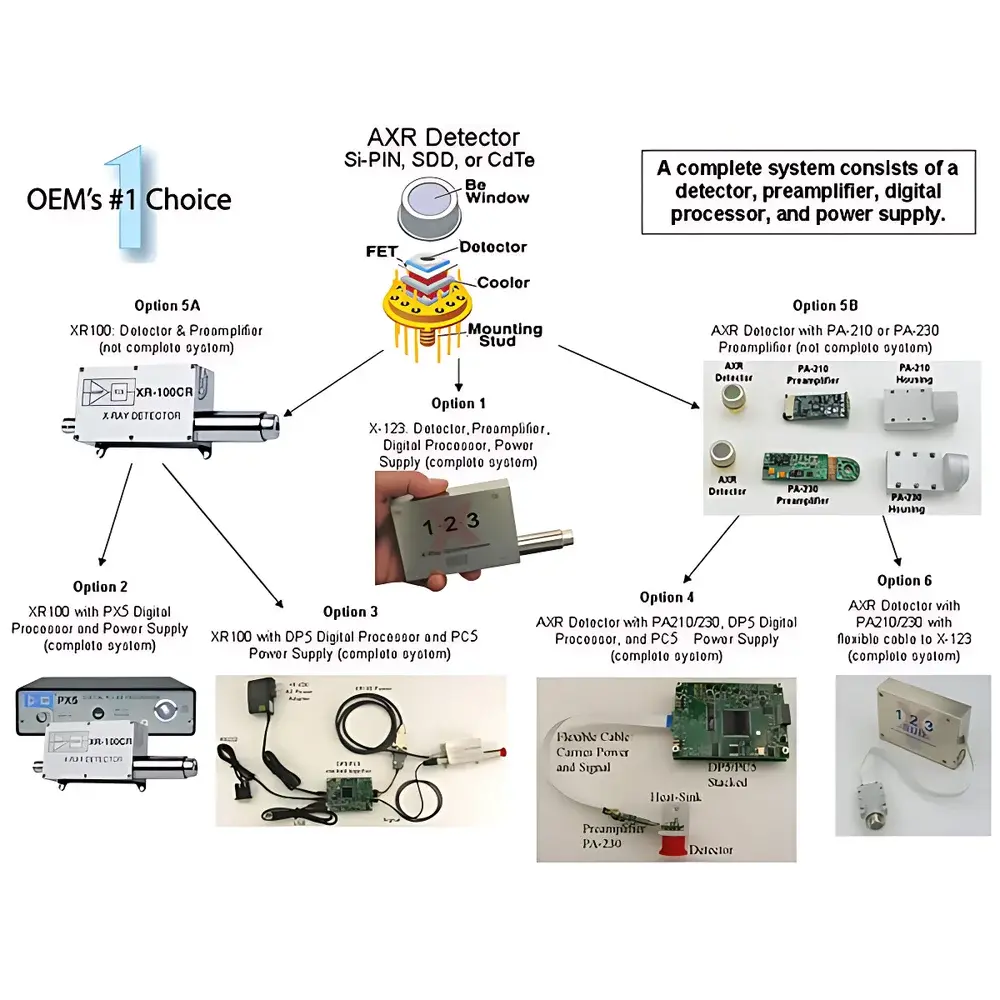
- OEM-ready mechanical and electrical interface: Standard 3-inch × 1.75-inch footprint, 4 mounting holes, and compatible voltage/current requirements for seamless integration with Amptek’s PX5, DP5, or X-123SDD digital pulse processing platforms.
Sample Compatibility & Compliance
The XR-100SDD supports analysis of solid, liquid, and powdered samples across diverse application domains—including environmental monitoring (soil, water filtrates), metallurgy (alloy verification), electronics (lead-free solder screening), catalysis research, and geochemical prospecting. Its 25 mm² active area and 500 µm thick silicon substrate provide balanced sensitivity for both light (Na, Mg, Al) and mid-Z elements (Fe, Cu, Zn), while the thin Be window ensures adequate transmission down to carbon Kα (0.28 keV) when operated under vacuum or helium purge. The detector complies with IEC 61000-6-3 (EMC), UL 61010-1:2004, and CSA C22.2 No. 61010-1:2004 for safety in laboratory instrumentation. For regulated environments—including GLP/GMP-compliant QA/QC labs—the XR-100SDD is routinely deployed alongside Amptek’s X-123SDD system, which supports audit-trail-enabled data logging compliant with FDA 21 CFR Part 11 when paired with validated software (e.g., XRF-FP). Calibration traceability follows NIST-traceable reference standards (e.g., NIST SRM 2100, 2101), and spectral stability is verified per ASTM E1361–22 (Standard Practice for Calibration of Energy-Dispersive X-ray Spectrometers).
Software & Data Management
The XR-100SDD operates natively with Amptek’s ecosystem of digital pulse processors: PX5 (analog-to-digital conversion + MCA), DP5 (real-time digital shaping and pile-up rejection), and X-123SDD (fully integrated spectrometer module). All platforms support USB 2.0, RS-232, and Ethernet connectivity, delivering calibrated spectra directly to host PCs running Amptek’s DPPMCA or third-party tools (e.g., PyMCA, Axil). Firmware updates and real-time temperature monitoring (via Kelvin-scale readout) are accessible through ASCII command protocols. For OEM integration, Amptek provides full SDKs (C/C++, Python, LabVIEW) and register-level documentation for custom control logic. Spectral data export conforms to standard formats (ASCII .txt, .csv, binary .spe), ensuring compatibility with LIMS and ELN systems. When used in regulated workflows, the X-123SDD configuration supports user authentication, electronic signatures, and immutable metadata tagging—facilitating compliance with ISO/IEC 17025 and 21 CFR Part 11 requirements.
Applications
- X-ray fluorescence (XRF) analysis for elemental composition mapping in alloys, ceramics, and polymers.
- Routine RoHS/WEEE screening of electronic components, plastics, and packaging materials.
- In-line process control in mining, cement production, and scrap metal sorting—leveraging high count rates for real-time feedback.
- Academic and national lab research: synchrotron-based micro-XRF, time-resolved XAS, and low-energy plasma diagnostics.
- Handheld and portable XRF analyzers requiring rugged, low-power, high-resolution detection without cryogens.
- Vacuum-compatible end-station instrumentation in surface science (AES, XPS auxiliary detection) and space-borne spectrometers (NASA heritage).
FAQ
Does the XR-100SDD require liquid nitrogen cooling?
No. It uses two-stage thermoelectric cooling to maintain ≈250 K (−23 °C); no cryogens or external chillers are needed.
What is the recommended high-voltage polarity for the XR-100SDD?
The detector requires negative bias (−90 V to −150 V); using positive HV will cause permanent damage and void warranty.
Can the XR-100SDD operate in vacuum?
Yes—it is rated for continuous operation from 10⁻⁸ Torr to atmosphere. Vacuum integration options include internal mounting with CF flange feedthroughs or external mounting with EXV9 extension tubes.
How does resolution vary with peaking time?
Energy resolution degrades slightly with shorter peaking times: 125 eV (11.2 µs), 150 eV (3.2 µs), and 155 eV (0.8 µs)—all measured at 5.9 keV. Trade-offs between resolution and throughput are configurable via digital pulse processor settings.
Is the XR-100SDD compatible with existing Si-PIN electronics?
Not directly—its negative HV requirement and positive-polarity preamp output differ from standard Si-PIN configurations. Amptek PX5 modules must be configured for negative HV output; mismatched polarity causes irreversible damage.
What is the typical lifetime under continuous operation?
Five to ten years, depending on thermal cycling, accumulated dose, and storage conditions (dry, 0–50 °C). Long-term storage (>10 years) is viable under desiccated conditions per MIL-STD-202G.
Related Products






