
Amptek XRF OEM Solution – Energy Dispersive X-Ray Fluorescence Spectrometer Module
| Brand | Amptek |
|---|---|
| Origin | USA |
| Manufacturer Type | Authorized Distributor |
| Product Category | Imported |
| Model | OEM Solution |
| Pricing | Upon Request |
Overview
The Amptek XRF OEM Solution is a modular, high-performance energy dispersive X-ray fluorescence (EDXRF) spectrometer platform engineered for seamless integration into custom analytical instrumentation. Built upon Amptek’s 30+ years of expertise in radiation detection and digital pulse processing, this solution delivers laboratory-grade elemental analysis capability in compact, low-power hardware modules. The system operates on the fundamental principle of EDXRF: incident X-rays from an excitation source (e.g., Mini-X or other OEM-compatible X-ray tube) induce characteristic secondary X-ray emission from sample atoms; these fluorescent photons are detected by a solid-state sensor (Si-PIN, SDD, or CdTe), and their energies are digitized and resolved using Amptek’s proprietary DP5 digital pulse processor. This architecture eliminates analog shaping amplifiers and traditional multi-channel analyzers (MCAs), significantly improving energy resolution stability, count-rate linearity, and temperature drift performance—critical for RoHS/WEEE-compliant screening, alloy verification, mining assay, and environmental monitoring.
Key Features
- Modular architecture supporting six scalable integration levels—from fully integrated X-123/X-123SDD spectrometers to bare detector + preamplifier configurations (AXR/PA-210/PA-230)
- High-resolution silicon drift detectors (SDD) with active areas up to 25 mm² and 500 µm thickness—optimized for light-element sensitivity (Na–U) and high throughput in regulatory compliance testing
- DP5 digital pulse processor: real-time pile-up rejection, adaptive baseline restoration, and firmware-upgradable spectral processing algorithms
- Low-power design: X-123 consumes only 1.2 W; all modules operate from +5 V DC input with USB 2.0 or RS-232 host interface
- Compact mechanical footprint: X-123 measures 70 × 100 × 25 mm (2.7 × 3.9 × 1.0 in); DP5+PC5 stack occupies just 89 × 64 × 23 mm (3.5 × 2.5 × 0.9 in)
- Software Development Kit (SDK) included: cross-platform C/C++ API with Windows, Linux, and embedded OS support; full register-level control and spectrum streaming capability
- Thermal management options: standard heat sinks, custom thermal interface solutions, and vacuum-compatible variants (e.g., XR-100 with CP75 feedthrough)
Sample Compatibility & Compliance
The Amptek XRF OEM platform supports solid, powder, liquid, and thin-film samples across industrial, academic, and regulatory environments. Detector selection (Si-PIN, SDD, CdTe) enables optimization for specific applications: Si-PIN for cost-sensitive handheld systems; SDD for high-resolution benchtop analyzers requiring detection limits <10 ppm for Pb, Cd, Hg, Cr, Br; CdTe for high-energy gamma/X-ray applications beyond 100 keV. All configurations comply with IEC 62321-5:2013 and ASTM F2859-10 for RoHS/WEEE screening. When paired with Amptek’s XRF-FP quantitative software and certified reference materials, systems meet GLP/GMP data integrity requirements—including audit trail logging, user access controls, and electronic signature support per FDA 21 CFR Part 11 when deployed in regulated QA/QC workflows.
Software & Data Management
Amptek provides a comprehensive software ecosystem for OEM integration. The X-123 firmware includes embedded MCA functionality with live spectrum display, region-of-interest (ROI) integration, and peak identification. The SDK enables deep customization: developers can embed spectral acquisition directly into proprietary GUIs, implement real-time elemental ratio calculations, or integrate with LIMS via TCP/IP or serial protocols. Optional XRF-FP software adds fundamental parameter (FP) quantification with matrix correction, standards-based calibration, and report generation compliant with ISO 18115-1:2017. All firmware and SDK releases undergo version-controlled revision history, SHA-256 checksum validation, and backward-compatible binary updates—ensuring long-term maintainability in field-deployed instruments.
Applications
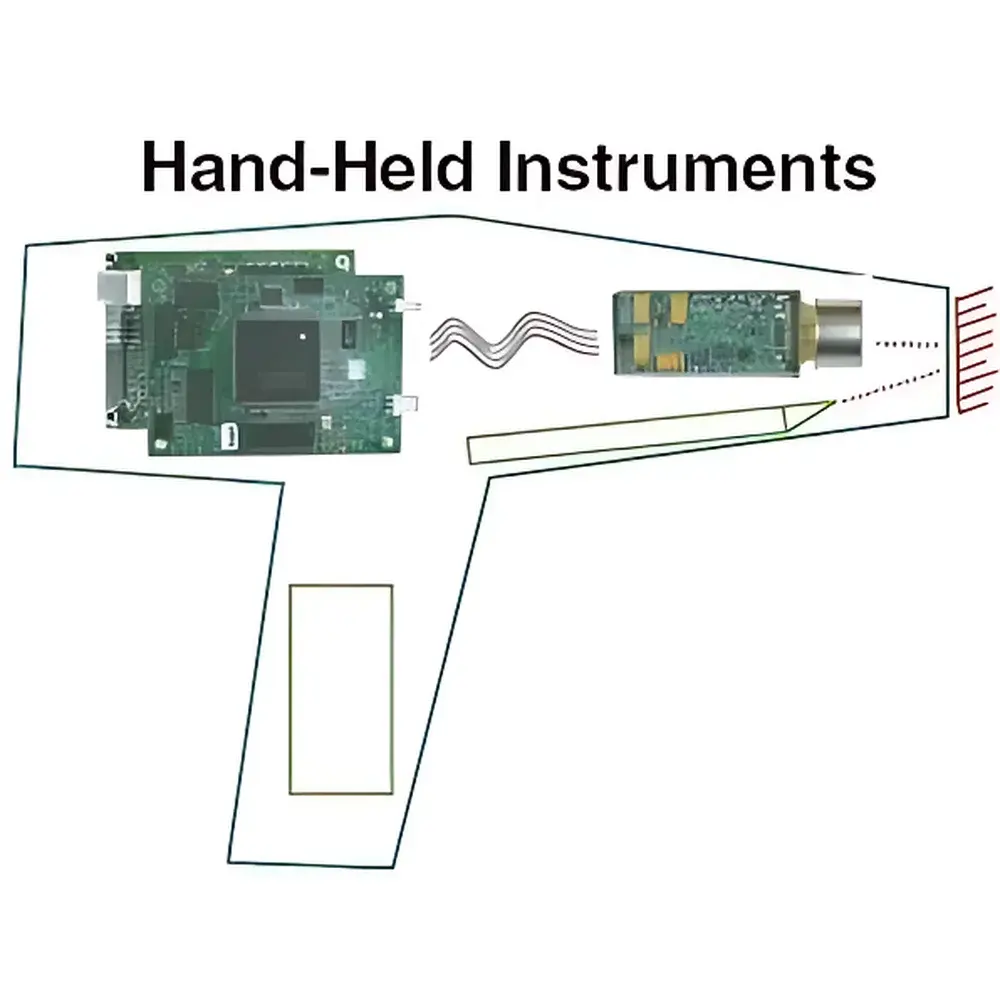
- Handheld XRF analyzers for scrap metal sorting, positive material identification (PMI), and soil heavy-metal screening
- Benchtop EDXRF systems for QC in electronics manufacturing (PCB solder, plating layers), catalyst analysis, and cement raw-material blending
- In-line process analyzers for mining slurry composition monitoring and recycling stream characterization
- Academic research platforms for synchrotron beamline end-stations, micro-XRF mapping, and nuclear forensics
- Vacuum-compatible XRF modules for space instrumentation and ultra-high-purity semiconductor metrology
FAQ
Which configuration is best for rapid time-to-market?
The X-123 or X-123SDD integrated module—fully assembled, calibrated, and USB-ready—is optimized for fastest integration, requiring only +5 V power and host communication.
Can I use my own X-ray tube with Amptek detectors?
Yes. All Amptek detectors and electronics are designed for interoperability with third-party X-ray sources, including open-tube, microfocus, and sealed-tube generators meeting standard HV and timing interface specifications.
Is the SDK compatible with ARM-based embedded Linux systems?
Yes. The Amptek SDK supports ARMv7/v8 architectures with documented build instructions for Yocto Project and Buildroot environments.
Do you provide RoHS-compliant documentation packages?
Yes. Full technical documentation—including CE DoC, REACH SVHC declarations, and IPC-J-STD-020 moisture sensitivity level (MSL) ratings—is provided with every OEM shipment.
What is the typical energy resolution (FWHM) at Mn Kα for the X-123SDD?
Typical resolution is ≤125 eV at 5.9 keV (Mn Kα) under standard operating conditions (−20 °C detector temperature, 100 kcps count rate).




