
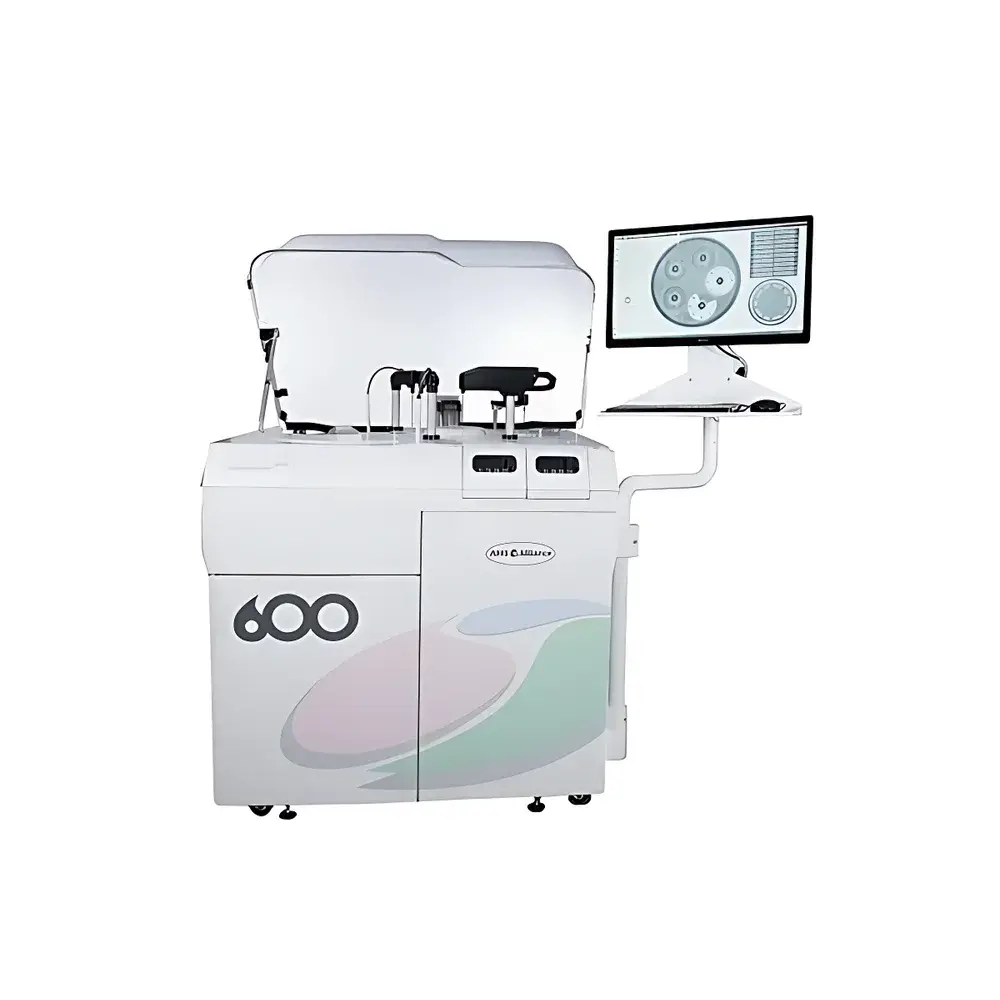
AMS Alliance Smartchem 600 Fully Automated Discrete Chemistry Analyzer
| [Brand | AMS Alliance |
|---|---|
| Origin | USA |
| Model | Smartchem 600 |
| Sample Capacity | 200 positions |
| Reagent Positions | 100 (with refrigeration) |
| Wavelength Range | 340–1100 nm |
| Cuvette Path Length | 10 mm (6 mm optional) |
| Detection Principle | Dual-beam, dual-wavelength photometry |
| Maximum Throughput | 600 samples/hour |
| Reaction Disc Capacity | 85 reusable cuvettes |
| Temperature Control | 37 °C ± 0.3 °C |
| Linear Absorbance Range | 0.00001–4.2 Abs |
| Resolution | 0.00001 Abs |
| Minimum Reaction Volume | 180 µL |
| Compliance | ISO, AOAC, US EPA, AFNOR, COFRAC, BATF] |
Overview
The AMS Alliance Smartchem 600 is a fully automated, benchtop discrete chemistry analyzer engineered for high-precision, high-throughput quantitative analysis of inorganic and low-molecular-weight organic analytes in complex matrices. Unlike continuous-flow or segmented-flow systems, the Smartchem 600 employs true discrete analysis—mimicking validated manual colorimetric protocols by dispensing precise volumes of sample and reagent into individual optical cuvettes, allowing complete reaction control, incubation, and endpoint or kinetic absorbance measurement. Its core detection system utilizes a high-stability dual-beam, dual-wavelength photometer with selectable wavelengths across 340–1100 nm, enabling accurate compensation for turbidity, background interference, and matrix effects. Designed for regulatory-compliant laboratories, the instrument supports method validation per ISO/IEC 17025, US EPA guidance documents (e.g., Method 353.2, 365.4), and AOAC Official Methods, making it suitable for environmental monitoring, food safety testing, agricultural quality control, and clinical research applications requiring trace-level quantification.
Key Features
- Three independent robotic arms with integrated liquid level, clog, and vibration sensors ensure precise, reproducible aspiration and dispensing across all fluid handling steps.
- Dual stirrers enable homogeneous mixing in cuvettes during reaction kinetics—critical for assays requiring controlled incubation (e.g., nitrate reduction via cadmium column).
- Automated, multi-stage cuvette cleaning station with optical quality verification guarantees zero carryover between analyses; cuvettes are reusable for >10,000 cycles, reducing consumable cost and waste generation.
- Refrigerated 100-position reagent carousel accommodates vials of 5, 25, 50, and 100 mL volumes; optional reagent barcode reader enables full traceability and automatic method assignment.
- 200-sample capacity organized across two rotating carousels (10 racks × 10 positions each), supporting emergency sample insertion without interrupting ongoing runs.
- Onboard temperature-controlled reaction disc (37 °C ± 0.3 °C) with 85 individually addressable, optically validated cuvettes ensures thermal consistency for enzyme-coupled and equilibrium-based assays.
- Low-volume operation: average water consumption <7 L/hour; minimum reaction volume 180 µL; optimized reagent usage reduces assay cost per test by up to 40% versus conventional flow systems.
Sample Compatibility & Compliance
The Smartchem 600 accepts standard 10–13 mm OD sample tubes (up to 100 mm height), including capped tubes for light- or oxygen-sensitive analyses (e.g., nitrite, sulfide). It handles undiluted, pre-diluted, or automatically diluted samples—including on-the-fly predilution or post-analysis rerun with dilution logic. The system complies with international regulatory frameworks including US EPA Methods (e.g., nitrate/nitrite via cadmium reduction, phosphate via ascorbic acid/molybdate), ISO 15681 (phosphorus), ISO 7890 (ammonia), AOAC 973.42 (total nitrogen), and AFNOR T90-210 (water hardness). All data acquisition, calibration, and audit trails meet FDA 21 CFR Part 11 requirements when configured with electronic signature and secure user access controls. Instrument qualification documentation supports GLP and GMP environments, including IQ/OQ/PQ protocols aligned with ASTM E2500 and EU Annex 11.
Software & Data Management
Smartchem Control Software is a Windows-based, touchscreen-optimized platform offering intuitive workflow navigation, real-time status visualization, and full remote diagnostics support. It supports unlimited method programming—including endpoint, kinetic, differential, dual-wavelength, and immunoturbidimetric assays—with up to 999 configurable tests per method file. Key software capabilities include: automatic startup/shutdown scheduling; barcode-driven sample and reagent identification; dynamic method switching without hardware reconfiguration; real-time recalibration (including curve point replacement and forced interpolation); automatic outlier detection and repeat analysis logic; LIMS integration via ASTM E1384 or HL7 messaging; and full audit trail logging (user actions, parameter changes, calibration events) compliant with ALCOA+ principles. Data export formats include CSV, PDF, and XML for seamless integration into enterprise laboratory informatics systems.
Applications
The Smartchem 600 delivers validated performance across diverse sectors:
- Environmental Testing: Ammonia-N, nitrate-N, nitrite-N, phosphate-P, sulfate, silicate, chromate(VI), chloride, alkalinity, COD (via dichromate digestion), cyanide, fluoride, hardness, total Kjeldahl nitrogen/phosphorus, and metals (Fe, Mn, Al, Cu, Zn) in wastewater, surface water, and soil extracts.
- Agriculture & Feed: Crude protein (via ammonia or urea), calcium, phosphorus, boron, magnesium, lysine, and nitrate in fertilizers, animal feed, and plant tissue digests.
- Food & Beverage: Glucose, fructose, sucrose, titratable acidity, free/total SO₂, amino nitrogen, ammoniacal nitrogen, malic acid, tartaric acid, acetic acid, gluconic acid, iron, copper, and nicotine in wine, beer, juice, dairy, and tobacco products.
- Clinical & Research: Urea, creatinine (Jaffé), uric acid, glucose (hexokinase), cholesterol (CHOD-PAP), and other small-molecule biomarkers in serum, urine, and cell culture supernatants.
FAQ
What distinguishes discrete analysis from flow injection or segmented flow methods?
Discrete analysis eliminates tubing-based dispersion and memory effects by performing reactions in isolated, optically characterized cuvettes—enabling superior precision, broader dynamic range, and compatibility with heterogeneous or particulate-containing samples.
Can the Smartchem 600 perform kinetic assays?
Yes—it supports full kinetic profiling with programmable time-point acquisition (up to 120 seconds), slope calculation, and rate-based quantification for enzymatic or slow-reacting assays.
Is the system compatible with existing laboratory information management systems (LIMS)?
Yes—via standardized ASTM E1384 or HL7 interfaces; bidirectional data exchange includes sample metadata, method parameters, raw absorbance values, and final concentration reports.
How is cross-contamination prevented during high-throughput operation?
Each aspiration probe undergoes three-stage washing (air, deionized water, detergent rinse) between every dispense cycle; cuvettes are optically verified post-cleaning before reuse.
What maintenance is required for long-term operational reliability?
Scheduled maintenance includes quarterly optical alignment verification, annual pump tubing replacement, and biannual calibration of photometric linearity and temperature stability—all documented within the instrument’s built-in service log.
Related Products







