
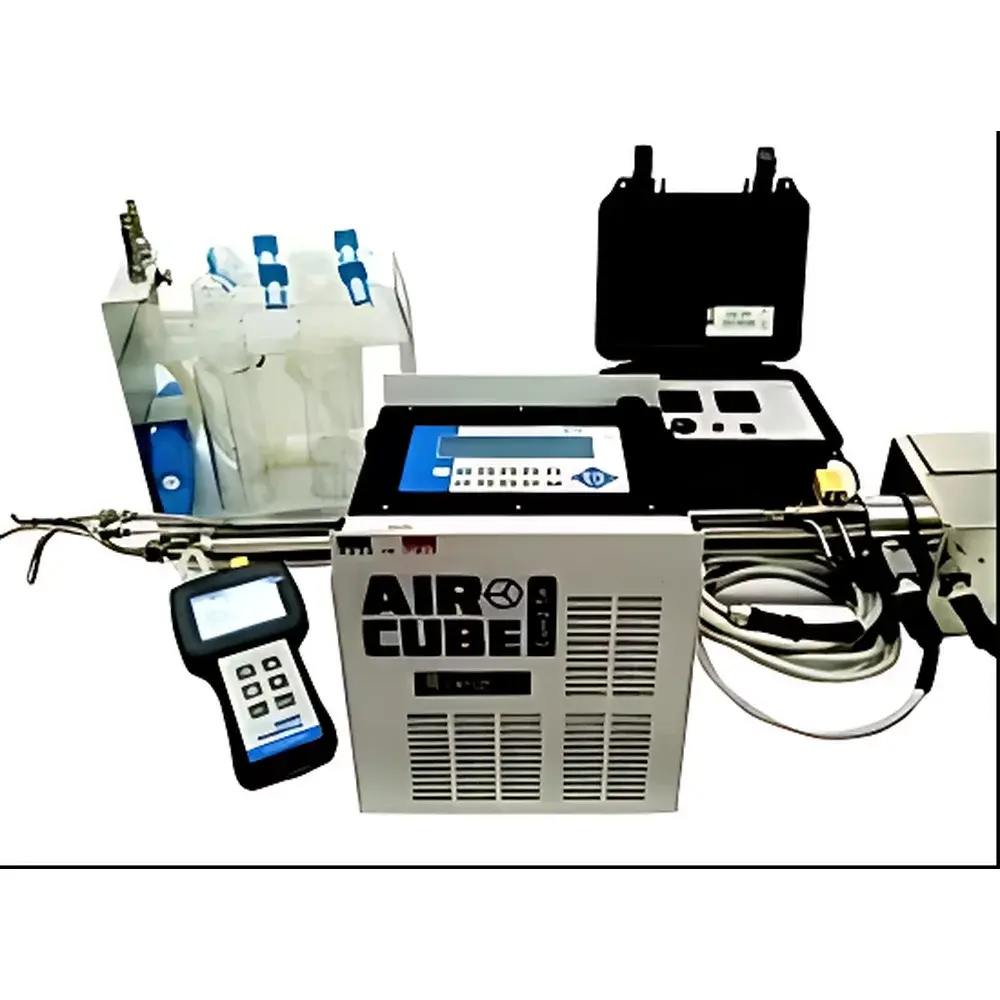
AMS AMS Flue Gas Heavy Metal Sampling System
| Brand | AMS |
|---|---|
| Origin | Italy |
| Manufacturer Type | Authorized Distributor |
| Product Origin | Imported |
| Model | AMS Flue Gas Heavy Metal Sampler |
| Instrument Type | Particulate and Heavy Metal Sampling System |
| Target Analytes | Heavy Metals (e.g., Pb, Cd, Hg, As, Ni, Cr) |
| Flow Accuracy | ±2% |
| Compliance Standard | UNI-EN 14385 |
Overview
The AMS Flue Gas Heavy Metal Sampling System is a CE-marked, field-deployable sampling platform engineered for the quantitative collection of volatile and semi-volatile heavy metal species—including elemental mercury (Hg⁰), oxidized mercury (Hg²⁺), lead (Pb), cadmium (Cd), arsenic (As), nickel (Ni), and chromium (Cr)—from industrial flue gas streams. Designed in strict accordance with UNI-EN 14385:2004 (“Stationary source emissions — Determination of mercury and other heavy metals in waste gases”), this system employs a heated probe-and-bubble absorption architecture to prevent condensation, adsorption loss, and speciation alteration during transit. The entire sample path—from the heated stainless-steel inlet nozzle to the final glass impinger train—is maintained above the acid dew point (typically ≥120 °C, exceeding dew point by ≥20 °C) to ensure gaseous-phase stability and minimize wall deposition. Unlike generic particulate samplers, this system eliminates metallic contact with sampled gas by routing flue gas exclusively through inert quartz, borosilicate glass, and PTFE components—thereby eliminating catalytic interference and memory effects critical for trace-level heavy metal analysis.
Key Features
- Heated sampling probe with real-time temperature monitoring and PID-controlled heating (operating range: 100–180 °C), certified to maintain ≥120 °C at the probe tip under full flow conditions
- Multi-stage glass impinger train (typically 3–4 units) configured for sequential speciation capture: first stage for Hg²⁺/oxidized metals in acidic KBr–KBrO₃ solution; second for Hg⁰ via gold-coated traps or SnCl₂ reduction; third for particulate-bound metals using quartz fiber filters followed by acid leaching
- Integrated critical flow venturi or mass flow controller (MFC) with ±2% flow accuracy across 0.2–1.5 L/min range, calibrated per ISO 5167 and traceable to NIST standards
- Modular design supporting both automatic (programmed time-integrated sampling) and semi-automatic operation (manual valve sequencing with timed intervals)
- Derivative sampling (DERIVATE SAMPLING) capability—enabling parallel extraction of multiple analyte fractions from a single gas stream without cross-contamination
- Compact, ruggedized field housing with IP54 ingress protection, integrated data logger for temperature, flow, pressure, and duration metadata
Sample Compatibility & Compliance
This system is validated for use with flue gases containing up to 20% O₂, ≤15% CO₂, ≤10% H₂O (v/v), and dust loadings up to 500 mg/m³. It accommodates stack diameters from 0.3 m to 4.0 m and operating temperatures up to 300 °C (with optional high-temp probe extension). All wet chemistry components comply with ASTM D6784-22 (Ontario Hydro Method adaptation) and EN 14385 requirements for recovery efficiency (>90% for Hg²⁺, >85% for Hg⁰, >80% for particulate Cd/Pb). The inert sample path meets EPA Method 29 and EU BREF reference method prerequisites for GLP-compliant reporting. Full audit trails—including calibration certificates, probe temperature logs, and flow verification records—are generated for FDA 21 CFR Part 11–aligned data integrity frameworks.
Software & Data Management
The system interfaces via RS-485 or optional Wi-Fi module with AMS’s proprietary SAMPLINK™ desktop software (Windows 10/11 compatible). SAMPLINK™ supports method setup per EN 14385 Annex A, auto-generates sampling reports with embedded uncertainty budgets (k=2), and exports CSV/Excel files compliant with LIMS integration protocols. All instrument parameters—including probe temperature setpoint, actual reading, flow rate, cumulative volume, and sampling duration—are timestamped with microsecond resolution and stored locally with battery-backed memory. Software validation documentation (IQ/OQ/PQ templates) and electronic signature support are provided for GMP/GLP-regulated environments.
Applications
- Regulatory compliance monitoring at coal-fired power plants, waste-to-energy facilities, and cement kilns under EU IED Directive (2010/75/EU) and U.S. EPA MATS Rule
- Source testing for mercury and toxic metal emissions during Best Available Techniques (BAT) assessments
- Method validation studies supporting ISO/IEC 17025-accredited laboratories
- Process optimization campaigns where speciation shifts (e.g., Hg⁰ vs. Hg²⁺) inform sorbent injection dosing strategies
- Research applications in atmospheric chemistry involving halogen-catalyzed mercury oxidation kinetics
FAQ
Does the system support simultaneous measurement of mercury speciation and total heavy metals?
Yes—the modular impinger configuration allows concurrent capture of Hg⁰, Hg²⁺, and particulate-bound metals in a single run, with post-extraction analysis by CV-AAS, ICP-MS, or IC-ICP-MS.
Is probe temperature uniformity verified during factory calibration?
Each probe undergoes thermal mapping at three axial positions (tip, mid-shaft, base) under simulated stack flow; certificate of conformance includes thermocouple calibration traceability to PTB.
Can the system be integrated into existing CEMS infrastructure?
Yes—digital outputs (4–20 mA, Modbus RTU) enable direct interfacing with central emission monitoring systems for synchronized data archiving and alarm triggering.
What maintenance intervals are recommended for field deployment?
Quartz liner cleaning after every 3 sampling events; glass impingers and filters replaced per run; annual recalibration of flow and temperature sensors per ISO/IEC 17025 requirements.
Is training and method-specific SOP documentation included?
Yes—AMS provides on-site operator training, EN 14385-aligned SOPs, and a comprehensive technical manual covering troubleshooting, leak testing, and QA/QC procedures (e.g., field blanks, spike recoveries, duplicate sampling).







