
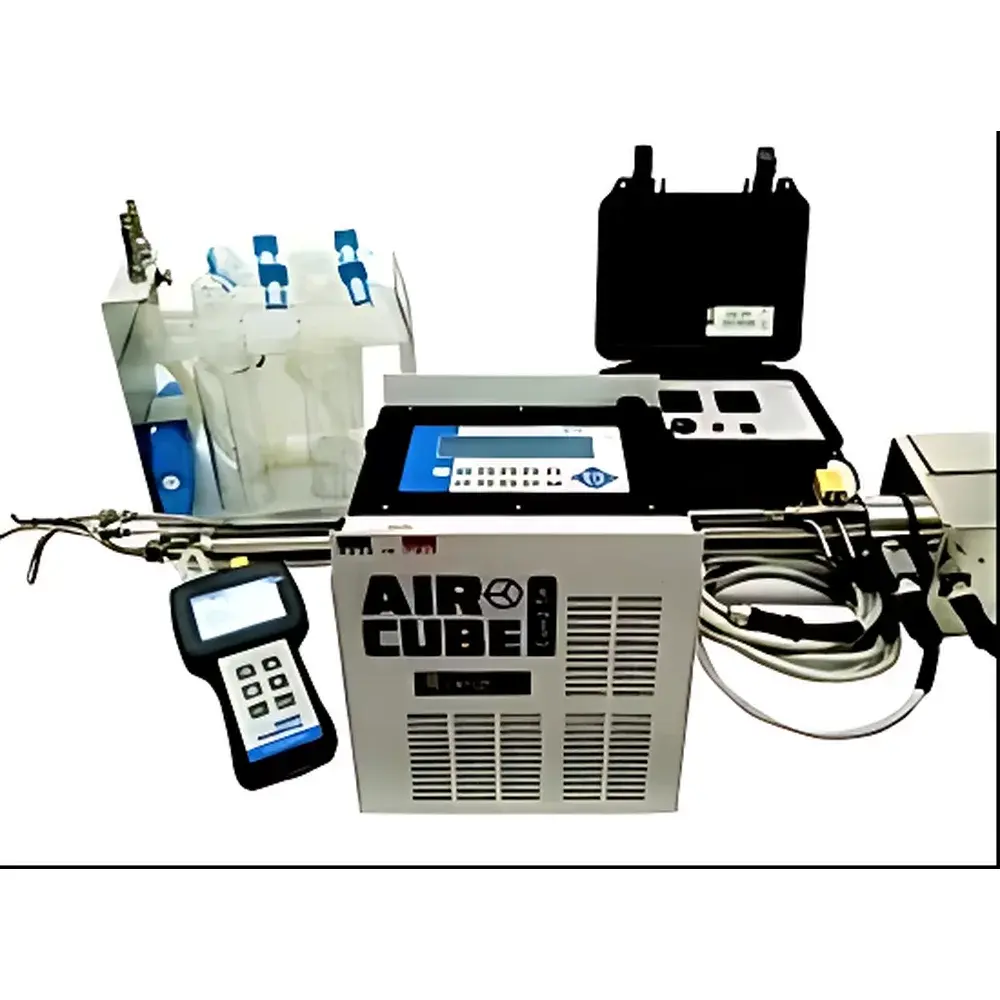
AMS HCl Flue Gas Sampling System
| Brand | AMS |
|---|---|
| Origin | Italy |
| Manufacturer Type | Authorized Distributor |
| Origin Category | Imported |
| Model | AMS HCl Flue Gas Sampling System |
| Instrument Type | Flue Gas Sampling System |
| Flow Accuracy | ±2% |
| Compliance | EN 1911, ISO 9096:1992 |
| Operating Probe Temperature | ≥120 °C (≥20 °C above HCl acid dew point) |
| Filter Efficiency | >99.5% (glass fiber or quartz fiber) |
| Sample Transit Time | <5 s (nozzle to impinger) |
| Main Stream Flow Rate | 30–150 L/min (isokinetic mode) |
| Impinger Flow Rate | 2–3 L/min |
| Typical Sampling Volume | 50–200 L (for [HCl] = 1–10 mg/m³ |
Overview
The AMS HCl Flue Gas Sampling System is a precision-engineered, EN 1911-compliant solution for the quantitative determination of hydrogen chloride (HCl) in industrial flue gases. Designed in strict accordance with ISO 9096:1992 for isokinetic sampling of gaseous pollutants, this system employs thermally controlled, inert-path components to prevent condensation, adsorption, or chemical transformation of HCl prior to collection. The core measurement principle relies on isokinetic probe aspiration followed by diffusion-based absorption into aqueous alkaline solution (e.g., NaOH or Na₂CO₃) within temperature-stabilized impingers. Critical design parameters—including probe heating uniformity, minimal dead volume between nozzle and absorber, and rigorous thermal management of filtration and transfer lines—are optimized to ensure analytical integrity, particularly for low-concentration HCl (1–10 mg/m³) where recovery losses due to wall deposition or hydrolysis must be minimized.
Key Features
- Heated stainless-steel sampling probe and nozzle assembly, manufactured to ISO 9096:1992 dimensional and thermal specifications, maintaining ≥120 °C at all contact surfaces—exceeding the typical HCl acid dew point by ≥20 °C.
- High-efficiency heated filter holder accommodating glass fiber or quartz fiber filters (>99.5% retention for sub-micron particulates), actively maintained at probe temperature to prevent chloride-containing aerosols from interfering with gaseous HCl quantification.
- Low-dead-volume, thermally insulated transfer line (<5 s residence time from nozzle exit to first impinger inlet) to minimize reactive loss and ensure representative sample delivery.
- Dual-stage impinger configuration: primary impinger for HCl absorption (2–3 L/min flow), optionally coupled with a backup impinger for recovery validation and blank correction.
- Integrated flow control and monitoring system with ±2% volumetric accuracy across the operational range (30–150 L/min main stream), supporting both manual isokinetic adjustment and semi-automated flow synchronization via pitot tube feedback.
- Modular thermal management architecture minimizing unheated sections; all critical components—including filter housing, transfer line, and impinger cooling jacket—are actively temperature-regulated to prevent localized condensation.
Sample Compatibility & Compliance
The system is validated for use in coal-fired power plants, waste incinerators, cement kilns, and metallurgical furnaces—environments characterized by high particulate loading, variable moisture content, and co-emission of SO₂, NOₓ, HF, and heavy metals. It meets the mandatory requirements of EN 1911:2021 for HCl determination in waste gas streams and supports full traceability under ISO/IEC 17025-accredited laboratory workflows. All wet chemistry collection steps are compatible with standard EPA Method 26A and ISO 15714 procedures for ion chromatographic (IC) or titrimetric analysis. The system’s construction materials (borosilicate glass impingers, PTFE-lined stainless steel, high-purity quartz filters) ensure chemical inertness and eliminate leachable chloride contamination. Documentation includes CE marking, Declaration of Conformity, and calibration certificates traceable to NIST or EU NMIs.
Software & Data Management
While the base configuration operates in semi-automated mode with analog flow meters and manual temperature logging, optional digital integration enables real-time data acquisition via RS-485 or Modbus TCP. Compatible with AMS LogView™ software (v3.2+), the system supports synchronized timestamped records of probe temperature, main stream flow rate, impinger pressure drop, and cumulative sampling volume. Audit trails comply with FDA 21 CFR Part 11 requirements when deployed in regulated environments (e.g., WtE facilities under EU Industrial Emissions Directive permitting). Raw data exports are structured in CSV and XML formats, enabling direct import into LIMS platforms and automated report generation aligned with EN 14181 QA/QC protocols.
Applications
- Regulatory compliance monitoring of HCl emissions under EU IED Annex V, U.S. EPA NSPS Subpart Eb, and China GB 18485–2014.
- Source testing during performance qualification of wet/dry scrubbers and activated carbon injection systems.
- Method validation studies comparing HCl recovery across different filter media and impinger configurations.
- Stack testing campaigns requiring simultaneous multi-pollutant sampling (e.g., coordinated HCl + heavy metals per EN 13284-2).
- Research into HCl speciation behavior under varying flue gas temperatures, humidity levels, and chloride feedstock conditions.
FAQ
What standards does this system explicitly comply with?
EN 1911:2021, ISO 9096:1992, and ASTM D6784-22 (for complementary particulate-bound chloride assessment).
Can the system be used for continuous emission monitoring (CEMS) verification?
Yes—it is routinely deployed as a reference method for CEMS performance evaluation per EN 14181 QAL2 and ASTMD6784 PS-1 protocols.
Is quartz fiber filtration mandatory for all applications?
Quartz is required when sampling at >300 °C or when organic interference (e.g., dioxins) is present; glass fiber suffices for standard municipal waste incineration stacks.
How is isokinetic flow verified during field operation?
Via integrated pitot tube and differential pressure transducer, with real-time calculation of stack velocity and automatic adjustment of pump speed to match nozzle velocity.
Does the system include calibration gas traceability documentation?
Yes—each unit ships with a factory calibration certificate for flow sensors and temperature probes, traceable to national metrology institutes (INRIM, PTB, or NPL).







