
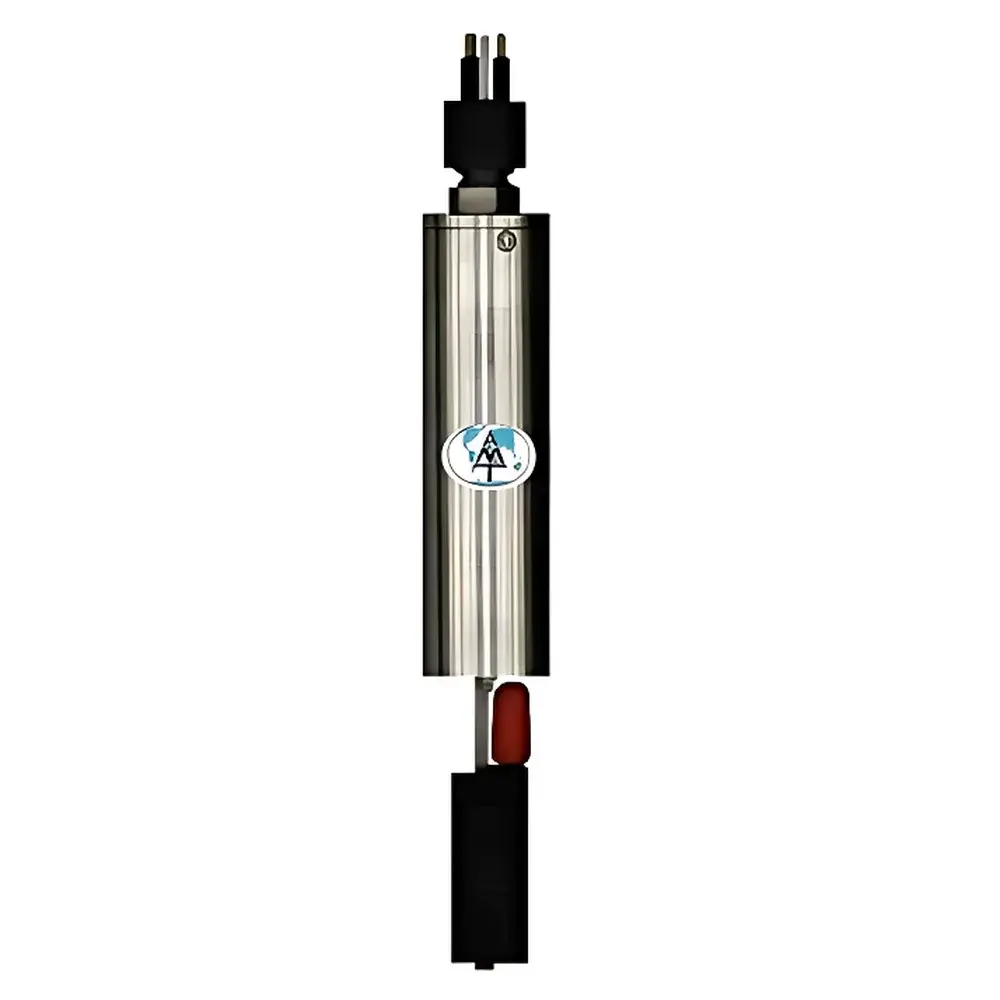
AMT AMT-EC7 Deep-Sea Seven-Electrode Conductivity Sensor
| Brand | AMT |
|---|---|
| Origin | Germany |
| Manufacturer Type | Authorized Distributor |
| Origin Category | Imported |
| Model | AMT-EC7 |
| Instrument Type | Online |
| Conductivity Ranges | 0–1 mS/cm |
| Outer Diameter | 40 mm |
| Total Length | ~270 mm |
| Weight | ~300 g |
| Housing Material | Titanium |
| Pressure Rating | 6000 m (6000 dbar) |
| Output Signal | 0–2.5 V DC or 0–5 V DC |
| Supply Voltage | 9–18 V DC |
| Connector | SubConn wet-mateable underwater connector |
| Measurement Principle | Seven-electrode AC conductivity with quartz-glass sensing tube |
| Channels | 4 measurement electrodes + 1 excitation + 2 guard/ground electrodes |
Overview
The AMT AMT-EC7 Deep-Sea Seven-Electrode Conductivity Sensor is an engineered solution for high-fidelity, long-term in-situ electrical conductivity measurement in marine and deep-ocean environments. Unlike conventional two- or four-electrode sensors, the AMT-EC7 employs a robust seven-electrode configuration operating on alternating current (AC) excitation to eliminate polarization effects and minimize electrode fouling artifacts. Its core sensing element—a hermetically sealed quartz-glass tube—ensures complete immunity to electromagnetic interference (EMI), critical for deployment near subsea power cables, ROV thrusters, or scientific instrumentation arrays. Designed for continuous operation at depths up to 6000 meters (6000 dbar), the sensor’s titanium alloy housing provides exceptional corrosion resistance and mechanical integrity under extreme hydrostatic pressure. The integrated pressure-compensated design eliminates the need for external pressure housings or compensation algorithms during data interpretation.
Key Features
- Seven-electrode AC conductivity architecture enabling stable, drift-resistant measurements across three selectable ranges: 0–1 mS/cm, 0–6 mS/cm, and 0–60 mS/cm — optimized for freshwater, estuarine, and full-strength seawater applications.
- Quartz-glass measurement cell offering intrinsic EMI immunity and chemical inertness — eliminating signal distortion from stray fields and ensuring compatibility with electrochemical monitoring networks.
- Titanium (Grade 5, Ti-6Al-4V) pressure housing rated to 6000 m depth — validated per ISO 17713-2 for submersible instrumentation and compliant with DNV-RP-F103 structural safety guidelines.
- Integrated SubConn wet-mateable underwater connector enabling reliable deployment/recovery without dry-dock intervention — compatible with standard 7-pin SubConn M series interfaces.
- Low-power analog output (0–2.5 V DC or 0–5 V DC) with linear response and <±0.5% FS full-scale accuracy over temperature range –2 °C to +30 °C — calibrated traceably to NIST-traceable KCl standards.
- Self-contained electronics module with built-in temperature compensation (PT1000 reference) and digital diagnostics accessible via voltage-level interrogation.
Sample Compatibility & Compliance
The AMT-EC7 is suitable for direct immersion in natural seawater, brackish water, riverine systems, and hypersaline lagoons. Its non-polarizing electrode geometry and quartz isolation prevent biofouling-induced hysteresis and ensure reproducible readings even after extended deployments (>6 months). The sensor complies with ISO 7888 (electrical conductivity of water), ASTM D1125 (standard test method for electrical conductivity), and supports GLP-compliant data acquisition when paired with AMT-certified logging systems. All materials contacting water meet EU REACH Annex XIV restrictions and are free of RoHS-restricted substances. No internal batteries or consumables are required; operation is fully passive once powered.
Software & Data Management
The AMT-EC7 delivers analog output only and is designed for integration into third-party SCADA, CTD telemetry, or ocean observatory data acquisition systems (e.g., Sea-Bird Electronics SBE-37, RBRconcerto, or custom LabVIEW-based DAQ platforms). Calibration coefficients and serial-specific metadata (including factory calibration date, pressure rating, and quartz batch ID) are provided in AMT’s standardized .csv format for import into data processing pipelines. While the sensor itself does not support digital protocols (e.g., RS-485, SDI-12), its analog interface ensures seamless compatibility with legacy infrastructure and facilitates audit-ready traceability when logged with time-synchronized temperature and pressure channels.
Applications
- Oceanographic mooring arrays requiring long-duration salinity derivation via conductivity–temperature–depth (CTD) inversion.
- Subsea cable corridor monitoring where EMI resilience is mandatory for interference-free operation near HVDC transmission lines.
- Deep-sea vent field studies requiring stable baseline conductivity under variable thermal gradients and particulate loading.
- Regulatory compliance monitoring for offshore discharge permits under MARPOL Annex IV and OSPAR Commission guidelines.
- Calibration reference for satellite-derived sea surface salinity (SSS) validation campaigns coordinated by NASA PACE or ESA SMOS missions.
FAQ
What maintenance intervals are recommended for sustained accuracy?
Routine cleaning and two-point calibration (using certified KCl standards at 0.01 mol/kg and 0.5 mol/kg) are advised every 3–6 months for deployments in biologically active zones; annual recalibration is required for metrological traceability.
Can the AMT-EC7 be deployed without a CTD frame?
Yes — it is self-contained and may be mounted independently on benthic landers, glider payloads, or fixed-platform brackets, provided mechanical strain relief and proper cable routing are implemented.
Is pressure compensation applied internally or externally?
No internal pressure compensation is performed; conductivity is reported as raw conductance. Seawater salinity computation requires concurrent pressure and temperature inputs from co-located sensors per UNESCO TEOS-10 algorithms.
Does the sensor support real-time diagnostics?
Voltage-level diagnostics (e.g., excitation amplitude monitoring, open-circuit detection) are embedded and readable via analog output modulation — full diagnostic protocol documentation is supplied with each unit.







