
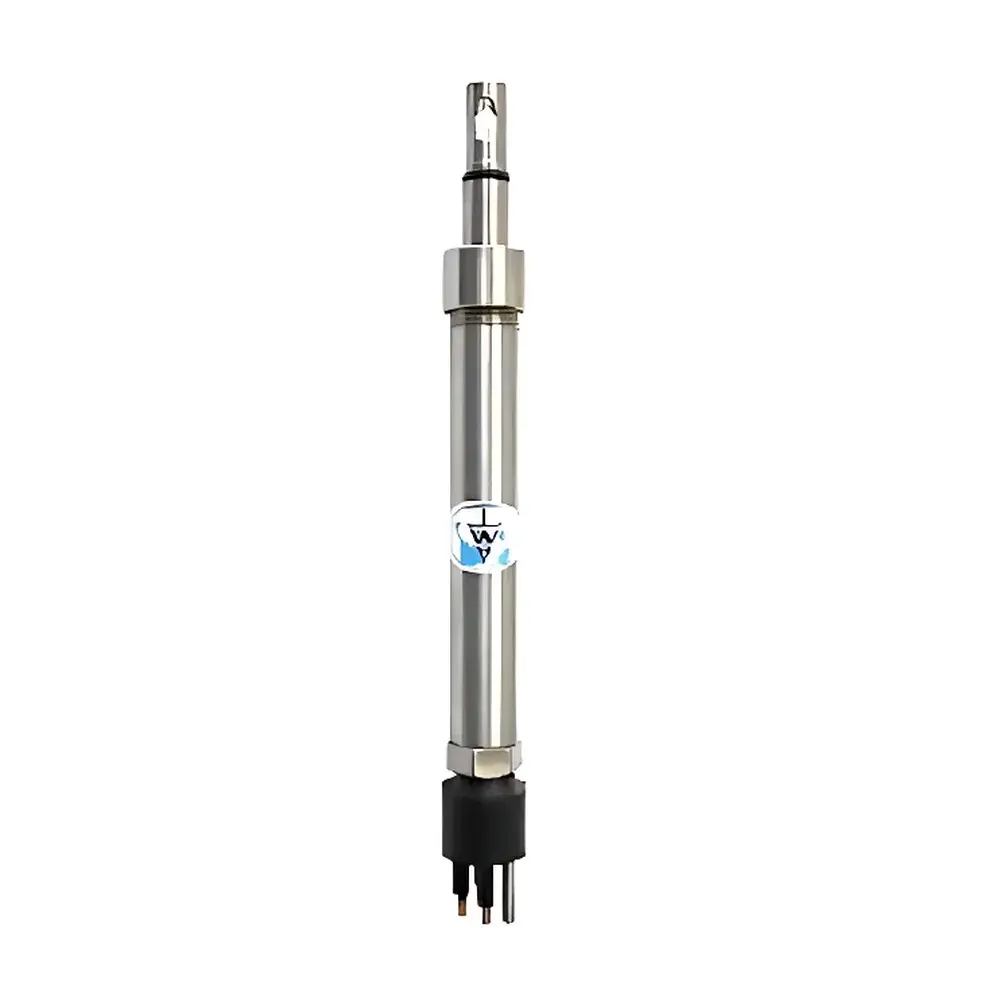
AMT AMT-H2S Submersible Hydrogen Sulfide (H₂S) Sensor
| Brand | AMT |
|---|---|
| Origin | Germany |
| Manufacturer Type | Authorized Distributor |
| Origin Category | Imported |
| Model | AMT-H2S |
| Price | Upon Request |
| Measurement Principle | Amperometric (Clark-type, 3-electrode) |
| Power Supply | 9–30 VDC |
| Output Signal | 0–5 VDC |
| Dimensions | Ø24 mm × 235 mm |
| Connector | SUBCONN BH-4-MP (optional alternatives available) |
| Warm-up Time | 5–15 min |
| Electrolyte Consumption | Low |
| Measurement Ranges | Type I: 0.05–10 mg/L H₂S |
| Type II | 0.5–50 mg/L H₂S |
| Type III | 0.01–3 mg/L H₂S |
| Accuracy | ±2% of reading |
| Operating Temperature | 0–30 °C |
| pH Range | 0–8.5 |
| Response Time (t₉₀) | <200 ms |
| Typical Service Life | 5–9 months |
| Pressure Rating | >10 bar |
Overview
The AMT AMT-H2S Submersible Hydrogen Sulfide (H₂S) Sensor is an electrochemical measurement system engineered for continuous, in-situ quantification of dissolved hydrogen sulfide in natural and engineered aquatic environments. Unlike optical or colorimetric methods—such as the classical methylene blue spectrophotometric assay (limited to 0.06–1 mg/L and unsuitable for field deployment)—or pH-dependent ion-selective electrodes (which respond to HS⁻/S²⁻ activity rather than true gaseous H₂S partial pressure), this sensor operates on a Clark-type amperometric principle. A gas-permeable silicone membrane isolates the internal sensing chamber from hydrostatic pressure and aqueous matrix interference while permitting selective diffusion of molecular H₂S. Within the sealed electrolyte-filled chamber, H₂S oxidation occurs at the working electrode, generating a current proportional to the partial pressure gradient across the membrane—a direct correlate of dissolved H₂S concentration in the surrounding water. This physical partitioning ensures robustness against fouling, ionic strength variation, and redox-active interferents commonly encountered in rivers, lakes, wastewater channels, and anaerobic digesters.
Key Features
- True dissolved H₂S measurement via membrane-controlled amperometry—decoupled from pH, ionic strength, and speciation effects
- Three-electrode configuration (working, counter, reference) for stable baseline and minimized polarization drift
- High-pressure-rated housing (>10 bar) enabling deployment in deep-water columns, submerged pipelines, and pressurized treatment systems
- Ultra-fast response time (t₉₀ < 200 ms) supporting high-temporal-resolution profiling and real-time process control
- Low-electrolyte-consumption design extends operational life to 5–9 months under typical ambient conditions (0–30 °C)
- Compact cylindrical form factor (Ø24 mm × 235 mm) with standardized SUBCONN BH-4-MP wet-mateable connector for seamless integration into multiparameter sondes or fixed monitoring stations
- Wide operational pH range (0–8.5), validated for use in acidic mine drainage, neutral freshwater, and mildly alkaline effluents without recalibration
Sample Compatibility & Compliance
The AMT-H2S sensor is validated for direct immersion in untreated natural waters—including turbid riverine systems, eutrophic lakes, sediment porewater, and municipal/industrial wastewater streams—without pretreatment or filtration. Its silicone membrane exhibits negligible permeability to water vapor, chloride, sulfite, thiosulfate, and common heavy metal ions, minimizing cross-sensitivity. The device complies with fundamental performance criteria outlined in ISO 5814:2012 (Water quality — Determination of dissolved oxygen — Electrochemical probe method), adapted for H₂S-specific amperometric transduction. While not certified to a dedicated H₂S standard, its measurement traceability aligns with EPA Method 376.1 (for sulfide) when used within defined operational constraints. For GLP/GMP-regulated applications, output signals are compatible with data loggers supporting audit-trail-enabled timestamping and calibration event logging.
Software & Data Management
The analog 0–5 VDC output is compatible with industry-standard SCADA platforms (e.g., Campbell Scientific CR-series, OTT Mesytec, YSI EXO telemetry systems) and programmable logic controllers (PLCs). When integrated into AMT’s optional multi-parameter acquisition modules, raw voltage signals undergo linearization using preloaded calibration polynomials specific to each sensor type (I, II, or III). Firmware supports configurable sampling intervals (1 s to 15 min), automatic temperature compensation (via integrated Pt1000 thermistor), and diagnostic flagging for membrane integrity loss or electrolyte depletion. All calibration parameters—including zero offset, span gain, and date-stamped verification points—are stored in non-volatile memory and exportable in CSV format for regulatory documentation per 21 CFR Part 11 requirements.
Applications
- Real-time monitoring of H₂S accumulation in anaerobic wastewater treatment units (e.g., UASB reactors, septic tanks, sludge digesters)
- In-situ assessment of sulfate-reducing bacterial activity in sediment-water interfaces and hypolimnetic zones
- Early-warning detection of H₂S release during dredging operations or reservoir destratification events
- Compliance tracking in industrial discharge outfalls subject to local H₂S emission limits (e.g., EU WFD Annex V, US Clean Water Act Section 402)
- Research-grade profiling in biogeochemical studies of sulfur cycling, particularly where speciation modeling requires direct H₂S(aq) input rather than total sulfide estimates
FAQ
How does this sensor differ from total sulfide ion-selective electrodes?
Unlike ISEs—which measure HS⁻ activity and require pH correction to estimate H₂S—it directly detects molecular H₂S partial pressure, eliminating pH dependency and speciation uncertainty.
Can the sensor be deployed in seawater?
Yes, but long-term exposure (>72 h) may accelerate membrane saturation due to elevated chloride; periodic cleaning and verification against saturated H₂S standards are recommended.
Is factory calibration traceable to NIST or equivalent standards?
Calibration is performed using gravimetrically prepared H₂S-saturated aqueous standards traceable to national metrology institutes; full calibration certificates include uncertainty budgets per ISO/IEC 17025.
What maintenance is required between deployments?
Rinse with deionized water after retrieval; inspect membrane for scratches or biofilm; replace electrolyte annually or per manufacturer’s service bulletin—no user-serviceable internal components.
Does the sensor require temperature compensation?
Yes—integrated Pt1000 provides real-time thermal correction; firmware applies Arrhenius-based diffusion coefficient adjustment to maintain accuracy across 0–30 °C.
Related Products







