
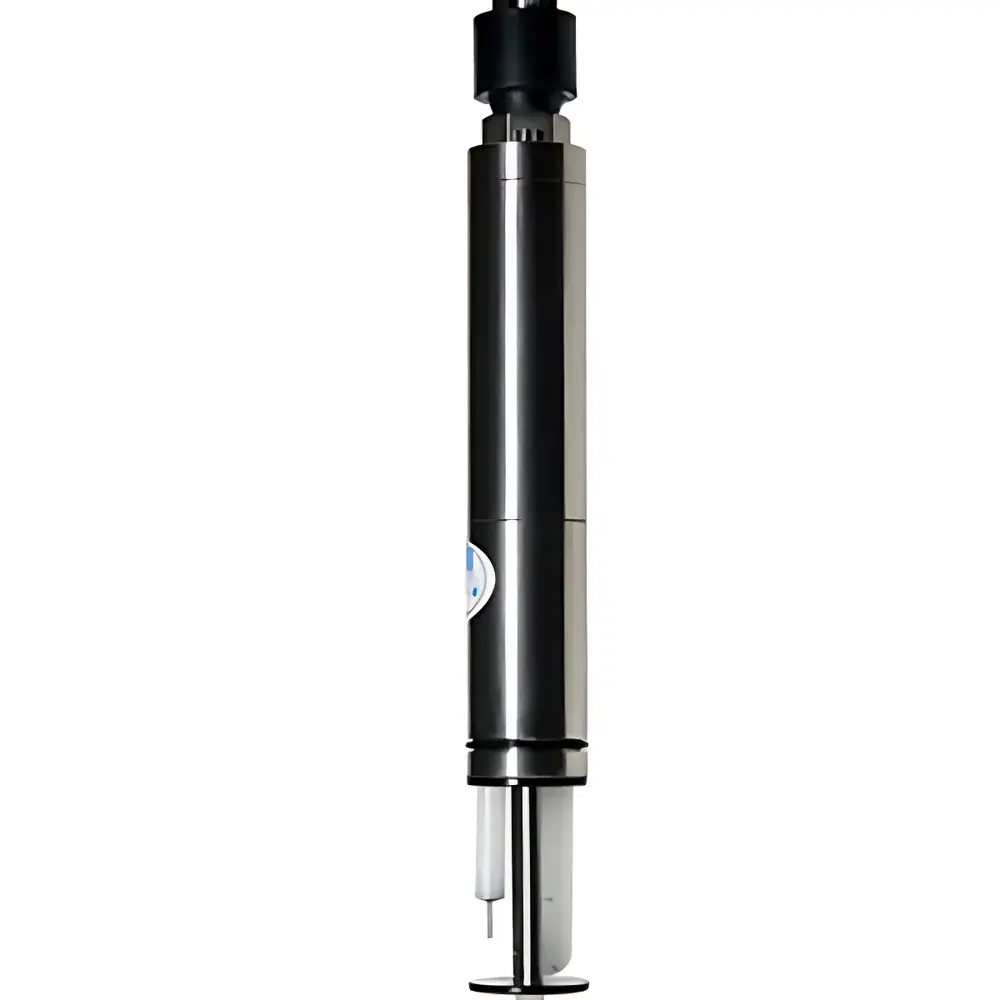
AMT AMT-ORP Deep-Sea Oxidation-Reduction Potential (ORP) Sensor
| Brand | AMT |
|---|---|
| Origin | Germany |
| Manufacturer Type | Authorized Distributor |
| Origin Category | Imported |
| Model | AMT-ORP |
| Price | Upon Request |
| Measurement Range | ±2000 mV |
| Resolution | 0.1 mV |
| Accuracy | ±2 mV |
| Power Supply | 9.5–18 VDC |
| Output Signal | 0–5 VDC |
| Dimensions | Ø30 mm × 250 mm |
| Pressure Rating | 600 dbar |
Overview
The AMT AMT-ORP Deep-Sea Oxidation-Reduction Potential (ORP) Sensor is an engineered solution for in-situ electrochemical potential measurement in extreme marine environments. It operates on the fundamental principle of potentiometric difference measurement between a noble metal indicator electrode (typically platinum or gold) and a stable, pressure-compensated reference electrode system. Unlike conventional ORP sensors relying on porous ceramic junctions—whose junction potential drifts significantly under hydrostatic compression—the AMT-ORP employs a proprietary dual-membrane architecture to isolate the internal reference electrolyte from ambient seawater while maintaining thermodynamic equilibrium across variable pressure gradients. This design enables reliable, drift-free measurements at depths up to 6000 meters (600 dbar), exceeding the operational ceiling of legacy deep-ocean ORP probes (typically limited to ≤1500 m). The sensor delivers analog voltage output (0–5 VDC) linearly proportional to measured potential (±2000 mV), with resolution of 0.1 mV and certified accuracy of ±2 mV under ISO/IEC 17025-aligned calibration conditions.
Key Features
- Integrated electrode assembly: Pt or Au working electrode and Ag/AgCl reference electrode co-located within a single cylindrical polymer housing (Ø30 mm × 250 mm), minimizing deployment footprint and eliminating multi-channel cabling requirements.
- Dual-membrane reference system: First membrane (microporous polymeric) allows controlled ionic contact between sample and outer reference gel; second membrane encloses a KCl-saturated colloidal gel matrix containing embedded Ag/AgCl element—preventing electrolyte dilution, pressure-induced junction potential shifts, and long-term chloride depletion.
- Full-ocean-depth rating: Certified for continuous operation at 600 dbar (6000 m), validated per IEC 60529 IP68 and ISO 85042 pressure cycling protocols.
- Low-power analog interface: Operates over wide input range (9.5–18 VDC), compatible with standard oceanographic data loggers and AUV/ROV telemetry systems without signal conditioning.
- No integrated temperature sensor: Designed for use with external calibrated CTD or thermistor modules to support temperature compensation during post-processing per ASTM D1293 and ISO 10523 conventions.
Sample Compatibility & Compliance
The AMT-ORP is optimized for conductive aqueous media including seawater, brines, hydrothermal vent fluids, and sediment porewater—with conductivity ≥5 mS/cm ensuring stable junction potential. It is incompatible with non-aqueous solvents, low-conductivity freshwater (<100 µS/cm), or highly sulfidic/anoxic matrices without prior validation. The sensor complies with EU RoHS Directive 2011/65/EU and bears CE marking for marine instrumentation. While not intrinsically safe for explosive atmospheres, its passive electrochemical design eliminates spark risk. Calibration traceability follows NIST-traceable Ag/AgCl reference standards (±0.5 mV uncertainty), supporting GLP-compliant environmental monitoring workflows under ISO 17025-accredited laboratories.
Software & Data Management
The sensor outputs a ratiometric 0–5 VDC signal directly scalable to mV using user-defined gain factors (e.g., 1 V = 400 mV). No proprietary firmware or drivers are required. Integration with common oceanographic software platforms—including Sea-Bird Scientific SBE Data Processing, MATLAB Oceanographic Toolbox, and Python-based PySeabird—is achieved via standard ADC interfaces. Raw voltage logs may be annotated with concurrent pressure, temperature, and salinity metadata for thermodynamic correction using the extended Nernst equation. Audit trails, calibration history, and sensor ID tagging are maintained externally in accordance with FDA 21 CFR Part 11 requirements when deployed in regulated environmental assessment programs.
Applications
- In-situ redox profiling across continental margins, hadal trenches, and subseafloor observatories.
- Long-term mooring deployments for biogeochemical cycle studies (e.g., Mn/Fe redox zonation, sulfate reduction fronts).
- ROV- and AUV-mounted mapping of hydrothermal plume oxidation states and microbial habitat boundaries.
- Calibration reference for optical redox proxies (e.g., luminescent lifetime sensors) in deep-sea benthic landers.
- Regulatory compliance monitoring of dredged material disposal sites under OSPAR and MARPOL Annex IV frameworks.
FAQ
Does the AMT-ORP include temperature compensation?
No. Temperature measurement is performed externally using a co-located CTD or thermistor; ORP values require post-acquisition correction using the Nernst slope (−59.16 mV/pH unit at 25 °C, adjusted for actual temperature).
What is the recommended recalibration interval for deep-sea deployments?
Annual calibration against certified Ag/AgCl reference electrodes is advised for regulatory applications; field verification using saturated quinhydrone buffer (pH 4.01, E⁰ = +252 mV vs. SHE at 25 °C) is recommended pre- and post-cruise.
Can the sensor be used in anoxic sediments?
Yes, but only after validating junction stability in sulfide-rich porewater; prolonged exposure to [H₂S] >100 µM may require more frequent cleaning and gel replacement per AMT Technical Bulletin TB-ORP-07.
Is the housing material compatible with titanium-based ROV frames?
Yes. The sensor body uses PEEK-reinforced polyetherimide (UL94 V-0 rated), with no galvanic coupling risk when mounted on Ti-6Al-4V structures.
Related Products







