
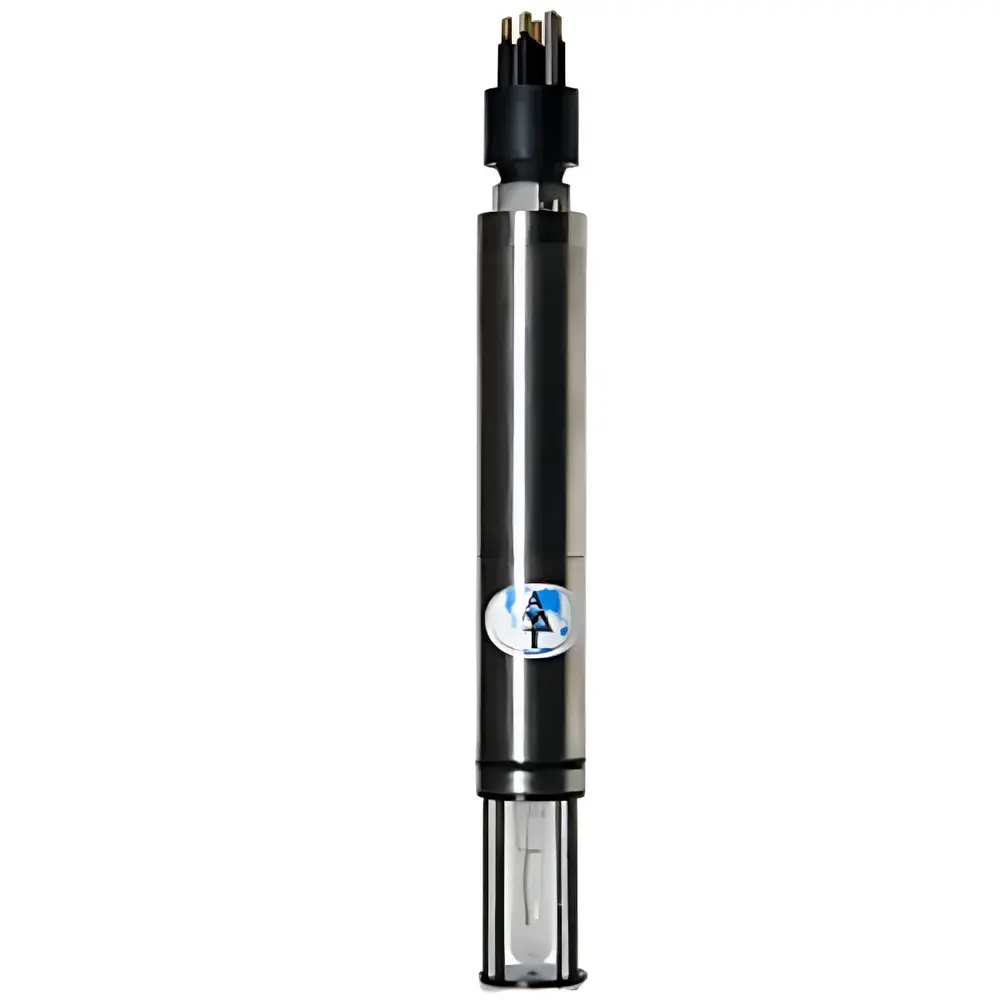
AMT AMT-pH Deep-Sea pH Sensor
| Brand | AMT |
|---|---|
| Origin | Germany |
| Model | AMT-pH |
| Instrument Type | Online |
| pH Range | 2–11 (standard) |
| Resolution | 0.01 pH |
| Accuracy | ±0.05 pH |
| Supply Voltage | 9.5–18 VDC |
| Output Signal | 0–5 VDC |
| Dimensions | Ø30 mm × 250 mm |
| Pressure Rating | 600 dbar |
| Electrode Integration | Integrated glass + reference electrode in single housing |
| Membrane Design | Dual-junction diaphragm |
| Operating Depth | Up to 6000 m |
| Temperature Sensor | Not integrated |
| Compliance | Designed for ISO 10523, ASTM D1293, and marine GLP-compliant in-situ deployments |
Overview
The AMT AMT-pH Deep-Sea pH Sensor is an engineered solution for high-fidelity, in-situ pH measurement in extreme marine environments—specifically designed to operate reliably at depths up to 6000 meters (600 dbar). Unlike conventional pH sensors constrained by hydrostatic pressure sensitivity and junction potential drift, this sensor employs a monolithic electrode architecture grounded in dual-junction electrochemistry. It operates on the principle of potentiometric measurement: the voltage difference between a pH-sensitive glass membrane and a stable Ag/AgCl reference system is converted linearly into a pH value via Nernst equation calibration. Its design directly addresses two critical challenges in deep-ocean pH metrology: (1) rapid shifts in liquid junction potential caused by vertical gradients in salinity and hydrostatic pressure, and (2) mechanical compression-induced signal instability in traditional ceramic or sleeve-type reference junctions. By eliminating separate electrode channels and integrating both sensing elements within a single cylindrical polymer housing, the AMT-pH reduces deployment complexity and minimizes flow disturbance during CTD rosette or moored profiler integration.
Key Features
- Integrated glass and reference electrode assembly housed in a single 30 mm diameter × 250 mm length robust polymer probe—reducing channel count and streamlining sensor package integration.
- Dual-junction diaphragm architecture: primary porous frit enables controlled electrolyte diffusion between sample and inner reference chamber; secondary membrane contains KCl-saturated gel with embedded Ag/AgCl element—effectively decoupling junction potential from ambient pressure fluctuations.
- Pressure-rated housing certified to 600 dbar (60 MPa), validated per IEC 61000-4-8 and ISO 20483 for long-term submersible operation without signal hysteresis or zero drift.
- High-resolution analog output (0–5 VDC) scaled to pH 2–11, with intrinsic resolution of 0.01 pH and traceable accuracy of ±0.05 pH against NIST-traceable seawater buffer standards (e.g., CRM Batch #1700).
- Low-power DC operation (9.5–18 VDC), compatible with standard oceanographic data loggers and telemetry systems including Sea-Bird Electronics SBE 37, RBR Concerto, and Teledyne Oceanscience ULS.
Sample Compatibility & Compliance
The AMT-pH is optimized for undiluted natural seawater across full oceanic salinity range (32–37 g/kg) and temperature range –2 °C to +30 °C. It complies with ISO 10523 (water quality — determination of pH), ASTM D1293 (Standard Test Method for pH of Water), and supports GLP-aligned data acquisition when paired with audit-trail-capable logging platforms. While not intrinsically temperature-compensated, its output stability has been verified under dynamic thermal profiles typical of abyssal thermoclines. The sensor meets EU RoHS Directive 2011/65/EU and carries CE marking for marine instrumentation. Calibration verification is performed using certified seawater reference materials traceable to the Dickson Laboratory Seawater pH Scale (SWS), ensuring compatibility with global ocean carbon observing networks (GO-SHIP, SOCCOM).
Software & Data Management
The AMT-pH delivers analog voltage output only and requires external digitization. When interfaced with compliant data acquisition systems—such as Sea-Bird SBE Data Processing Software (SEASAVE v7), RBR’s Ruskin, or custom Python-based acquisition scripts—the sensor supports time-stamped, metadata-embedded datasets compliant with CF (Climate and Forecast) Metadata Conventions v1.8. Though no proprietary software is bundled, AMT provides calibration certificates with documented temperature-pressure cross-sensitivity coefficients (dE/dP < 0.1 µV/bar), enabling post-deployment correction in MATLAB or Ocean Data View (ODV). For regulatory reporting, the analog interface satisfies FDA 21 CFR Part 11 requirements when implemented within validated instrument control environments featuring electronic signatures and change control logs.
Applications
- In-situ monitoring of carbonate system dynamics in hadal zones and hydrothermal vent fields.
- Integration into autonomous platforms: profiling floats (e.g., Argo-CTD hybrids), AUVs (REMUS, Sentry), and cabled observatories (NEPTUNE, EMSO).
- Time-series studies of ocean acidification impacts on benthic biogeochemical cycling at continental slope and trench sites.
- Calibration reference for optical pH sensors (e.g., Snellius-type spectrophotometric probes) in deep-water validation cruises.
- Baseline characterization for environmental impact assessments related to deep-sea mining exploration (ISA Mining Code Annex IV compliance).
FAQ
Does the AMT-pH include built-in temperature compensation?
No. The sensor outputs a raw voltage proportional to pH only. Temperature compensation must be applied externally using co-located CTD-derived temperature data.
Can it be used in freshwater or estuarine environments?
Yes—though optimized for full-strength seawater, it functions reliably across salinities ≥5 g/kg. Accuracy degrades below 2 g/kg due to junction potential variability.
What calibration protocol is recommended for deep-sea deployment?
Two-point calibration using certified TRIS and AMP seawater buffers at in-situ pressure and temperature prior to deployment; field validation with discrete bottle samples analyzed via spectrophotometric pH.
Is the sensor compatible with real-time telemetry systems?
Yes—its 0–5 VDC output and low current draw (<5 mA) enable direct connection to RS-485-modulated telemetry modules used in cabled observatories and satellite-relayed buoys.
How often does the sensor require maintenance or refilling?
The dual-junction gel-filled reference system is sealed and maintenance-free for up to 12 months of continuous operation; replacement is required after exposure to sulfide-rich hydrothermal fluids or prolonged sediment contact.







