
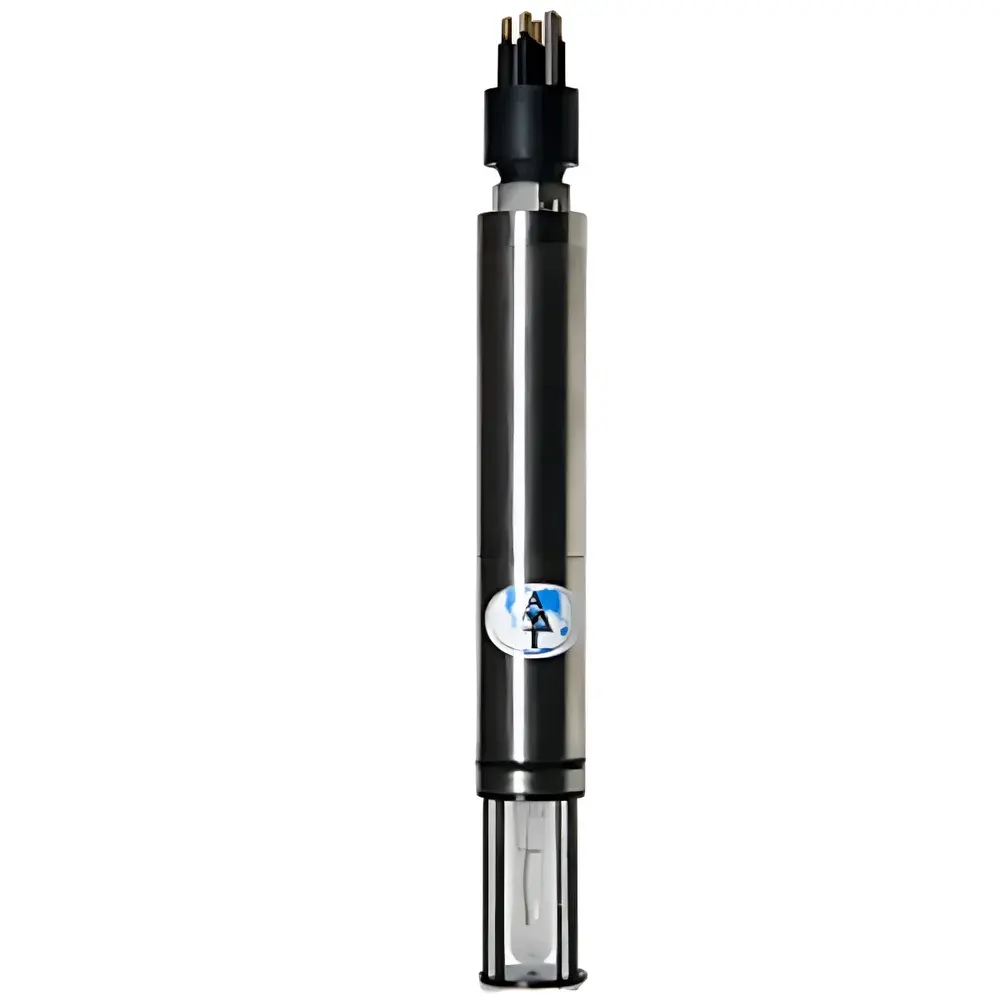
AMT Deep-Sea Dissolved Oxygen Sensor AMT-DO
| Brand | AMT (Germany) |
|---|---|
| Origin | Germany |
| Manufacturer Status | Authorized Distributor |
| Origin Category | Imported |
| Instrument Type | Online |
| Measurement Principle | Electrochemical (Polarographic Membrane-Type) |
| Accuracy | ±2% of reading |
| Power Supply | 9–30 VDC |
| Output Signal | 0–5 VDC |
| Dimensions | Ø25 mm × 240 mm |
| Air Weight | 260 g |
| Interface | SUBCONN BH-4-MP |
| Housing Material | Titanium & POM |
| Pressure Rating | 200 dbar (2000 m) or 600 dbar (6000 m) |
| Response Time (t₆₃%) | ~10 s |
| Dual-Membrane Configuration | Inner sensing membrane + outer protective membrane |
| Polarization Power Source | Integrated Li-ion battery (auto-disengaged when external power is applied) |
| Cable | Multi-core 4-wire marine-grade cable |
| Environmental Compatibility | Seawater, freshwater lakes & rivers |
Overview
The AMT Deep-Sea Dissolved Oxygen Sensor AMT-DO is an engineered polarographic membrane-type electrochemical sensor designed for long-term, high-stability dissolved oxygen (DO) measurement in extreme deep-water environments—up to 2000 m (200 dbar) or 6000 m (600 dbar) depth. Operating on the principle of controlled-potential amperometry, the sensor employs a dual-electrode configuration: a silver/silver halide reference anode housed within a sealed Ag-tube electrolyte reservoir, and a platinum micro-wire cathode embedded in a glass electrode body. Oxygen diffuses through a selective gas-permeable polytetrafluoroethylene (PTFE) membrane and is reduced at the cathode surface under a fixed polarization voltage (typically −0.8 V vs. Ag/AgCl), generating a diffusion-limited current linearly proportional to the partial pressure of dissolved O₂. This fundamental voltammetric response ensures traceable, NIST-aligned quantification without chemical reagents or optical interference—critical for unattended deployments in remote oceanic observatories, abyssal moorings, and subsea monitoring networks.
Key Features
- Deep-rated titanium housing with POM (polyoxymethylene) end caps and chloroprene rubber underwater connector seals—certified for continuous operation at 200 dbar or 600 dbar hydrostatic pressure
- Dual-layer membrane architecture: inner sensing membrane optimized for O₂ permeability and response kinetics; outer protective membrane mitigates biofouling, sediment abrasion, and mechanical damage during deployment
- Integrated polarization electronics with rechargeable Li-ion battery—maintains stable cathode polarization during power interruptions; automatically disables battery supply upon external DC power connection to extend service life
- Low-power analog output (0–5 VDC) compatible with standard data loggers, CTDs, and autonomous platforms; optional custom output ranges (e.g., 4–20 mA, RS-485 Modbus) available upon request
- Marine-grade 4-conductor cable with integrated power and signal lines—designed for low-noise transmission over distances exceeding 1 km without signal degradation
- Calibration traceable to Winkler titration standards; factory calibration includes zero-point (nitrogen-saturated water) and span-point (air-saturated seawater at defined temperature/salinity)
Sample Compatibility & Compliance
The AMT-DO sensor is validated for use across natural aquatic matrices including seawater (0–40 PSU), freshwater lakes, and slow-flowing rivers. Its titanium construction provides exceptional resistance to chloride-induced corrosion, while the inert PTFE membrane prevents interference from hydrogen sulfide, nitrate, or organic surfactants commonly found in benthic zones. The sensor complies with ISO 5814:2012 (Water quality — Determination of dissolved oxygen — Electrochemical probe method) and supports GLP-compliant data acquisition when paired with audit-trail-enabled logging systems. For regulatory reporting under EU Water Framework Directive (WFD) or US EPA Method 360.1, users may apply matrix-specific correction factors for salinity, temperature, and barometric pressure—parameters accommodated by AMT’s calibration software suite.
Software & Data Management
The AMT-DO operates as a standalone analog transducer but integrates seamlessly with third-party acquisition platforms (e.g., Sea-Bird Electronics SBE37, RBRconcerto, or Campbell Scientific CR1000X). AMT provides a Windows-based configuration utility for offset adjustment, temperature compensation coefficient input (based on thermistor readings), and membrane saturation diagnostics. All firmware updates and calibration logs are timestamped and exportable in CSV format. When deployed in networked observatories, the sensor supports time-synchronized sampling aligned to GPS-referenced UTC clocks—ensuring temporal coherence across multi-sensor arrays. No proprietary drivers or cloud dependencies are required; raw voltage outputs map directly to DO concentration (mg/L or % saturation) using the Clark equation with built-in temperature compensation per ASTM D888-22 Annex A1.
Applications
- Long-term oceanographic time-series monitoring at fixed-node observatories (e.g., Ocean Networks Canada, EMSO, or NOAA’s OOI)
- Benthic boundary layer studies assessing hypoxia dynamics near cold seeps, methane hydrate zones, and hydrothermal vent fields
- Environmental impact assessments for offshore energy infrastructure, including subsea pipelines and carbon capture storage (CCS) sites
- Calibration reference for optical DO sensors in mixed-method validation campaigns
- Integration into autonomous underwater vehicles (AUVs) and profiling floats where low mass (260 g), compact form factor (Ø25 × 240 mm), and minimal power draw (<15 mW standby) are critical design constraints
FAQ
What is the recommended recalibration interval for deep-sea deployments?
For missions exceeding 6 months, AMT recommends post-recovery verification against a Winkler-standardized reference and membrane replacement if t₆₃% exceeds 15 s or signal noise increases >3% RMS.
Can the sensor be used in anoxic or sulfidic sediments?
No—the polarographic cathode is susceptible to poisoning by H₂S and reduced sulfur species; use only in oxic or suboxic water columns above the chemocline.
Is pressure compensation handled internally or externally?
The sensor itself is pressure-tolerant but does not compensate for hydrostatic pressure effects on solubility; users must apply Henry’s law corrections externally using concurrent CTD-derived pressure, temperature, and salinity data.
Does the dual-membrane design affect response time?
The outer protective membrane adds <2 s to t₆₃%, resulting in a nominal ~10 s response in open water—within acceptable limits for profiling and moored applications per ISO 15682:2021.
Are spare membranes and electrolyte supplied with the unit?
Yes—each AMT-DO shipment includes one full membrane kit (inner + outer), 5 mL of proprietary AgCl-saturated KCl electrolyte, and torque-calibrated tools for field servicing.
Related Products







