
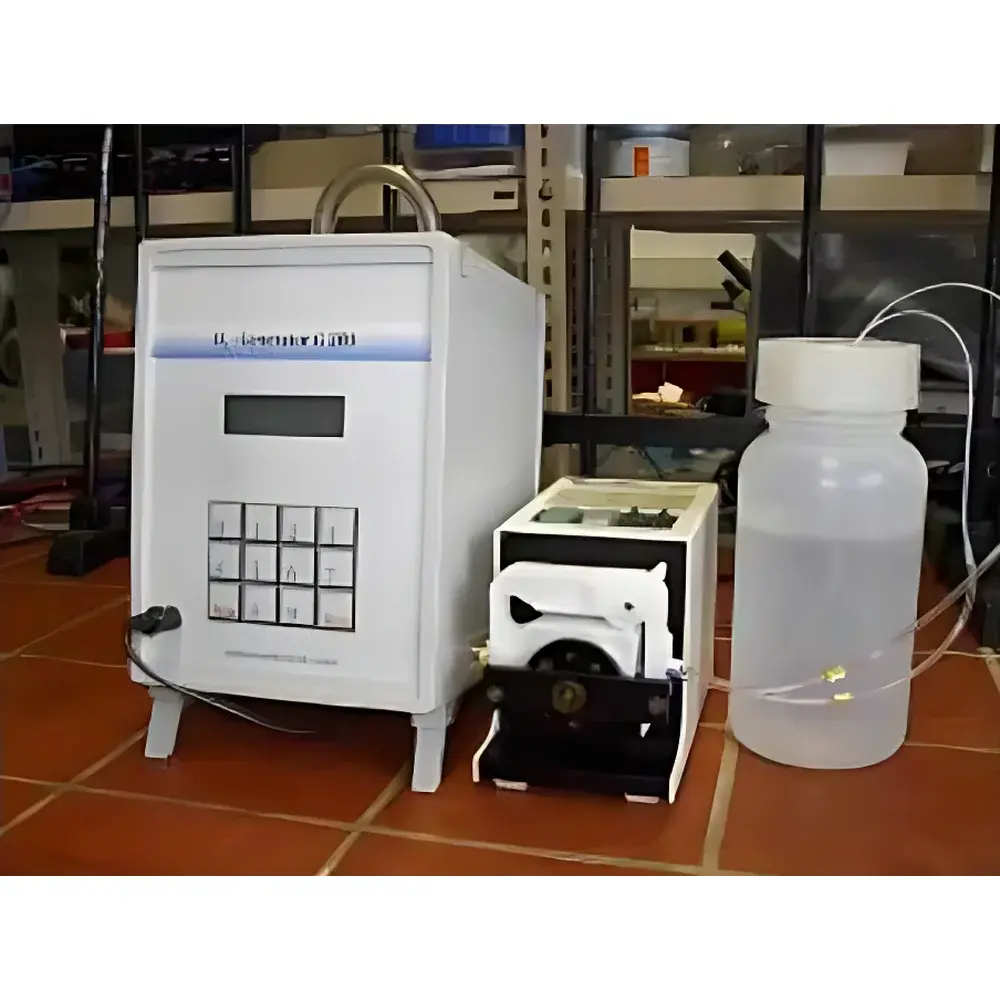
AMT Electrochemical Oxygen Generator
| Brand | AMT |
|---|---|
| Origin | Germany |
| Distributor Type | Authorized Distributor |
| Origin Category | Imported |
| Model | Not Specified |
| Price | Upon Request |
| Dimensions | 220 mm × 160 mm × 250 mm |
| Power Supply | 230 V AC |
| Flow Rate | 10–12 mL/min |
| Dissolved Oxygen Range | 0.4 µg/L – 9.95 mg/L |
| Accuracy | ±0.25% of reading |
| Response Time | ≤5 min |
| Deoxygenation Efficiency | Residual O₂ < 35 µg/L |
| Deaeration Protocol | 45-min purge followed by ~5-min equilibration |
| Calibration Reference Method | Winkler titration per DIN 38408-21 (modified) |
Overview
The AMT Electrochemical Oxygen Generator is a precision-engineered laboratory instrument designed to produce ultra-low-oxygen aqueous standards for the rigorous calibration and verification of dissolved oxygen (DO) sensors—particularly electrochemical (Clark-type) and optical (luminescence-based) probes used in environmental monitoring, wastewater treatment, and aquatic research. Unlike conventional two-point air-saturated/water-saturated calibration methods—which introduce uncertainty due to atmospheric variability, temperature-dependent saturation limits, and interfacial mass transfer artifacts—this generator enables traceable, reproducible zero-O₂ and low-O₂ reference solutions via controlled electrochemical deoxygenation. Its core operation relies on a solid polymer electrolyte (SPE) cell that catalytically reduces dissolved molecular oxygen at a platinum cathode under applied current, converting O₂ to water without introducing chemical reagents or altering solution ionic strength or pH. This principle ensures metrological integrity across diverse matrixes—including freshwater, seawater analogs, and nutrient-rich process streams—while maintaining compliance with foundational quality assurance frameworks such as ISO/IEC 17025 and EPA Method 4500-O.
Key Features
- Integrated electrochemical deoxygenation module with real-time current control and thermal stabilization for consistent O₂ removal kinetics
- Dual-stage fluidic architecture: first-stage degassing via vacuum-assisted membrane contactor, second-stage electrochemical reduction for sub-ppb residual O₂
- Stainless steel and PFA-wetted path components ensuring chemical resistance and minimal leaching in ultrapure applications
- Programmable flow regulation (10–12 mL/min) enabling stable delivery to calibration chambers or inline sensor test loops
- Onboard diagnostics including voltage monitoring, temperature logging, and electrode potential feedback for preventive maintenance alerts
- Compact benchtop footprint (220 × 160 × 250 mm) with CE-marked 230 V AC power interface compliant with EN 61000-6-3 EMC standards
Sample Compatibility & Compliance
The generator accommodates aqueous samples ranging from deionized water to synthetic seawater (up to 35 g/L NaCl) and buffered nutrient media commonly used in BOD incubation or algal toxicity testing. It is compatible with standard 12–14 mm OD glass or quartz calibration vials and integrates seamlessly with AMT’s DO probe validation kits. All operational protocols align with DIN 38408-21 (determination of dissolved oxygen—Winkler titration), and its output solutions are suitable for method validation under ISO 5814 (electrochemical determination of dissolved oxygen) and ASTM D888 (measuring dissolved oxygen in water). For regulated environments—including drinking water utilities operating under U.S. EPA Safe Drinking Water Act requirements or EU Water Framework Directive laboratories—the system supports GLP-compliant documentation when paired with validated data acquisition software.
Software & Data Management
While the base unit operates in standalone mode, optional USB- and RS-232–enabled firmware permits integration with third-party LIMS or SCADA platforms. Logged parameters—including elapsed time, cell voltage, sample temperature, and cumulative charge passed—are timestamped and exportable in CSV format. Audit-trail functionality meets FDA 21 CFR Part 11 requirements when deployed with compliant electronic signature modules and role-based user access controls. Firmware updates are delivered via secure HTTPS channels and verified using SHA-256 checksums to ensure firmware integrity.
Applications
- Primary calibration of DO sensors prior to field deployment in river, lake, and estuarine monitoring networks
- Verification of zero-point drift in continuous online DO analyzers installed in activated sludge basins or anaerobic digesters
- Preparation of certified reference materials (CRMs) for inter-laboratory comparison studies under ILAC MRA frameworks
- Method development for low-O₂ biological assays requiring strict hypoxic control (e.g., denitrification rate measurements)
- Supporting ISO 14001 environmental management system audits through documented traceability of measurement uncertainty budgets
FAQ
What is the lowest achievable residual oxygen concentration?
The generator consistently achieves residual dissolved oxygen concentrations below 35 µg/L (ppb) in deionized water at 20 °C, verified by independent Winkler titration.
Can it be used with saline or wastewater samples?
Yes—performance has been validated in matrices up to 35 g/L chloride and with COD levels ≤ 500 mg/L; electrode fouling mitigation protocols are included in the operator manual.
Is routine maintenance required?
The SPE cell requires annual replacement; all wetted seals and membranes are accessible via front-panel service ports without specialized tools.
Does it comply with regulatory calibration guidelines?
It supports compliance with ISO 5814, ASTM D888, DIN 38408-21, and EU Standard EN 25814 for DO measurement validation.
How is traceability ensured?
Each unit ships with a factory-issued calibration certificate referencing NIST-traceable Winkler standards and includes a unique serial-numbered logbook for lifetime metrological history tracking.
Related Products







