
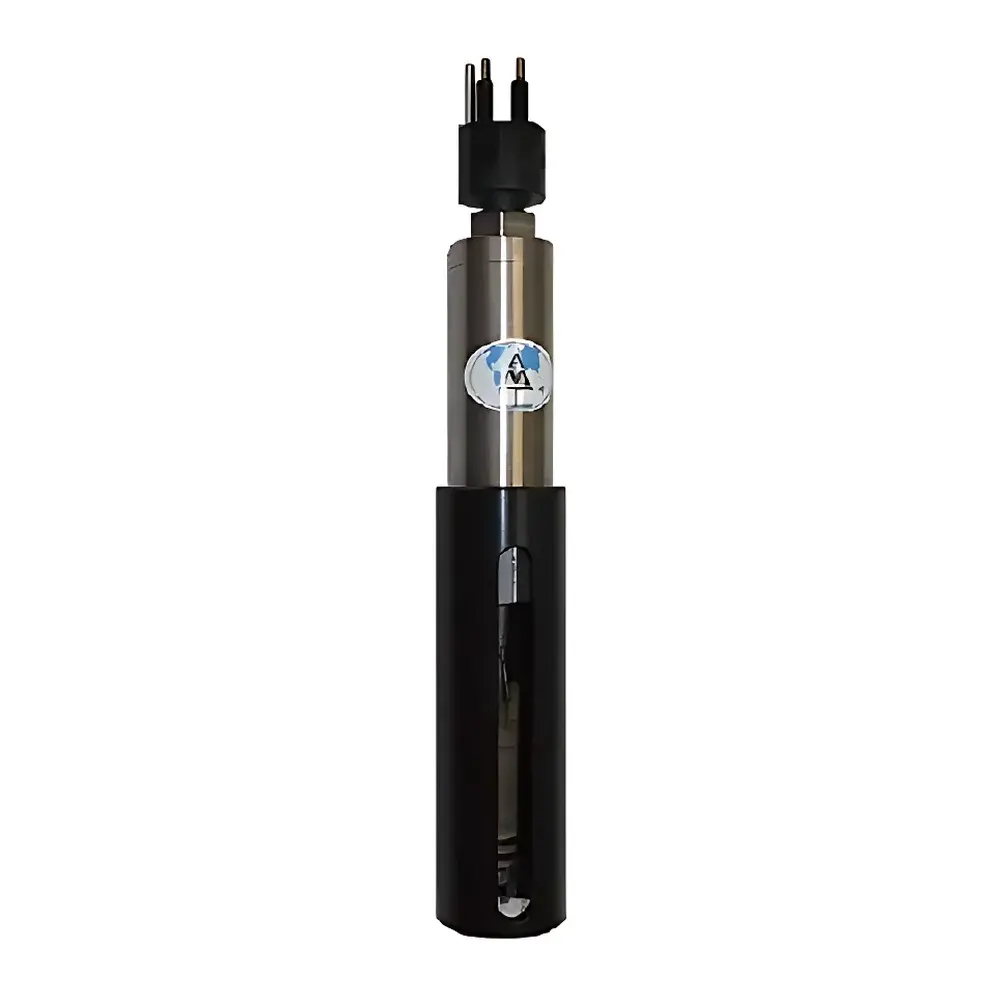
AMT pH Shallow-Water Sensor with Integrated Electronics
| Brand | AMT |
|---|---|
| Origin | Germany |
| Manufacturer Status | Authorized Distributor |
| Origin Category | Imported |
| Model | pH |
| Price | Upon Request |
Overview
The AMT pH Shallow-Water Sensor with Integrated Electronics is a rugged, field-deployable electrochemical sensor engineered for high-accuracy, long-term pH monitoring in freshwater, estuarine, and coastal marine environments. It operates on the potentiometric principle, utilizing a pressure-balanced glass pH electrode paired with a solid-state Ag/AgCl reference electrode—both housed coaxially within a single polymer probe body. The sensor’s measurement mechanism relies on the Nernst equation, where the potential difference between the sensing and reference electrodes is linearly proportional to pH across the full aqueous range (0–14). Unlike conventional pH sensors vulnerable to sulfide poisoning, this unit employs a KCl-based gel electrolyte free of soluble silver ions, enabling stable operation in sulfide-rich waters—including anoxic sediments, wastewater outfalls, and sulfur spring effluents. Its titanium housing (Grade 2) provides corrosion resistance, mechanical robustness, and compatibility with subsea deployment up to 1200 dbar (≈1200 m depth), though it is optimized for shallow-water applications (<200 m) where rapid response and thermal stability are critical.
Key Features
- Pressure-balanced glass pH electrode with integrated Ag/AgCl reference element in a co-axial polymer probe body
- Sulfide-resistant KCl-gel electrolyte—silver-ion-free formulation prevents electrode fouling in H₂S-rich environments
- High-porosity ceramic junction (multiple pore channels) ensures stable liquid junction potential and low drift
- Titanium (Ti Grade 2) housing, BH4M SUBCONN wet-mateable connector, and removable plastic protective cap for handling and storage
- Analog output: 0–5 VDC (linear with pH), compatible with standard CTD systems, data loggers, and SCADA interfaces
- Wide operating voltage range: 9–30 VDC; typical current draw: ~13 mA at 12 VDC
- Response time (t₉₀): ≤1 second in stirred aqueous solution at 25°C
- Temperature compensation: Built-in thermistor (NTC 10 kΩ @ 25°C) for automatic temperature correction in host software
Sample Compatibility & Compliance
The sensor is validated for use in natural waters (fresh, brackish, seawater), treated effluents, aquaculture systems, and low-conductivity surface runoff. It complies with ISO 7888 (water quality — determination of pH), ASTM D1293 (Standard Test Methods for pH of Water), and supports GLP-compliant workflows when paired with audit-trail-capable data acquisition systems. While not intrinsically certified for hazardous areas, its titanium construction and sealed electronics meet IP68 ingress protection standards per IEC 60529. Calibration traceability follows NIST-traceable buffer standards (pH 4.01 and 7.00 at 25°C); users perform two-point calibration in situ or in the lab using supplied wet-cap storage with pH 4.01/KCl gel buffer.
Software & Data Management
The sensor outputs a calibrated analog signal requiring digitization via external DAQ hardware (e.g., Sea-Bird Electronics SBE 37, RBRconcerto³, or Campbell Scientific CR1000X). No proprietary firmware or embedded software resides in the sensor itself—ensuring vendor-neutral integration. When used with compliant data loggers supporting IEEE 1451.2 TEDS templates, the unit can be auto-identified and scaled. Raw voltage values are convertible to pH using the factory-provided sensitivity coefficient (typically −0.178 V/pH ±0.002 V/pH at 25°C) and offset. For regulatory reporting, systems integrating this sensor may be configured to meet FDA 21 CFR Part 11 requirements for electronic records and signatures—provided the host platform implements audit trails, user authentication, and secure data archiving.
Applications
- Long-term pH trend monitoring in estuaries, reservoirs, and riverine systems
- In-situ validation of autonomous water quality buoys and AUV-mounted sensor packages
- Real-time pH control in aquaculture recirculating systems (RAS)
- Environmental impact assessments near industrial discharge points or acid mine drainage sites
- Calibration reference for spectrophotometric or ISFET-based pH arrays
- Field studies of carbonate system dynamics in coastal carbon cycling research
FAQ
How often does the sensor require calibration?
Calibration frequency depends on deployment conditions. In stable freshwater, quarterly two-point calibration suffices; in turbid or sulfide-rich environments, biweekly verification is recommended.
Can the sensor be deployed continuously for months without maintenance?
Yes—its gel-filled, silver-free electrolyte eliminates refilling and minimizes junction clogging, supporting uninterrupted operation for ≥6 months in clean water; biofouling mitigation (e.g., copper banding or periodic cleaning) extends longevity in eutrophic settings.
Is the BH4M SUBCONN interface compatible with standard oceanographic CTD frames?
Yes—the BH4M male connector mates directly with standard female SUBCONN receptacles found on SBE, RBR, and Valeport CTDs; custom cable assemblies with molded connectors are available upon request.
Does the sensor include temperature compensation?
Yes—a built-in NTC thermistor enables real-time temperature measurement; pH correction algorithms must be implemented in the host data logger or acquisition software.
What is the expected service life under routine field use?
With proper handling and periodic cleaning, the glass membrane and reference system typically maintain specification for 2–3 years; titanium housing and electronics exhibit indefinite service life barring mechanical damage.
Related Products







