
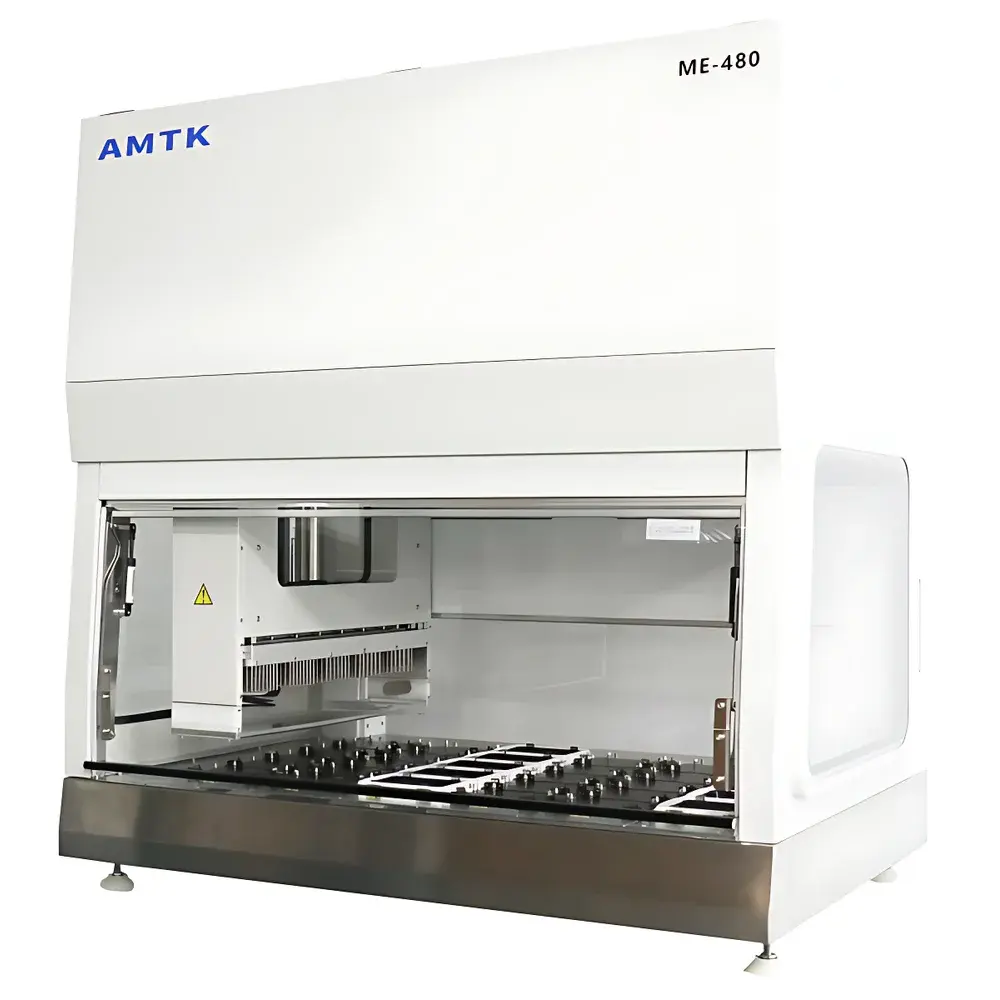
AMTK ME-480 High-Throughput Automated Magnetic Bead-Based Nucleic Acid Extraction System
| Brand | AMTK |
|---|---|
| Origin | Jiangsu, China |
| Manufacturer Type | Authorized Distributor |
| Product Category | Domestic |
| Model | ME-480 |
| Price Range | USD 140,000–280,000 |
| Instrument Type | Magnetic Bead-Based Extraction |
| Automation Level | Dedicated Fully Automatic |
| Batch Capacity | 480 samples per run |
| Sample Volume Range | 20–1000 µL |
| Processing Time per Batch | 15–30 minutes |
| Throughput Configuration | 96-channel magnetic rod array (5×96 = 480) |
| Temperature Control | 10 independent heating zones, 20–100 °C |
| Magnetic Field Strength | ≥5200 Gauss |
| Magnetic Bead Recovery Rate | ≥98% |
| Inter-Sample CV | <5% |
| Power Supply | AC 220 V, 50 Hz, 900 VA |
| Dimensions (W×D×H) | 1130 × 770 × 1160 mm |
| Weight | 175 kg |
| Aerosol Containment | Integrated HEPA H14 filter (≥99.99% efficiency for 0.3 µm particles), UV-C sterilization (100 µW/cm²), anti-drip baffles |
Overview
The AMTK ME-480 is a dedicated high-throughput automated nucleic acid extraction system engineered for laboratories requiring robust, reproducible, and scalable sample preparation under regulated or high-demand operational conditions. It operates on the principle of magnetic bead-based solid-phase extraction — a well-established methodology in molecular diagnostics and genomics workflows. During processing, paramagnetic beads functionalized with silica or carboxyl groups bind nucleic acids under chaotropic salt and pH-controlled conditions. The ME-480 employs a 96-channel magnetic rod array (arranged in a 5×96 configuration) to simultaneously manipulate beads across deep-well plates, enabling coordinated movement through lysis, binding, washing, and elution steps without liquid handling pumps or disposable tips. This architecture eliminates cross-contamination risks associated with pipetting, reduces reagent carryover, and ensures uniform field exposure across all 480 positions per batch. The system is designed for integration into clinical diagnostic pipelines, public health surveillance programs, agricultural genotyping initiatives, and veterinary outbreak response networks where throughput, traceability, and compliance with laboratory quality standards are critical.
Key Features
- True 480-sample batch capacity: Achieved via five synchronized 96-channel magnetic rod modules operating in parallel — not sequential stacking — delivering full batch completion in as little as 15 minutes.
- Automated magnetic tip handling: Integrated magnetic sleeve loading/unloading mechanism eliminates manual intervention during bead transfer cycles, reducing operator dependency and human error.
- Dual-stage aerosol containment: Combines laminar airflow with negative pressure differential, H14-class HEPA filtration (validated per ISO 14644-1 Class 3), and 254 nm UV-C irradiation (100 µW/cm² intensity) for continuous decontamination of internal chamber surfaces and air pathways.
- Precision thermal control: Ten independently controlled heating blocks support simultaneous temperature programming for lysis (up to 100 °C), wash (room temperature to 70 °C), and elution (45–85 °C), accommodating diverse kit chemistries and sample matrices.
- High-fidelity magnetic actuation: Permanent neodymium magnets deliver ≥5200 Gauss surface field strength at the rod tip interface, ensuring >98% bead recovery across viscous or particulate-rich samples including FFPE lysates, stool suspensions, and whole blood.
- Inter-sample consistency: Processed sample CV remains <5% across replicate extractions, validated using standardized reference materials (e.g., NIST SRM 2374) and qPCR quantification of housekeeping genes.
Sample Compatibility & Compliance
The ME-480 supports broad-spectrum sample input types without hardware modification: whole blood, serum/plasma, nasopharyngeal swabs, bronchoalveolar lavage fluid, urine sediment, sputum homogenates, fecal slurries, formalin-fixed paraffin-embedded (FFPE) tissue digests, plant leaf extracts, animal tissue homogenates, dried blood spots, and saliva supernatants. Its open reagent architecture accepts any CE-IVD or FDA-cleared magnetic bead-based extraction kits — including those from QIAGEN, Thermo Fisher, Takara Bio, and domestic manufacturers — provided they conform to standard 96-well deep-well plate formats (e.g., ABgene 96-Deep Well PCR Plates). From a regulatory perspective, the system’s audit trail functionality, user access controls, and electronic signature support align with requirements for GLP-compliant research environments and ISO 15189-accredited clinical laboratories. While not pre-certified for 21 CFR Part 11, its software architecture permits configuration to meet ALCOA+ data integrity principles when deployed with validated IT infrastructure.
Software & Data Management
The ME-480 runs on embedded Linux-based firmware with a touchscreen HMI interface supporting multi-language operation (English, Spanish, French, Simplified Chinese). Protocols are stored as encrypted XML files with versioning and checksum validation. Each run generates a comprehensive log file containing timestamped events (e.g., magnet engagement timing, temperature ramp profiles, UV cycle activation), operator ID, protocol name, plate barcode scan history, and real-time anomaly alerts (e.g., lid open detection, heater deviation >±2 °C). Raw logs export via USB or Ethernet to LIMS-compatible CSV or JSON formats. Optional middleware enables HL7 ADT message ingestion for patient-level traceability in hospital-based labs. All data storage adheres to GDPR-compliant retention policies; no cloud transmission occurs unless explicitly enabled via secure, audited API gateways.
Applications
- Clinical diagnostics: Mass screening for HBV, HPV, SARS-CoV-2, influenza A/B, RSV, and other respiratory pathogens in centralized testing facilities or mobile deployment units (e.g., containerized labs, field-deployable vans).
- Public health surveillance: Rapid response to emerging infectious disease outbreaks, including zoonotic spillover events requiring parallel processing of thousands of environmental and host-derived specimens.
- Agricultural biotechnology: High-volume SNP genotyping in crop breeding programs, where tens of thousands of seedling DNA extractions must be completed within narrow seasonal windows.
- Veterinary epidemiology: Surveillance of African swine fever virus (ASFV), avian influenza subtypes, and foot-and-mouth disease virus (FMDV) across regional livestock populations.
- Biobanking & cohort studies: Standardized nucleic acid isolation from longitudinal biospecimen collections, ensuring inter-batch comparability across years of accrual.
FAQ
Does the ME-480 require proprietary consumables?
No — it uses standard 96-well deep-well plates and magnetic sleeves compatible with third-party kits. No vendor lock-in is enforced.
Can the system process FFPE tissue samples directly?
Yes, when paired with commercially available FFPE-specific lysis buffers and proteinase K digestion protocols; the 100 °C heating module supports complete deparaffinization and protein denaturation.
What maintenance intervals are recommended?
Daily UV lamp inspection and HEPA filter visual check; biannual calibration of temperature sensors and magnetic field strength verification using NIST-traceable gaussmeter; annual full-system performance qualification per ISO/IEC 17025 Annex A.3 guidelines.
Is remote monitoring supported?
Yes — optional Ethernet-connected status dashboard provides real-time run progress, error logging, and predictive maintenance alerts via SNMP or MQTT protocols.
How is cross-contamination prevented between batches?
Through physical isolation (HEPA-filtered negative-pressure chamber), UV-C irradiation between runs, anti-drip baffle design, and mandatory magnetic sleeve replacement after each batch — enforced by the system’s robotic sleeve loader.
Related Products





