
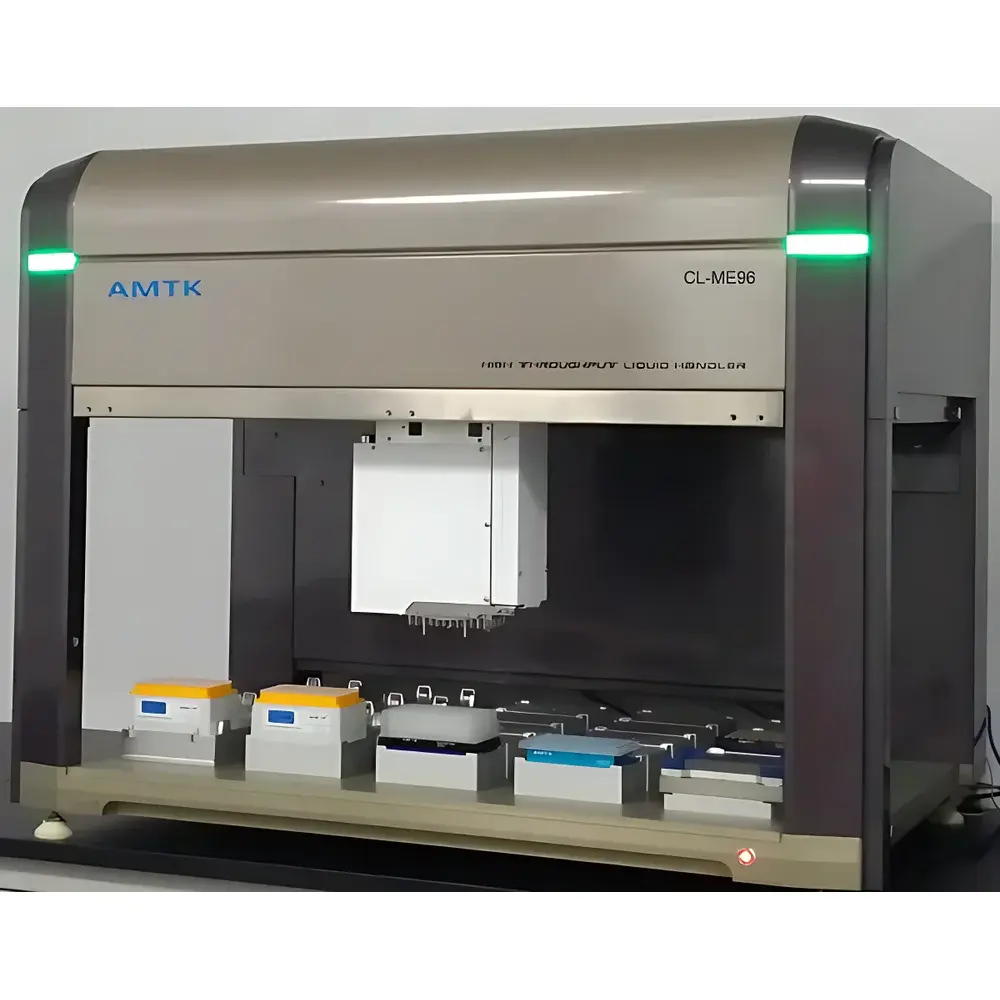
AMTK CL-ME96/192 Automated Magnetic Bead-Based Nucleic Acid Extraction System
| Brand | AMTK |
|---|---|
| Origin | Jiangsu, China |
| Instrument Type | Magnetic Bead-Based Extraction |
| Automation Level | Dedicated Fully Automated Platform |
| Throughput | 96 or 192 samples per run |
| Sample Volume Range | 10–200 µL |
| Processing Time per Run | 15–30 minutes |
| Dimensions (L×W×H) | 110 × 75 × 88 cm |
| Weight | ~200 kg |
| Deck Capacity | 25 plate positions |
| Power Supply | AC 220 V, 50 Hz, 650 W |
| Pipetting Range | 2–200 µL |
| Compatible Tips | 250 µL standard or filter tips |
| Pipetting Precision | ≤4% CV at 10 µL |
| Pipetting Accuracy | ±8% at 10 µL |
| Regulatory Status | Class I Medical Device Filing (Su Su Yi Xie Bei 20181026) |
Overview
The AMTK CL-ME96/192 Automated Magnetic Bead-Based Nucleic Acid Extraction System is an engineered platform designed for high-throughput, reproducible isolation and purification of DNA and RNA from diverse biological matrices. It operates on the principle of magnetic bead-based solid-phase extraction—leveraging paramagnetic particles functionalized with surface chemistries that selectively bind nucleic acids under controlled buffer conditions. Following binding, beads are immobilized via integrated magnetic separation modules while contaminants are washed away; purified nucleic acids are then eluted in low-ionic-strength buffers. This methodology ensures consistent recovery across sample types—including whole blood, plasma, buccal swabs, stool, saliva, viral lysates, cultured cells, and plasmid preparations—without reliance on organic solvents or centrifugation. The system integrates precision liquid handling, thermally regulated incubation zones, orbital shaking for efficient binding/wash kinetics, and real-time software-controlled protocol execution. Its architecture complies with fundamental design principles for laboratory automation under ISO 13485-aligned quality frameworks and supports operational traceability required in regulated environments.
Key Features
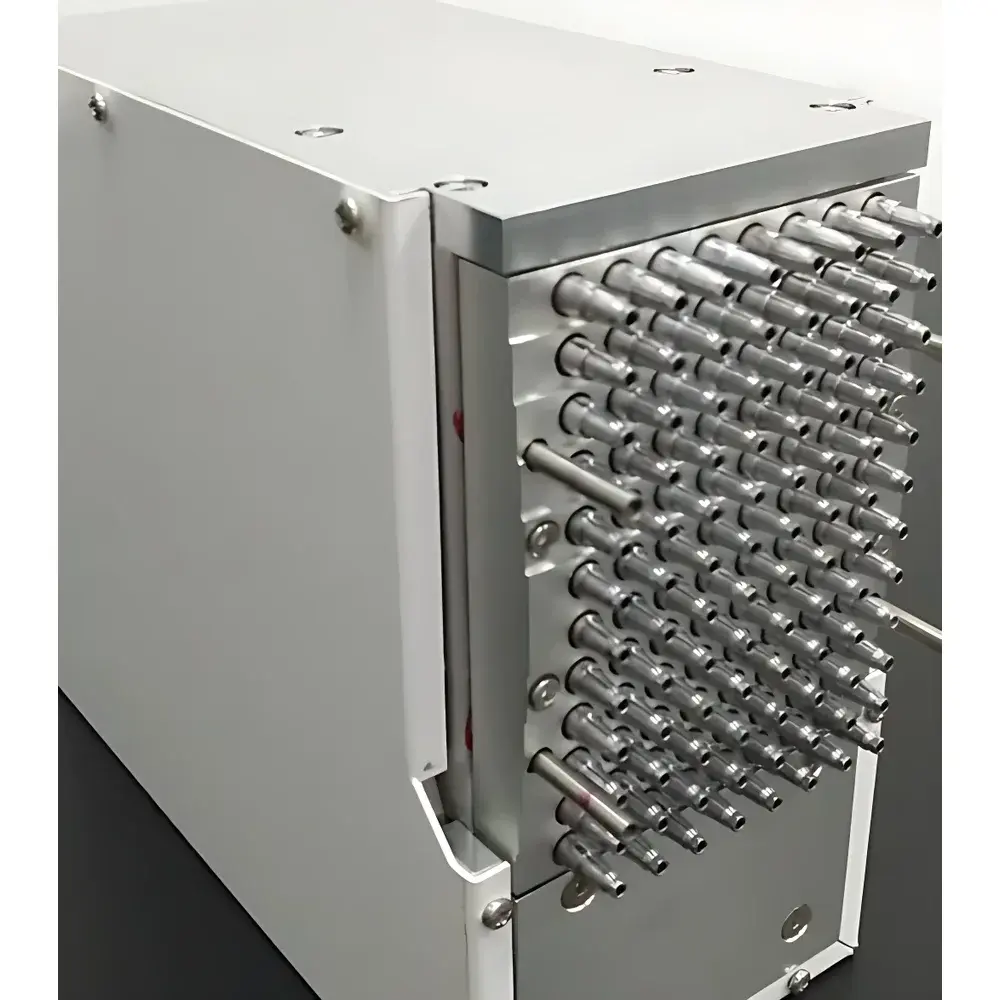
- Precision pipetting module with hardened lightweight alloy barrels ensuring long-term volumetric accuracy and minimal carryover between cycles
- Dual-throughput configuration supporting either 96-well or 192-well microplate formats without hardware modification
- Integrated magnetic separation stations with programmable field strength and dwell time to optimize bead capture efficiency across viscosity ranges
- Thermally controlled incubation blocks (ambient to 85 °C) enabling lysis, binding, and elution steps within a single instrument footprint
- Orbital shaking module with variable speed and duration control to enhance nucleic acid–bead interaction kinetics and wash stringency
- Emergency stop circuitry and physical interlocks safeguarding operator safety and sample integrity during active processing
- ANSI/SLAS-compliant deck layout accommodating standard SBS-format plates—including deep-well, PCR, and skirted microplates—as well as custom adapters
- Software-configurable tip ejection, pre-wet, and multi-dispense routines to minimize reagent waste and improve assay robustness
Sample Compatibility & Compliance
The CL-ME96/192 demonstrates broad compatibility with clinical, environmental, and research-grade specimens processed using commercially available magnetic bead kits. It supports nucleic acid extraction from whole blood, serum/plasma, oral/buccal swabs, fecal suspensions, saliva, viral transport media, bacterial cultures, mammalian cell pellets, and plasmid miniprep lysates. All protocols are validated against ISO 20387:2018 (Biobanking—General requirements for biobanking) and align with analytical performance expectations outlined in CLSI EP12-A2 and EP25-A. As a Class I medical device registered under Jiangsu Provincial Medical Device Filing No. Su Su Yi Xie Bei 20181026, the system meets essential safety and performance criteria for in vitro diagnostic use in China. While not CE-marked or FDA 510(k)-cleared, its mechanical and software architecture permits integration into GLP-compliant workflows when paired with validated reagents and documented SOPs.
Software & Data Management
The embedded control software provides a graphical user interface with drag-and-drop protocol builder functionality, enabling lab personnel to configure extraction workflows without scripting expertise. Each run logs timestamped metadata—including deck map, pipetting parameters, temperature profiles, magnetic actuation cycles, and error flags—for full audit trail generation. Export options include CSV and PDF reports compatible with LIMS integration. The system supports user-level access controls (administrator/operator modes), electronic signature capability, and optional audit log encryption—features aligned with data integrity expectations under ALCOA+ principles and applicable to laboratories operating under ISO/IEC 17025 or CAP accreditation. Raw log files retain full command history for forensic troubleshooting and regulatory inspection readiness.
Applications
- High-volume nucleic acid isolation for clinical diagnostics laboratories and blood bank screening programs
- Pre-analytical processing in next-generation sequencing (NGS) workflows—including library normalization, size selection cleanup, and adapter removal
- Automated sample dilution series and master mix dispensing for qPCR assay setup
- Pathogen nucleic acid purification from environmental swabs and wastewater concentrates in public health surveillance
- Plasmid DNA purification for CRISPR vector production and transfection-grade preparation
- RNA isolation from low-input FFPE tissue sections with optimized binding chemistry protocols
FAQ
What sample types are validated for use with this system?
Whole blood, plasma, saliva, buccal swabs, stool suspensions, viral transport media, cultured cells, and bacterial pellets are routinely supported using third-party magnetic bead kits.
Does the system support custom protocol development?
Yes—the graphical programming interface allows users to define aspiration/dispense volumes, mixing steps, incubation temperatures/durations, magnetic hold times, and plate movements without coding.
Is the instrument compatible with filter tips to prevent aerosol contamination?
Yes, it accepts standard 250 µL universal filter tips, which are recommended for high-risk applications such as viral RNA extraction and NGS library prep.
Can the system be integrated into a larger automated laboratory workflow?
Its ANSI/SLAS-compliant deck and open communication protocols (RS-232, USB, Ethernet) enable robotic arm interfacing and middleware-driven scheduling in consolidated lab automation ecosystems.
What regulatory documentation is provided with the instrument?
Class I medical device filing certificate (Su Su Yi Xie Bei 20181026), electrical safety test report, and factory calibration records are included; IQ/OQ documentation templates are available upon request.





