
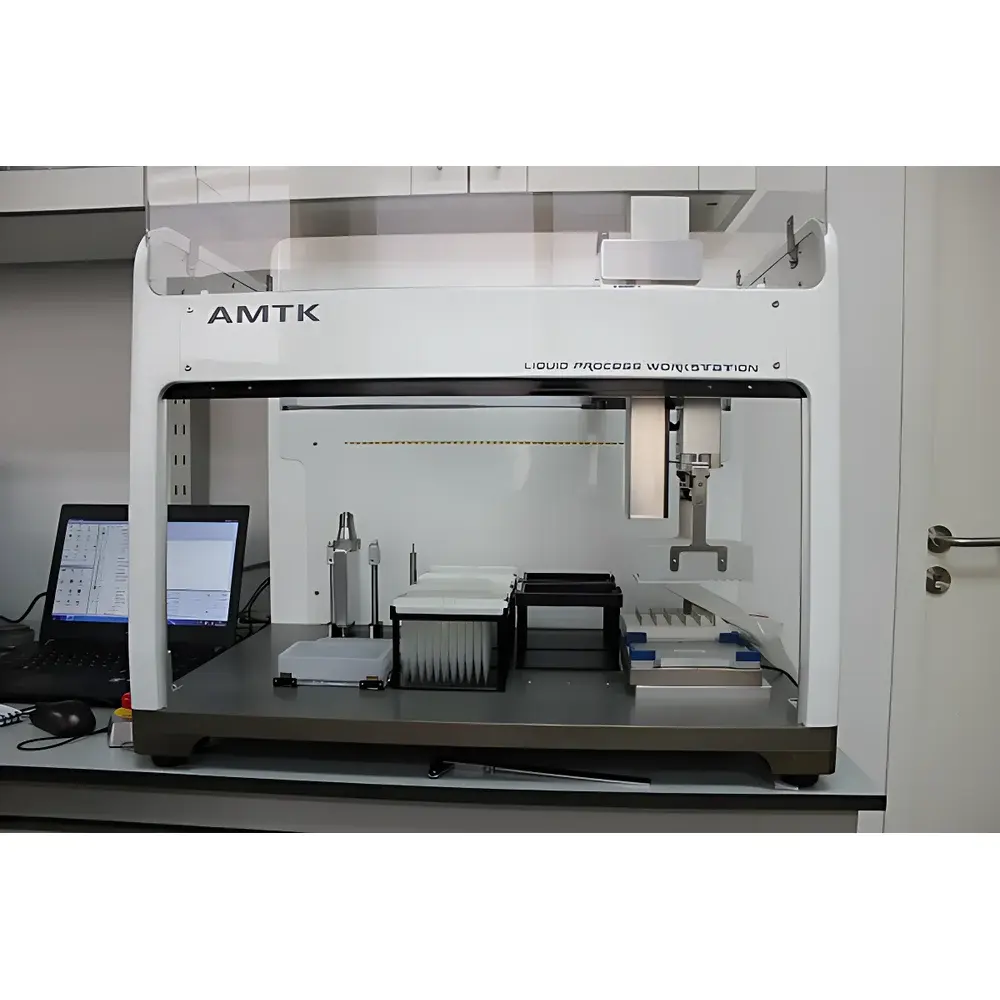
AMTK HL1406 Automated Enzyme Reaction Reagent Template Preparation Workstation
| Brand | AMTK |
|---|---|
| Model | HL1406 |
| Origin | Beijing, China |
| Plate Capacity | 12 positions |
| Pipetting Range | 0.3 µL – 5 mL |
| Pipetting Precision | CV < 10% at volumes < 1 µL |
| Sample Throughput Options | 1 / 8 / 16 / 32 samples per run |
| Dimensions (W×D×H) | 50 × 60 × 70 cm |
| Operating Temperature | 23 °C ± 5 °C |
| Power Supply | 110/220 VAC, 50/60 Hz |
| Relative Humidity | 10–90% RH (non-condensing) |
Overview
The AMTK HL1406 Automated Enzyme Reaction Reagent Template Preparation Workstation is a dedicated liquid handling platform engineered for high-fidelity reagent assembly in molecular biology workflows—specifically optimized for the preparation of standardized enzyme reaction master mixes used in polymerase chain reaction (PCR), reverse transcription PCR (RT-PCR), digital PCR (dPCR), and related nucleic acid amplification assays. Unlike general-purpose liquid handlers, the HL1406 integrates application-specific pipetting logic, fixed-volume dispensing protocols, and plate-based template layout mapping to ensure stoichiometric consistency across replicate reactions. Its core architecture employs air displacement pipetting with temperature-stabilized tips and calibrated positive-displacement calibration routines, enabling reliable low-volume transfers down to 0.3 µL while maintaining traceable reproducibility under ambient lab conditions (23 °C ± 5 °C). The system operates without integrated thermal control or on-deck incubation, positioning it as a pre-amplification preparation tool rather than an end-to-end assay platform.
Key Features
- Dedicated reagent templating workflow: Preconfigured protocols for master mix assembly—including DNA polymerase, dNTPs, MgCl₂, buffer, and template DNA—mapped to ANSI/SLAS-standard 96-well and 384-well plates.
- 12-position deck layout with modular carrier slots: Accommodates tube racks (1.5 mL, 2.0 mL), reservoirs, tip boxes, and microplates simultaneously—enabling walk-away preparation of up to two full plates (<10 minutes runtime).
- High-precision air displacement pipetting: Dual-channel pipettor with adjustable tip ejection force and aspirate/dispense speed profiles; supports both single- and multi-tip dispensing modes.
- Volumetric flexibility: Adjustable pipetting range from 0.3 µL to 5 mL per aspiration, with automatic volume-dependent calibration compensation to maintain CV < 5% for volumes ≥ 1 µL and CV < 10% below 1 µL.
- Environmentally robust operation: Designed for continuous use in ISO Class 7–8 laboratory environments; meets IEC 61000-4 electromagnetic compatibility standards and UL 61010-1 safety requirements.
Sample Compatibility & Compliance
The HL1406 accepts standard consumables including polypropylene tubes (0.2–2.0 mL), sterile filtered reservoirs, and ANSI/SLAS-compliant microplates (96-well, 384-well, skirted/unskirted). It does not support magnetic bead handling, centrifugation, or heating/cooling modules. All pipetting operations are traceable via onboard log files timestamped to system clock (NTP-synchronized optional). While the workstation itself is not FDA 510(k)-cleared or CE-IVD marked, its operational parameters align with ISO 8655-6 (volumetric accuracy of piston-operated pipettes) and support GLP-compliant documentation when integrated with validated LIMS or ELN systems. Users may configure audit trails and electronic signatures per 21 CFR Part 11 requirements using third-party middleware.
Software & Data Management
The HL1406 runs on AMTK’s proprietary Windows-based ControlSuite v3.x software, offering graphical protocol builder with drag-and-drop step sequencing, real-time pipette status monitoring, and error logging with cause-code classification (e.g., “tip clog,” “liquid level detection failure,” “plate misalignment”). Protocols are stored as XML-based templates with version control and user-access permissions. Raw execution logs—including timestamped volume dispensed, tip usage count, and positional coordinates—are exportable in CSV or PDF format. The system supports OPC UA connectivity for integration into centralized lab automation networks and offers RESTful API endpoints for remote job submission and status polling.
Applications
- Preparation of PCR master mixes for genotyping, pathogen detection, and gene expression profiling.
- Serial dilution series generation for standard curve construction in qPCR assays.
- Reagent pooling and normalization across multiple sample batches prior to high-throughput sequencing library prep.
- Consistent distribution of restriction enzyme cocktails or ligation master mixes in cloning workflows.
- Support for ISO/IEC 17025-accredited testing labs requiring documented repeatability in reagent formulation steps.
FAQ
Does the HL1406 support dynamic volume adjustment during a single run?
Yes—volume parameters can be modified per well or per column using conditional logic within ControlSuite, enabling gradient dilutions or variable template inputs across a plate.
Is tip washing or carryover prevention implemented?
The system includes configurable air-wash cycles between aspirates and optional post-dispense tip wiping; however, it does not feature integrated fluid-based tip wash stations.
Can the HL1406 be validated for GMP environments?
While the hardware and firmware are designed for reliability and repeatability, formal IQ/OQ/PQ validation packages must be developed and executed by the end user or qualified third party in accordance with their internal quality system requirements.
What maintenance is required for long-term precision?
Monthly gravimetric verification using certified reference weights and annual recalibration of pipetting axes and Z-height sensors are recommended per AMTK Technical Bulletin TB-HL1406-02.



