
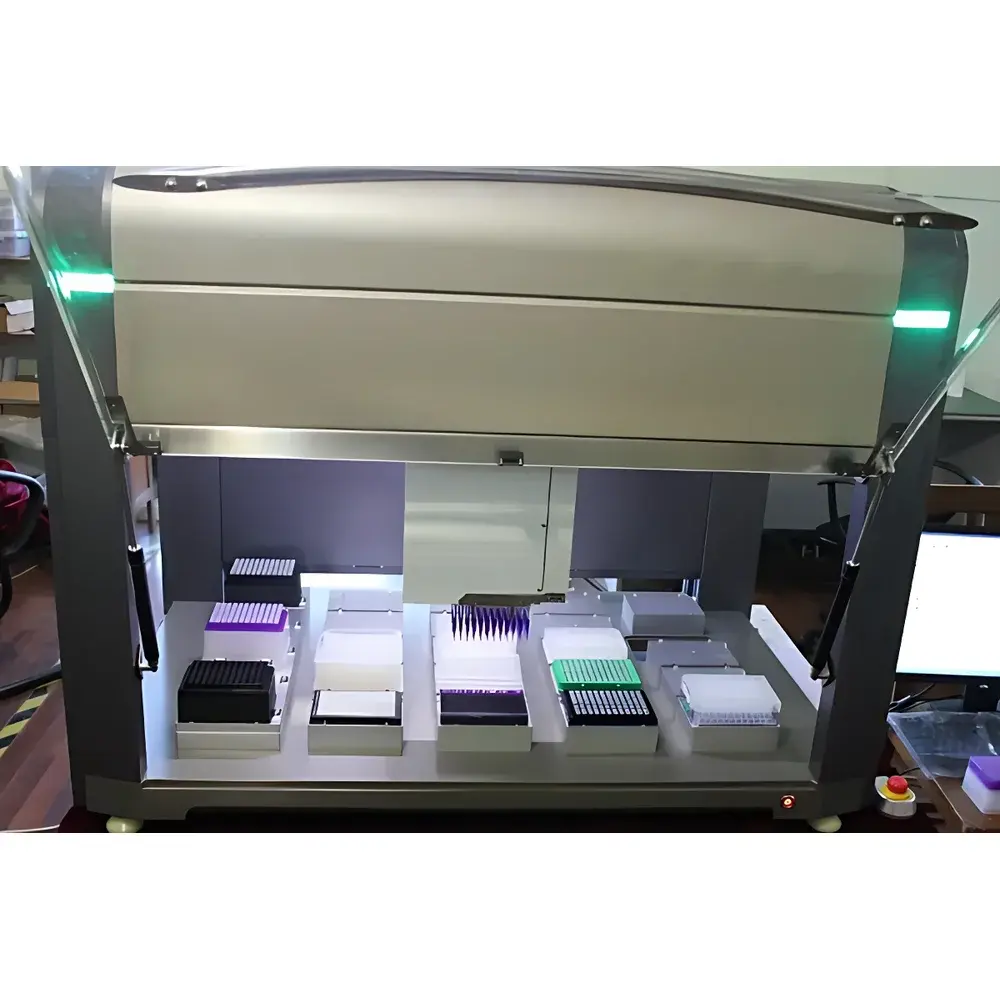
AMTK LH-1209 High-Throughput Magnetic Bead-Based Nucleic Acid Extraction Workstation
| Brand | AMTK |
|---|---|
| Origin | Beijing, China |
| Manufacturer Type | Authorized Distributor |
| Country of Origin | China |
| Model | LH-1209 |
| Price Range | USD 70,000–140,000 |
| Instrument Type | Magnetic Bead-Based Extraction System |
| Automation Level | Dedicated Fully Automated Platform |
| Throughput | 96 or 192 samples per run |
| Sample Volume Range | 0.5–200 µL |
| Processing Time per Batch | ~40 minutes |
| Elution Volume | Adjustable (typically 30–100 µL) |
| Plate Capacity | 25 deck positions |
| Operating Temperature | 23 °C ± 5 °C |
| Power Supply | 220 V AC, 50 Hz |
| Relative Humidity | 10–90% RH (non-condensing) |
| Yield | 4–8 µg genomic DNA from 100–200 µL fresh whole blood |
Overview
The AMTK LH-1209 High-Throughput Magnetic Bead-Based Nucleic Acid Extraction Workstation is an integrated, walk-away automation platform engineered for reproducible, scalable isolation of DNA and RNA from diverse biological matrices—including whole blood, saliva, buccal swabs, cultured cells, tissue homogenates, and FFPE-derived lysates. Utilizing robust magnetic bead separation chemistry—compatible with commercially available kits adhering to ISO 20387:2018 (Biobanking) and ISO/IEC 17025:2017 (Testing Laboratory Competence)—the system executes binding, washing, and elution steps under programmable thermal and magnetic field control. Its modular architecture comprises precision liquid handling (positive displacement pipetting), multi-zone heating (lysis and elution blocks), high-gradient magnetic separation racks, and a 25-position deck accommodating standard SBS-format plates, reservoirs, and waste containers. Designed for deployment in clinical diagnostic laboratories, contract research organizations (CROs), and high-volume public health testing facilities, the LH-1209 supports both single-plate (96-well) and dual-plate (192-well) configurations without hardware reconfiguration.
Key Features
- Fully automated nucleic acid purification using magnetic bead-based chemistries—no centrifugation or vacuum manifolds required.
- Dual-plate processing capability: simultaneous extraction from two 96-well plates (192 samples/batch) with independent protocol scheduling.
- Integrated thermal modules: lysis heating up to 85 °C; elution heating up to 70 °C; precise temperature uniformity (±0.5 °C) across all wells.
- Positive-displacement pipetting system ensures accurate dispensing across the full sample volume range (0.5–200 µL), minimizing carryover and cross-contamination.
- 25-position universal deck with barcode scanning support for plate tracking and audit-ready traceability.
- Onboard real-time monitoring of critical process parameters—including tip attachment status, liquid level detection, magnetic rack engagement, and heater temperature feedback.
- Compliance-ready firmware architecture supporting user role management, electronic signatures, and audit trail logging aligned with FDA 21 CFR Part 11 requirements.
Sample Compatibility & Compliance
The LH-1209 demonstrates broad compatibility with human and non-human biospecimens processed via standardized lysis buffers (e.g., guanidinium thiocyanate–based or silica-magnetic bead formulations). It accommodates input volumes from low-volume clinical specimens (e.g., dried blood spots reconstituted in 50 µL buffer) to high-yield tissue lysates (up to 200 µL). All workflows are validated per CLSI EP12-A2 and ISO 15189:2022 Annex A.5 for molecular testing laboratories. The system meets IEC 61000-6-2 (immunity) and IEC 61000-6-3 (emissions) standards for laboratory equipment. CE marking is supported under Directive 2014/30/EU (EMC) and 2012/7/EU (LVD); optional UKCA documentation available upon request.
Software & Data Management
Control and method development are performed via AMTK’s proprietary ExtractionSuite™ v3.2 software, a Windows-based application featuring drag-and-drop protocol builder, real-time run visualization, and export of raw instrument logs in CSV and XML formats. Each run generates a timestamped digital record including operator ID, protocol version, plate barcodes, thermal profiles, magnetic actuation cycles, and error flags. Data integrity safeguards include automatic checksum validation, encrypted local storage (AES-256), and configurable network backup to LIMS or ELN systems via HL7 or RESTful API endpoints. Audit trails retain ≥18 months of activity history and comply with GLP/GMP data retention expectations.
Applications
- High-volume SARS-CoV-2 RT-qPCR screening in regional public health labs.
- Pre-analytical processing for next-generation sequencing (NGS) library preparation in oncology and pharmacogenomics pipelines.
- Automated extraction for companion diagnostics requiring batch-wise consistency under ISO 13485-certified manufacturing environments.
- Biobank specimen processing where traceability, yield consistency (>95% inter-run CV for human gDNA), and minimal hands-on time are critical.
- Regulatory submissions requiring documented process validation—supporting IQ/OQ/PQ protocols with third-party calibration certificates.
FAQ
Does the LH-1209 support custom magnetic bead kits from third-party vendors?
Yes—the system is open-platform and compatible with all major magnetic bead chemistries requiring 96-well plate format, including those from Qiagen, Thermo Fisher Scientific, Zymo Research, and Takara Bio.
Is remote monitoring or troubleshooting supported?
The workstation includes embedded Ethernet and optional Wi-Fi connectivity, enabling secure remote access via TLS-encrypted VNC for technical support and real-time status review.
What validation documentation is provided with the system?
Each unit ships with Factory Acceptance Test (FAT) report, Installation Qualification (IQ) checklist, and a template Operational Qualification (OQ) protocol compliant with ISO/IEC 17025 and CLIA guidelines.
Can the system be integrated into an existing LIMS environment?
Yes—ExtractionSuite™ supports bidirectional integration through configurable HL7 ADT/ORM messages and REST API endpoints for sample registration, result ingestion, and instrument status polling.
What maintenance intervals are recommended?
Preventive maintenance is scheduled every 6 months or after 1,000 runs, covering pipette calibration verification, magnetic rack alignment check, heater calibration, and firmware integrity scan.
Related Products



