
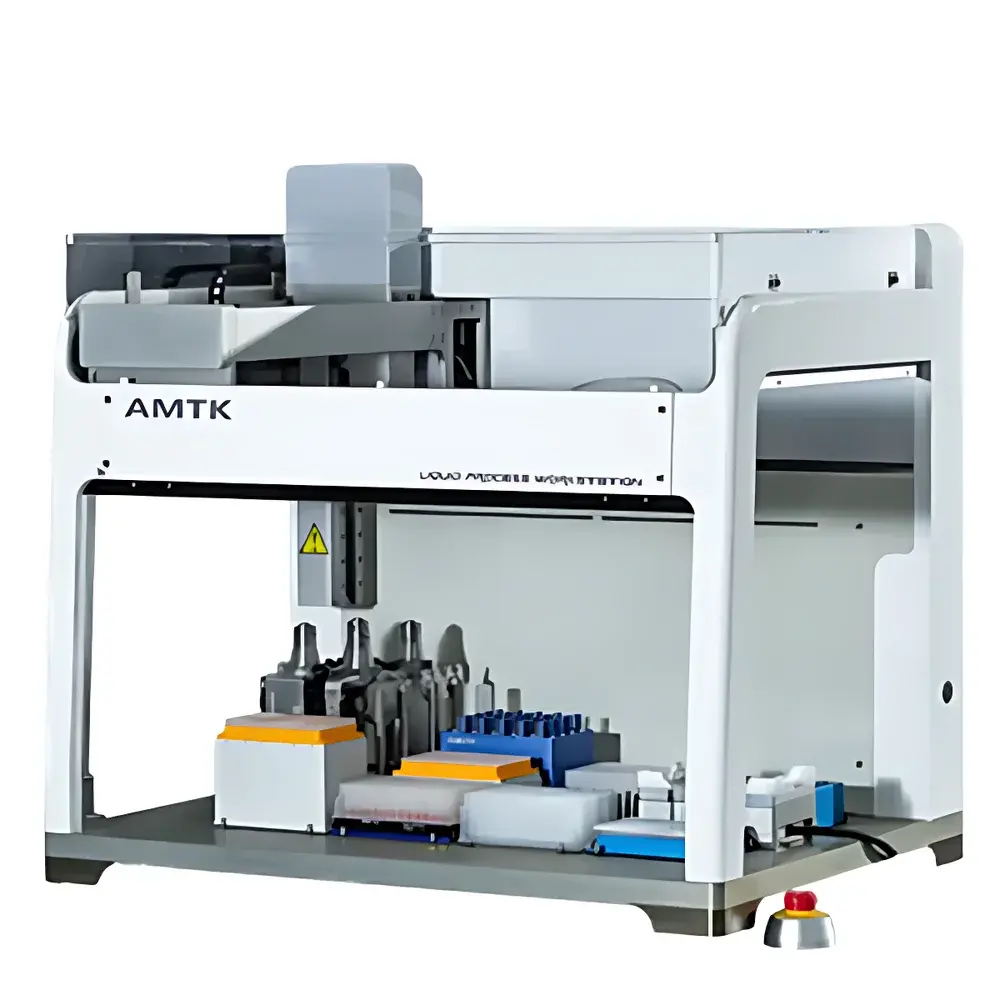
AMTK LH-1406 NGS Library Preparation & QC Integrated Workstation
| Brand | AMTK |
|---|---|
| Origin | Jiangsu, China |
| Model | LH-1406 |
| Instrument Type | Integrated NGS Library Construction and Quality Control Workstation |
| Library Construction Method | Hybridization Capture-Based |
| Supported Plate Format | 96-well SBS-standard plates |
| Liquid Handling Range | 0.5 µL – 1 mL |
| Pipetting Precision | CV < 5% at 2 µL |
| Positioning Accuracy | ±0.1 mm (XYZ) |
| Onboard Deck Capacity | 12 standardized deck positions |
| Thermal Modules | Integrated PCR Module (VCM® technology), Heating-Shaking Module, Triple-Zone Temperature-Controlled Enclosure (6–110 °C, including ambient and refrigerated zones) |
| Software | Graphical workflow editor with breakpoint resumption, open scripting interface, and audit-trail-ready operation log |
Overview
The AMTK LH-1406 is an integrated, benchtop NGS library preparation and quality control workstation engineered for precision, reproducibility, and operational flexibility in molecular biology laboratories. It implements a modular, open-deck architecture based on air-displacement pipetting principles, enabling end-to-end automation of hybridization capture-based NGS library construction workflows—from shearing-assisted fragmentation (when interfaced with compatible fragmentation modules), end-repair and A-tailing, adapter ligation, size selection (via magnetic bead handling), hybridization-based target enrichment, post-capture amplification, to final quantification and QC validation. Its core measurement fidelity derives from high-resolution XYZ robotic positioning (±0.1 mm), dynamically adjustable liquid class parameters calibrated per viscosity and surface tension, and thermally stabilized functional modules compliant with ISO/IEC 17025 traceability requirements for temperature-controlled steps.
Key Features
- Modular open-deck design accommodating up to 12 SBS-compliant positions, supporting custom integration of third-party or OEM-developed modules including magnetic bead processors, centrifuges, and spectrophotometers.
- Multi-channel pipetting head library (1-, 4-, 8-, 16-, and 32-channel) with unified mechanical interface—automatically loaded/unloaded by the robotic arm under software command; all heads utilize hardened alloy barrels with wear-resistant coating and factory-qualified, low-retention tips.
- VCM®-based fully automated PCR module delivering exceptional thermal uniformity: ±0.2 K inter-well variation at 55 °C, 72 °C, and 95 °C; horizontal lid sealing mechanism eliminates cross-contamination and prevents reagent evaporation during thermal cycling.
- Integrated heating-shaking module combining precise temperature control (range: ambient to 95 °C) with orbital agitation (200–1,200 rpm), optimized for hybridization kinetics and enzymatic reaction homogenization.
- Patented triple-zone temperature-controlled enclosure (Patent No. ZL20181012771.0): three physically isolated chambers—Chamber 1 (ambient), Chamber 2 (6–room temperature), Chamber 3 (room temperature–110 °C)—enabling simultaneous storage of cold-sensitive enzymes, volatile reagents, and high-temperature incubation steps without cross-interference.
- Graphical programming interface with sequential logic flow, real-time deck layout visualization, and validated breakpoint resumption—ensuring process continuity after power interruption or manual intervention.
Sample Compatibility & Compliance
The LH-1406 supports standard 96-well plates (SBS format), tube racks (0.2–15 mL), and custom carriers for non-standard consumables. All liquid handling operations adhere to CLSI EP15-A3 guidelines for precision verification, and thermal modules are calibrated per ISO/IEC 17025 requirements. The system’s software architecture supports ALCOA+ data integrity principles and is configurable for 21 CFR Part 11 compliance—including electronic signatures, audit trails, role-based access control, and immutable operation logs—making it suitable for GLP- and GMP-regulated environments such as clinical diagnostics labs and contract research organizations.
Software & Data Management
The embedded control software features an intuitive drag-and-drop workflow builder, parameterized liquid class libraries (viscosity-, volatility-, and surface-tension-aware), and exportable protocol templates in XML format. Raw execution logs include timestamped event records for each pipetting action, thermal setpoint confirmation, and mechanical status flags. Data output conforms to MIAME and MINSEQE metadata standards for seamless integration with LIMS platforms (e.g., LabVantage, STARLIMS) and downstream NGS analysis pipelines (e.g., Illumina DRAGEN, BWA-GATK). Optional API access enables remote orchestration via Python or RESTful calls.
Applications
- NGS library preparation for whole-genome sequencing (WGS), whole-exome sequencing (WES), targeted panels (e.g., oncology, inherited disease), and RNA-Seq (including stranded and single-cell protocols).
- Clinical molecular testing: SARS-CoV-2 RT-qPCR assay setup, multiplex pathogen detection, and companion diagnostic assay implementation under CAP/CLIA accreditation frameworks.
- Automated nucleic acid extraction and normalization prior to library construction.
- Enzymatic reaction staging—including restriction digestion, phosphatase treatment, and USER enzyme cleanup—with precise thermal zoning and timed agitation.
- Pre-analytical sample processing for proteomics: immunoprecipitation setup, peptide desalting, and MALDI-TOF sample spotting.
- Drug discovery support: target engagement assays, CRISPR gRNA library pooling, and high-throughput screening plate replication.
FAQ
Does the LH-1406 support 384-well plate handling?
Yes—the robotic arm is calibrated for both 96-well and 384-well SBS-standard plates, though primary NGS library protocols are optimized for 96-well formats.
Can the system be validated for ISO 13485 or FDA 21 CFR Part 11 compliance?
The hardware and firmware architecture support IQ/OQ/PQ documentation packages; optional validation support services—including URS, DQ, and traceable calibration certificates—are available through AMTK’s global service network.
Is third-party instrument integration supported?
Yes—via RS232, USB, or Ethernet interfaces using Modbus TCP or vendor-specific SDKs; common integrations include Agilent Bioanalyzer systems, Qubit fluorometers, and Beckman Biomek liquid handlers.
What maintenance is required for the pipetting heads?
No routine recalibration is needed; tip ejection force and aspiration/dispense timing are self-compensating. Annual preventive maintenance includes optical encoder verification, thermal module calibration, and seal integrity testing of the triple-zone enclosure.
How is carryover contamination prevented during NGS library prep?
The system employs positive-displacement air-gap dispensing, tip-washing protocols between samples, UV-C irradiation of the deck (optional add-on), and physical segregation of pre- and post-amplification zones via software-enforced deck mapping rules.



