
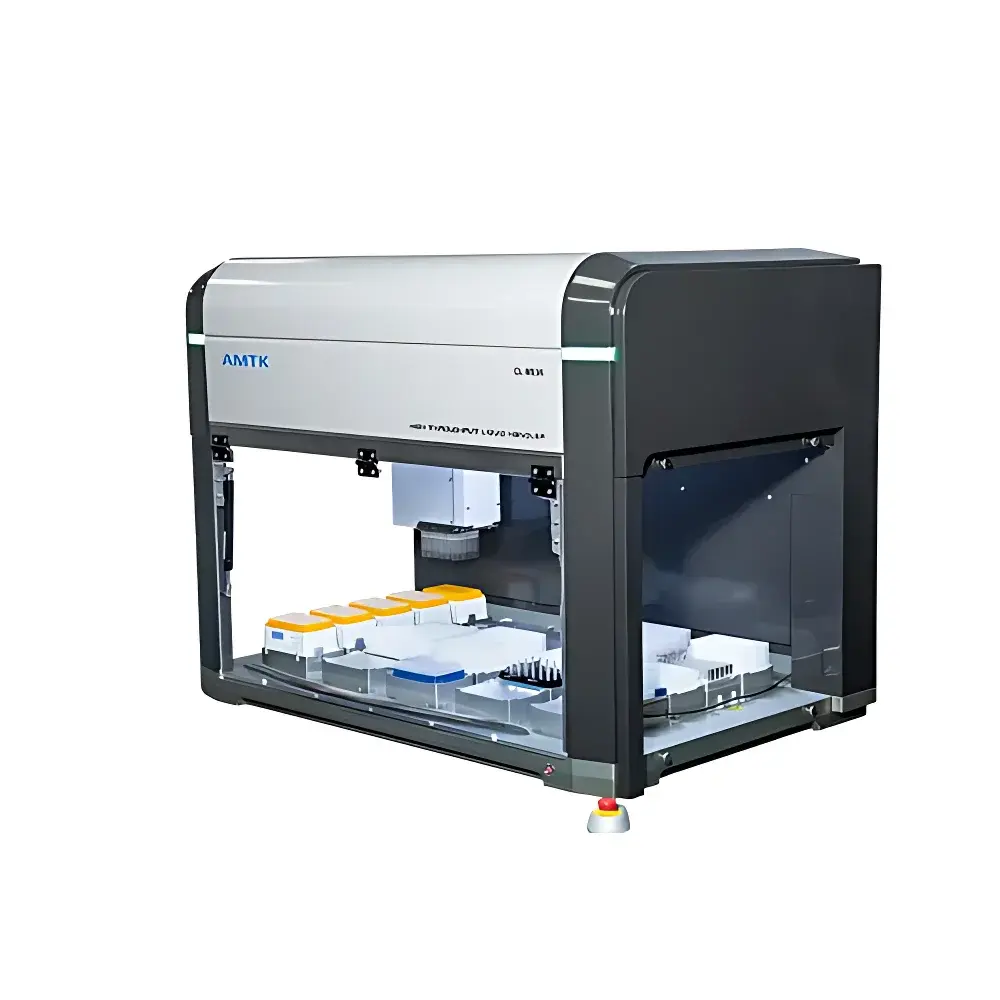
AMTK LH1209 Automated Liquid Handling Platform for NGS Library Preparation
| Brand | AMTK |
|---|---|
| Origin | Jiangsu, China |
| Manufacturer Type | Authorized Distributor |
| Product Category | Domestic Instrument |
| Model | LH 1209 |
| Price Range | USD $68,000–$109,000 (FOB) |
| Instrument Type | NGS Library Construction System |
| Library Construction Method | Hybridization Capture-Based |
| Supported Plate Formats | ANSI/SLAS-compliant 96-well, 384-well, and 1536-well microplates |
| Pipetting Range | 0.1–250 µL |
| Precision | CV <10% at 0.1–2 µL |
| Accuracy | ±2% at 1 µL and 10 µL |
| Resolution | 0.1 µL |
| Dimensions (W×D×H) | 1100 × 720 × 800 mm |
| Weight | 110 kg |
| Power Supply | 220 V, 50 Hz |
| Operating Temperature | 5–40 °C |
| Safety Features | Emergency Stop Button, UV-Compatible Enclosure Option, Integrated Alcohol-Wipe-Compatible Surfaces |
| Modular Accessories | Heater, Shaker, Magnetic Stand, Barcode Scanner, Vacuum Filtration Module, Wash Station |
| Consumable Compatibility | ANSI/SLAS-standard plates, reservoirs, tube racks, and low-cost domestic disposable tips (with optional aerosol-resistant filter tips) |
Overview
The AMTK LH1209 Automated Liquid Handling Platform is a purpose-built, 96-channel benchtop workstation engineered specifically for high-throughput nucleic acid library preparation in next-generation sequencing (NGS) workflows. Based on positive-displacement pipetting architecture with precision stepper-motor-driven syringe pumps and thermally stable barrel assemblies, the system delivers reproducible liquid transfer across a broad dynamic range—from ultra-low volumes (0.1 µL) to mid-range dispensing (250 µL). Its core design addresses critical bottlenecks in hybridization capture-based library construction, including fragment end-repair, A-tailing, adapter ligation, size selection, PCR amplification setup, and target enrichment pooling. The platform operates under controlled environmental conditions (5–40 °C ambient), supporting both open-bench integration for method development and fully enclosed configurations compliant with ISO 14644-1 Class 8 cleanroom practices when equipped with UV germicidal irradiation and ethanol-compatible surface finishes.
Key Features
- 96-channel parallel liquid handling with independent channel control, enabling full-plate transfers in a single aspiration/dispense cycle
- Elastic tip-loading deck with self-aligning mechanism ensures consistent tip attachment and minimizes wear on pipetting barrels over extended operational lifetimes
- 25 standardized deck positions—expandable via modular rail system—support simultaneous integration of thermal modules, magnetic separation units, barcode readers, and vacuum filtration stations
- High-precision aluminum-alloy pipetting barrels with optimized mass-to-inertia ratio ensure mechanical stability and positional repeatability during rapid acceleration/deceleration cycles
- Onboard camera-assisted coordinate calibration reduces manual deck mapping time by >70%, supporting rapid reconfiguration between assay protocols
- Emergency stop circuitry compliant with IEC 60204-1, integrated into both front-panel hardware and software-level interlock logic
- ANSI/SLAS-standard consumable compatibility ensures seamless interoperability with third-party plates, reservoirs, and tube racks without mechanical adaptation
- Filter-tip support mitigates cross-contamination risk from aerosol generation during volatile or viscous reagent handling—critical for low-input cfDNA and FFPE-derived libraries
Sample Compatibility & Compliance
The LH1209 accommodates standard nucleic acid sample inputs—including fragmented genomic DNA, sheared RNA, and enzymatically digested chromatin—across input ranges from 1 ng to 1 µg per reaction. It supports all major commercial NGS library prep kits (e.g., Illumina TruSeq, IDT xGen, Agilent SureSelect, Roche KAPA HyperPrep) without protocol modification. From a regulatory standpoint, the system’s audit-trail-capable software architecture aligns with GLP and GMP documentation requirements. While not pre-certified for FDA 21 CFR Part 11, its electronic log structure—including user login timestamps, parameter change history, and run completion signatures—provides foundational traceability for internal validation and external inspection readiness. UV-compatible enclosure materials meet ISO 10993-5 cytotoxicity standards, and surface disinfection protocols have been validated using 70% ethanol and UVC (254 nm, 30 mJ/cm²).
Software & Data Management
The LH1209 is operated via AMTK ControlSuite v3.x—a Windows-based application supporting drag-and-drop protocol building, real-time instrument status monitoring, and export of structured CSV logs containing volume, position, timestamp, and error codes. Protocols are stored as XML files with embedded checksums to prevent unauthorized tampering. The software includes built-in QC checks: tip presence verification before aspiration, liquid level detection via pressure sensing, and post-dispense volume confirmation through gravimetric validation routines. Raw data exports comply with MIAME and MINSEQE metadata standards, facilitating downstream integration with LIMS platforms such as LabVantage and STARLIMS via RESTful API adapters. All user actions are recorded in an immutable event log with SHA-256 hashing for integrity verification.
Applications
- Hybridization capture-based exome and whole-genome sequencing library construction
- Targeted panel preparation for clinical oncology assays (e.g., tumor-normal paired analysis)
- ChIP-seq and CUT&RUN library generation with low-cell-number inputs
- Single-cell ATAC-seq tagmentation setup and post-library amplification normalization
- High-throughput qPCR assay plate setup for gene expression validation
- Automated serial dilution series for reference standard curve generation
- Multi-step enzymatic reaction staging in CRISPR guide RNA library cloning workflows
FAQ
Does the LH1209 support dual-indexed library preparation protocols?
Yes—the platform’s flexible deck layout and multi-step scheduling engine enable full automation of dual-index PCR cycles, including primer addition, thermal cycling coordination (when integrated with compatible cycler modules), and post-amplification pooling.
Can the system be validated for ISO/IEC 17025-compliant laboratories?
While the instrument itself is not accredited, its performance specifications (CV, accuracy, resolution) meet or exceed ISO 8655-6 requirements for piston-operated volumetric apparatus. Full validation packages—including IQ/OQ/PQ templates—are available upon request.
Is remote monitoring supported?
Local network access is enabled via Ethernet port; remote desktop access is permitted only within secure institutional VLANs. Cloud-based telemetry is disabled by default and requires explicit configuration approval.
What maintenance intervals are recommended?
Daily tip ejection check, weekly rail lubrication, and quarterly syringe seal inspection are specified in the Maintenance Manual. Calibration verification is advised every 200 operational hours or biweekly—whichever occurs first.
Are OEM integration options available for OEM partners?
Yes—AMTK provides SDK documentation, RS-232/Modbus TCP interface specifications, and mechanical mounting drawings under NDA for co-development of turnkey diagnostic or pharma screening systems.





