
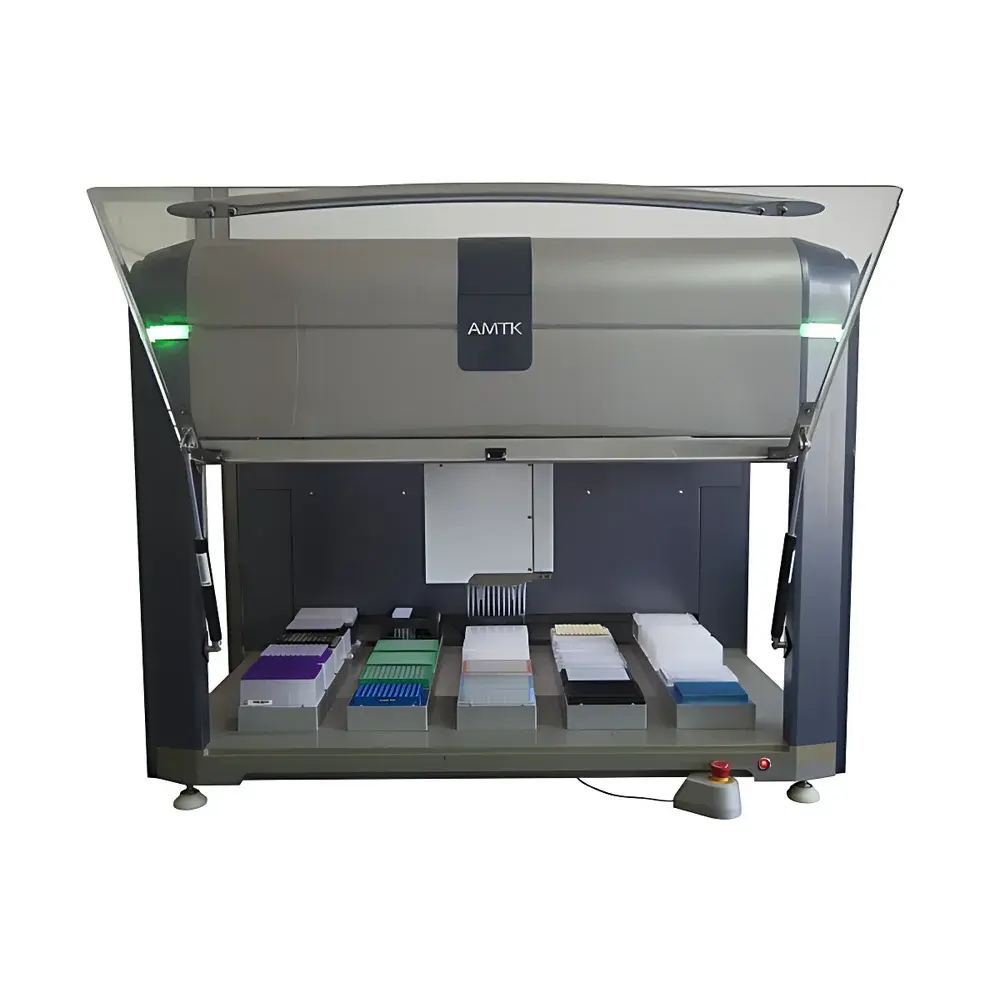
AMTK LH1209 High-Throughput Automated Liquid Handling Workstation
| Brand | AMTK |
|---|---|
| Origin | Beijing, China |
| Manufacturer Type | Authorized Distributor |
| Country of Origin | China |
| Model | LH1209 |
| Price Range | USD 70,000–112,000 (FOB) |
| Deck Capacity | 25 positions |
| Pipetting Precision | CV < 5% (for volumes ≥ 1 µL) |
| Pipetting Range | 0.3–200 µL |
| Sample Throughput | 96-well format per run |
| Dimensions (W×D×H) | 1100 mm × 750 mm × 900 mm |
| Compatible Tips | 10 µL, 30 µL, 70 µL, 250 µL |
| Operating Temperature | 23 °C ± 5 °C |
| Power Supply | 220 VAC, 50 Hz |
| Relative Humidity | 10–90% RH (non-condensing) |
Overview
The AMTK LH1209 High-Throughput Automated Liquid Handling Workstation is a benchtop-integrated, multi-channel liquid handling platform engineered for precision, reproducibility, and operational flexibility in regulated and research-intensive laboratory environments. Based on positive-displacement pipetting architecture with motorized Z-axis control and programmable tip ejection, the system delivers consistent volumetric transfer across microtiter plate formats—including 96-, 384-, and custom labware—without cross-contamination or carryover. Designed to meet the workflow demands of clinical diagnostics, biopharmaceutical process development, genomics library preparation, and environmental sample screening, the LH1209 supports both serial dilution, reagent addition, plate replication, and assay setup protocols. Its modular deck layout accommodates up to 25 standardized labware positions, enabling simultaneous integration of reservoirs, source plates, destination plates, tip racks, and ancillary modules such as barcode readers or temperature-controlled blocks.
Key Features
- 25-position configurable deck with standardized ANSI/SLAS footprint compatibility for seamless integration with third-party accessories
- Dual pipetting head options: ST (Standard Tip) and LT (Low-Volume Tip), supporting interchangeable tip types (10 µL, 30 µL, 70 µL, 250 µL) for optimized accuracy across dynamic volume ranges
- Precision liquid handling from 0.3 µL to 200 µL, with coefficient of variation (CV) ≤ 10% at sub-microliter volumes and ≤ 5% at volumes ≥ 1 µL—validated per ISO 8655-6 guidelines
- Intelligent breakpoint recovery: System retains full positional and protocol state upon interruption, allowing resumption from any step without manual recalibration or reinitialization
- Real-time deck mapping interface with color-coded visual feedback for plate location, tip status, and liquid level detection
- Integrated collision avoidance sensors and force-limited Z-axis actuation ensure safe operation with variable-height labware and irregular surfaces
Sample Compatibility & Compliance
The LH1209 handles aqueous buffers, viscous glycerol solutions (up to 50% v/v), serum, whole blood (with anticoagulant), PCR master mixes, and detergent-containing lysates—subject to appropriate tip selection and aspiration/dispense parameter tuning. All liquid contact surfaces are chemically resistant to common laboratory solvents and sterilizable via ethanol wipe-down. The system complies with IEC 61000-6-2 (immunity) and IEC 61000-6-3 (emissions) electromagnetic compatibility standards. While not certified under FDA 21 CFR Part 11 out-of-the-box, its software architecture supports audit trail generation, user access levels, and electronic signature implementation—enabling qualification for GLP and GMP workflows when deployed with validated SOPs and change control documentation.
Software & Data Management
Controlled via AMTK LiquidStudio™ v3.x—a Windows-based application supporting drag-and-drop protocol builder, real-time monitoring dashboard, and export of raw log files in CSV and XML formats. Protocol templates adhere to ANSI/SLAS standard naming conventions and support variable substitution for batch processing. Data integrity safeguards include timestamped event logs, automatic backup to network drives, and optional encryption for exported datasets. Integration with LIMS platforms is achieved through RESTful API endpoints and HL7-compliant message exchange, facilitating traceability from sample receipt to result reporting in clinical and QC laboratories.
Applications
- High-volume blood bank sample aliquoting and serological panel preparation
- qPCR and NGS library normalization workflows requiring precise low-volume transfers
- Cell-based assay setup—including dose-response matrices and co-culture media formulation
- Environmental water testing where replicate analysis of heavy metal chelates or microbial DNA extracts is required
- Pharmaceutical stability studies involving repeated sampling from accelerated degradation vials
- Quality control release testing of monoclonal antibody formulations under ICH Q5A/Q5B conditions
FAQ
What is the minimum recommended maintenance interval for the LH1209?
Routine calibration verification is advised every 3 months; full preventive maintenance—including pipette axis alignment, tip ejector torque validation, and vacuum pump filter replacement—is recommended annually or after 10,000 pipetting cycles.
Can the LH1209 be integrated into a Class II biosafety cabinet?
Yes—the system’s footprint (1100 mm × 750 mm) and height (900 mm) allow installation within most standard Class II A2 cabinets, provided airflow balance is verified post-installation and external exhaust routing is maintained.
Does the system support dynamic tip type switching during a single protocol?
Yes—LiquidStudio™ enables conditional tip selection based on volume thresholds or well-specific parameters, permitting automated switching between 10 µL and 250 µL tips within one run.
Is remote monitoring available?
Remote desktop access is supported via secure VPN; however, no native cloud-based telemetry or push notifications are implemented—on-site IT infrastructure must manage connectivity and firewall exceptions.
What documentation is provided for IQ/OQ/PQ qualification?
AMTK supplies a comprehensive Validation Support Package including URS template, FAT/SAT checklists, calibration certificates for onboard sensors, and blank protocol execution records compliant with ISO/IEC 17025 and ASTM E2500-18 frameworks.



