
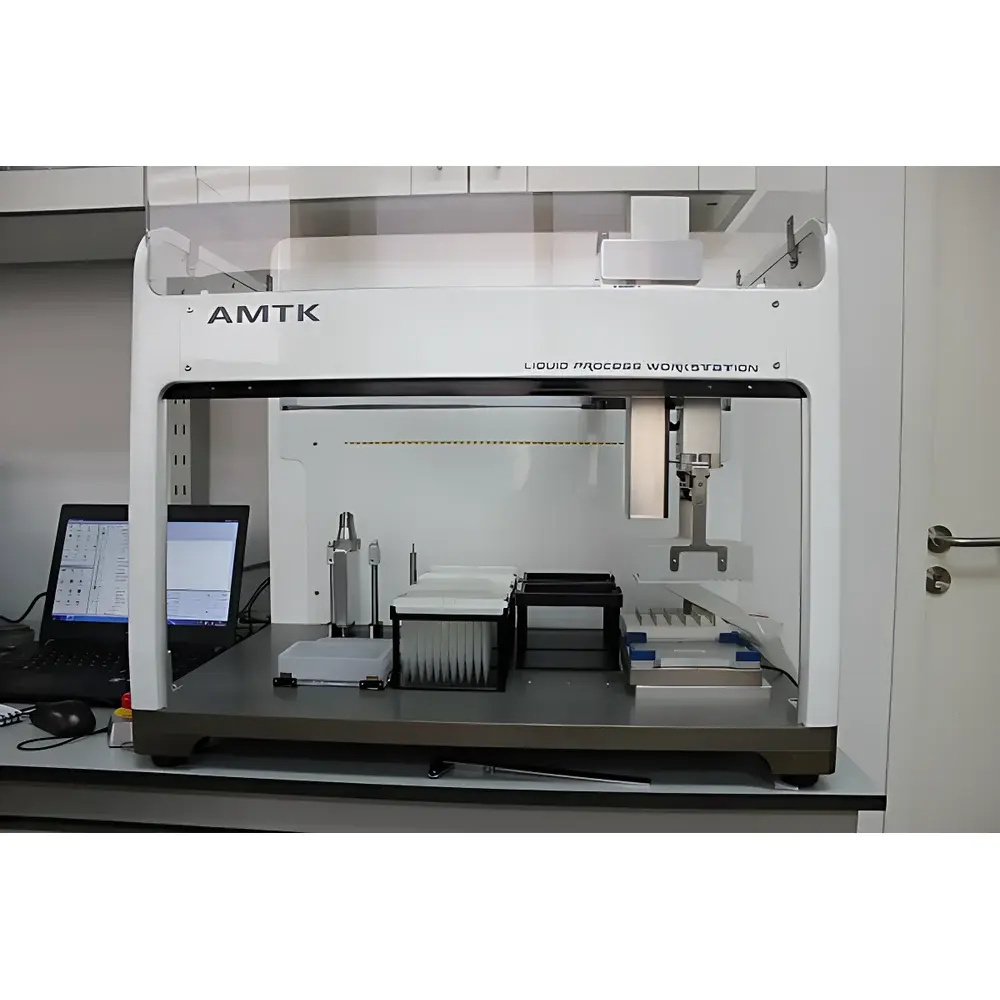
AMTK LH1406 Multifunctional Liquid Handling Workstation
| Brand | AMTK |
|---|---|
| Origin | Beijing, China |
| Manufacturer Type | Authorized Distributor |
| Country of Origin | China |
| Model | LH-1406 |
| Plate Positions | 12 |
| Pipetting Precision | CV < 5% (for volumes > 1 µL) |
| Pipetting Range | 1 µL – 5 mL |
| Sample Throughput Options | 1 / 8 / 16 / 32 samples per run |
| Dimensions | 60 cm × 50 cm × 70 cm |
| Operating Environment | 10–30 °C |
| Power Supply | AC 220 V, 50 Hz |
| Compatible Tips | 10 µL, 30 µL, 70 µL, 250 µL, 1 mL, 5 mL |
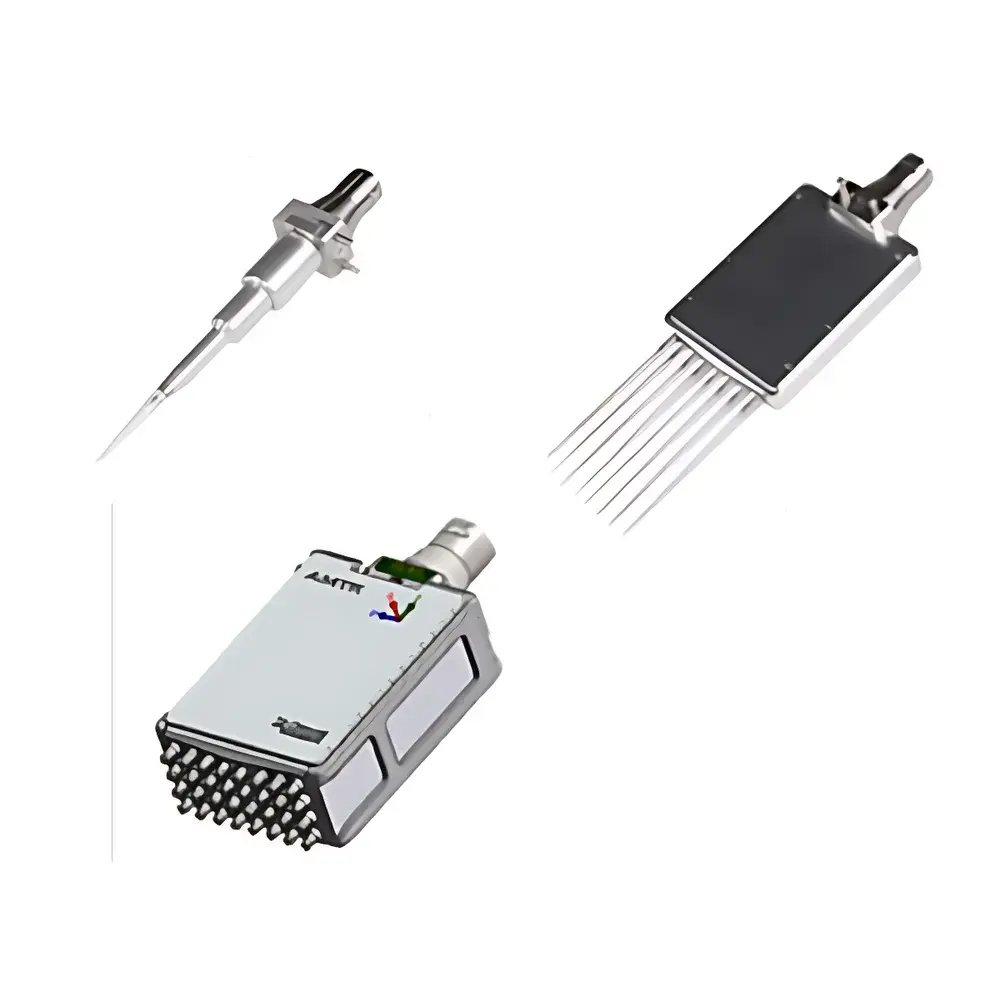
| Available Heads | ST (Standard Tip), LT (Low-Volume Tip), XT (Extended-Range Tip), Gripper Module |
Overview
The AMTK LH1406 Multifunctional Liquid Handling Workstation is an engineered platform for precise, programmable liquid manipulation in low-to-moderate throughput laboratory environments. Designed around a modular robotic arm architecture with interchangeable pipetting and gripping modules, the system executes volumetric transfers, serial dilutions, reagent dispensing, sample pooling, mixing, and plate-to-tube or tube-to-plate transfers under fully automated control. Its core fluidic principle relies on air displacement pipetting with positive displacement compatibility via selectable tip types—ensuring accuracy across viscous, volatile, or low-volume biological samples. The workstation operates within standard biosafety cabinet footprints and integrates seamlessly into workflows requiring traceable, repeatable liquid handling without full-scale high-throughput automation infrastructure.
Key Features
- Modular head configuration supporting ST (Standard Tip), LT (Low-Volume Tip), XT (Extended-Range Tip), and gripper modules—enabling flexible adaptation to diverse assay formats and container geometries.
- Twelve-position deck layout optimized for SBS-standard microplates (96-/384-well), PCR tubes (0.2–2.0 mL), conical tubes (15–50 mL), and custom labware—allowing simultaneous staging of source, intermediate, and destination vessels.
- Variable throughput modes: single-well, single-column, full-plate, or batched multi-sample processing (1/8/16/32 samples per cycle), configurable via intuitive graphical interface.
- Breakpoint resume functionality: protocol execution can be paused at any step and resumed from the exact position—critical for troubleshooting, maintenance, or scheduled interruptions without data loss or manual recalibration.
- Calibrated air-displacement pipetting with volume-dependent precision: CV < 10% at 0.5–1 µL; CV < 5% across 1–5000 µL range—validated per ISO 8655-6 guidelines using gravimetric assessment.
- Integrated environmental monitoring: real-time logging of ambient temperature (10–30 °C operational range) ensures thermal stability during extended runs involving temperature-sensitive reagents.
Sample Compatibility & Compliance
The LH1406 accommodates a broad spectrum of biological and chemical samples including whole blood, plasma, buccal swabs, saliva, tissue lysates, plasmid preps, and fragmented nucleic acids. It supports common consumables such as filter tips (10–5000 µL), non-filter low-retention tips, and sterile polypropylene tubes. All liquid handling operations comply with Good Laboratory Practice (GLP) documentation requirements through timestamped audit trails and user-access logs. While not certified for GMP manufacturing environments, the system meets essential criteria for method validation in research-grade molecular biology labs—including adherence to ASTM E2754 (Standard Guide for Validation of Automated Liquid Handling Systems) and alignment with USP analytical instrument qualification principles.
Software & Data Management
The workstation runs on AMTK’s proprietary LHControl Suite—a Windows-based application offering drag-and-drop protocol builder, real-time status dashboard, and exportable CSV/Excel log files. Each run generates a unique identifier linked to operator ID, timestamp, executed steps, error flags, and calibration history. Software supports role-based access control (RBAC) and optional electronic signature integration compatible with FDA 21 CFR Part 11 Annex 11 readiness when deployed with validated IT infrastructure. Raw data files are stored locally with automatic backup to network drives; no cloud transmission occurs by default, preserving data sovereignty per institutional IT policies.
Applications
- Magnetic bead-based nucleic acid extraction from clinical matrices (whole blood, plasma, oral swabs, saliva, solid tissues, and plasmid preparations).
- NGS library preparation workflows—including NIPT, oncology panels, whole-genome sequencing, and RNA-seq library construction—with accurate fragmentation normalization and adapter ligation setup.
- PCR and qPCR master mix assembly with strict stoichiometric control across multi-target assays.
- Nucleic acid quantification and concentration normalization prior to downstream sequencing or transfection.
- NGS library pooling with fixed molar ratios—enabled by dual-channel dispensing and dynamic volume adjustment per well.
- Preparation of serial dilution standards for ELISA, qPCR standard curves, and QC reference materials.
- Bulk reagent aliquoting and distribution into assay-ready plates or tubes with minimized cross-contamination risk.
FAQ
What is the minimum recommended pipetting volume for reliable CV performance?
For optimal reproducibility, volumes ≥1 µL are recommended; below this threshold, CV increases to <10% due to surface tension and evaporation effects inherent to air-displacement systems.
Can the LH1406 be integrated with third-party LIMS or ELN platforms?
Yes—via CSV/Excel export and optional API extension modules (available under separate validation agreement), enabling bidirectional data exchange with major LIMS vendors including LabVantage, Thermo Fisher SampleManager, and Benchling.
Is routine calibration required, and how often?
Gravimetric calibration is advised every 3 months or after head replacement; AMTK provides NIST-traceable calibration kits and SOP templates aligned with ISO/IEC 17025 internal quality requirements.
Does the system support positive displacement pipetting?
Not natively—but low-retention positive displacement tips (e.g., 10 µL and 30 µL) are mechanically compatible and routinely used for glycerol-rich, viscous, or volatile samples to reduce carryover and improve accuracy.
What safety certifications does the LH1406 hold?
It conforms to IEC 61010-1:2010 for electrical safety in laboratory equipment and carries CE marking under the EU Low Voltage Directive; EMC compliance per EN 61326-1:2013 is also verified.



