
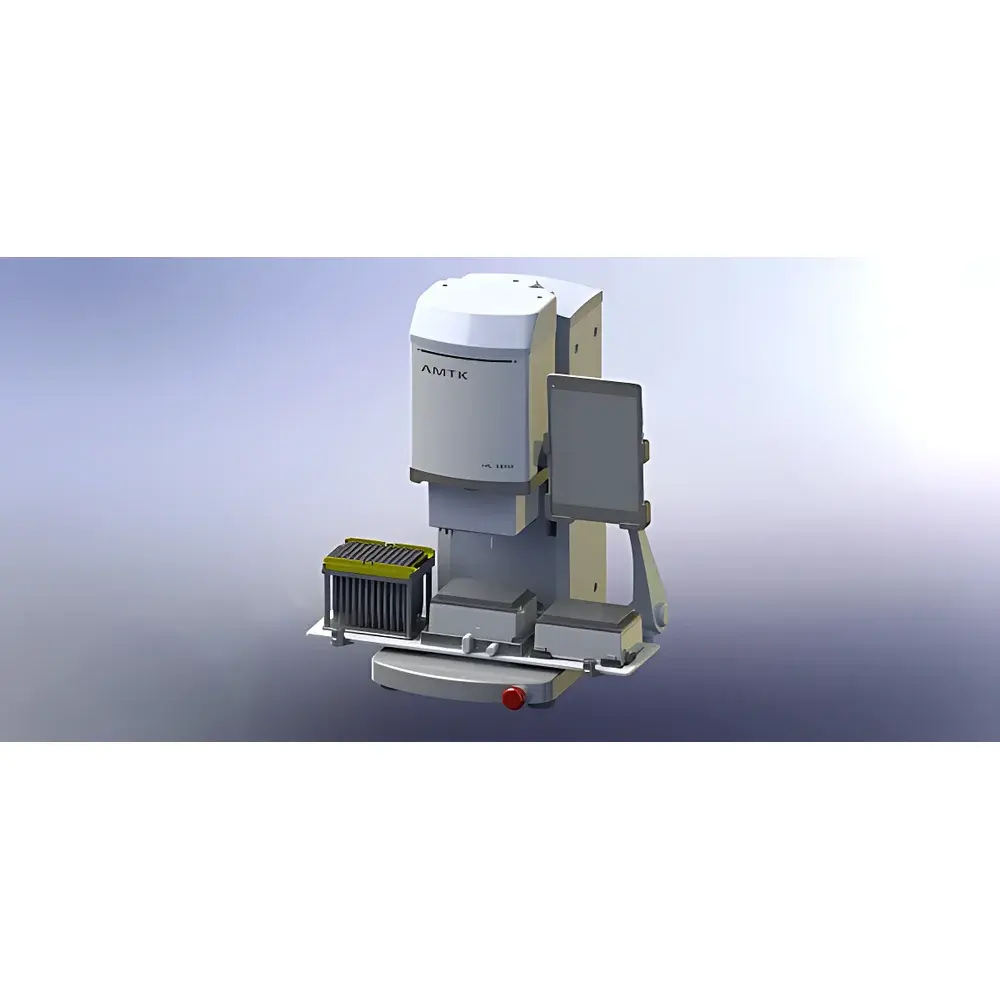
AMTK S-L Semi-Automatic Liquid Handling Workstation
| Brand | AMTK |
|---|---|
| Origin | Beijing, China |
| Manufacturer Type | Authorized Distributor |
| Country of Origin | China |
| Model | S-L |
| Plate Positions | 3 |
| Pipetting Accuracy | <5% CV at ≥2 µL |
| Pipetting Range | 0.5 µL – 1 mL |
| Sample Throughput | 96–192 samples per run |
| Dimensions (W×D×H) | 47 × 37 × 60 cm |
| Pipetting Precision | CV <10% at <1 µL |
| Compatible Tips | 10 µL, 30 µL, 70 µL, 250 µL, 1 mL |
| Operating Environment | 23 °C ±5 °C, Relative Humidity 10–90% non-condensing |
| Power Supply | 85–240 VAC, 50/60 Hz |
Overview
The AMTK S-L Semi-Automatic Liquid Handling Workstation is an engineered solution for reproducible, mid-throughput liquid dispensing and transfer in molecular biology, clinical diagnostics, and pharmaceutical quality control laboratories. Designed around a precision stepper-motor-driven Z-axis and calibrated air-displacement pipetting mechanism, the S-L operates on core principles of positive displacement and gravimetric calibration traceability—ensuring consistent aspiration and dispense performance across its full 0.5 µL to 1 mL range. Unlike fully automated platforms requiring script-based programming or robotic deck mapping, the S-L adopts a semi-automated paradigm: users manually position plates and initiate individual steps via intuitive tactile controls or optional PC interface, retaining full procedural oversight while eliminating repetitive manual pipetting fatigue. Its compact footprint (47 × 37 × 60 cm) enables seamless integration into biosafety cabinets, laminar flow hoods, or shared benchtop environments without compromising workflow continuity.
Key Features
- Three-position plate deck accommodates standard SBS-format microplates (96-well and 384-well), tube racks, and reservoirs—enabling sequential processing of source, intermediate, and destination vessels within a single setup.
- Selectably configurable pipetting heads: ST (single-tip), LT (low-volume tip), or XT (extended-tip) configurations support optimal dead-volume management and compatibility with industry-standard conical or filter tips (10 µL, 30 µL, 70 µL, 250 µL, and 1 mL).
- Calibrated volumetric accuracy validated per ISO 8655-2:2022: coefficient of variation (CV) ≤10% at volumes below 1 µL and ≤5% at volumes ≥1 µL, verified using gravimetric measurement under controlled environmental conditions (23 °C ±5 °C, RH 10–90% non-condensing).
- No embedded operating system or proprietary scripting language required—operation is initiated via front-panel buttons or optional USB-connected software, minimizing validation burden for GLP/GMP-regulated environments.
- Modular upgrade path: Optional accessories—including barcode readers, temperature-controlled plate holders, and auto-tip-detection modules—allow functional expansion without hardware replacement.
Sample Compatibility & Compliance
The S-L supports aqueous buffers, viscous glycerol solutions (up to 40% v/v), diluted serum matrices, and low-concentration nucleic acid preparations—provided surface tension and vapor pressure remain within ISO 8655-defined operational envelopes. Tip compatibility adheres to ANSI/SBS 1-2004 dimensional standards, ensuring mechanical interoperability with consumables from major global suppliers. While not pre-certified for FDA 21 CFR Part 11 compliance out-of-the-box, the workstation’s deterministic control logic, audit-ready event logging (when used with optional software), and user-accessible calibration records support laboratory-developed validation protocols aligned with ISO/IEC 17025 and CLIA requirements.
Software & Data Management
The optional PC-based control software provides protocol templating, step-by-step execution logging, and exportable CSV reports containing timestamped aspirate/dispense events, tip usage counters, and environmental metadata. All data files are stored locally with no cloud dependency—maintaining full data sovereignty. Software-generated logs include operator ID fields, version-stamped method files, and checksum-verified configuration backups, facilitating internal audits and regulatory inspections. No administrative privileges or network connectivity are required for basic operation, reducing cybersecurity exposure in isolated lab networks.
Applications
- Pre-analytical sample normalization for qPCR and NGS library preparation workflows.
- Serial dilution series generation in ELISA assay development and reference standard preparation.
- High-reproducibility reagent aliquoting for cell culture media formulation and cryopreservation buffer assembly.
- QC testing of raw material consistency in biomanufacturing environments where batch-to-batch variability must be tracked against SOP-defined acceptance criteria.
- Teaching laboratories requiring robust, serviceable instrumentation that demonstrates fundamental liquid handling principles without abstraction layers.
FAQ
Is the S-L compatible with third-party tips?
Yes—the pipetting head conforms to ANSI/SBS 1-2004 tip geometry specifications, enabling reliable engagement with tips from Eppendorf, Gilson, USA Scientific, and other ISO-compliant manufacturers.
Can I validate the system for GxP use?
Absolutely. The S-L’s mechanical design, documented calibration procedures, and deterministic response to user inputs provide a foundation for IQ/OQ/PQ protocols. Full validation documentation templates are available upon request from AMTK’s technical support team.
What maintenance is required?
Quarterly visual inspection of Z-axis belt tension, annual gravimetric verification of pipetting performance, and routine cleaning of tip ejector mechanisms per manufacturer guidelines—no scheduled firmware updates or cloud-dependent diagnostics.
Does it support 384-well plate processing?
Yes—when configured with the XT pipetting head and appropriate tip adapters, the S-L achieves accurate dispensing across 384-well formats at volumes ≥2 µL.
Is power supply compatible with international voltage standards?
Yes—the integrated universal switching power supply accepts 85–240 VAC at 50/60 Hz, eliminating the need for external transformers in EU, UK, APAC, and North American installations.



