
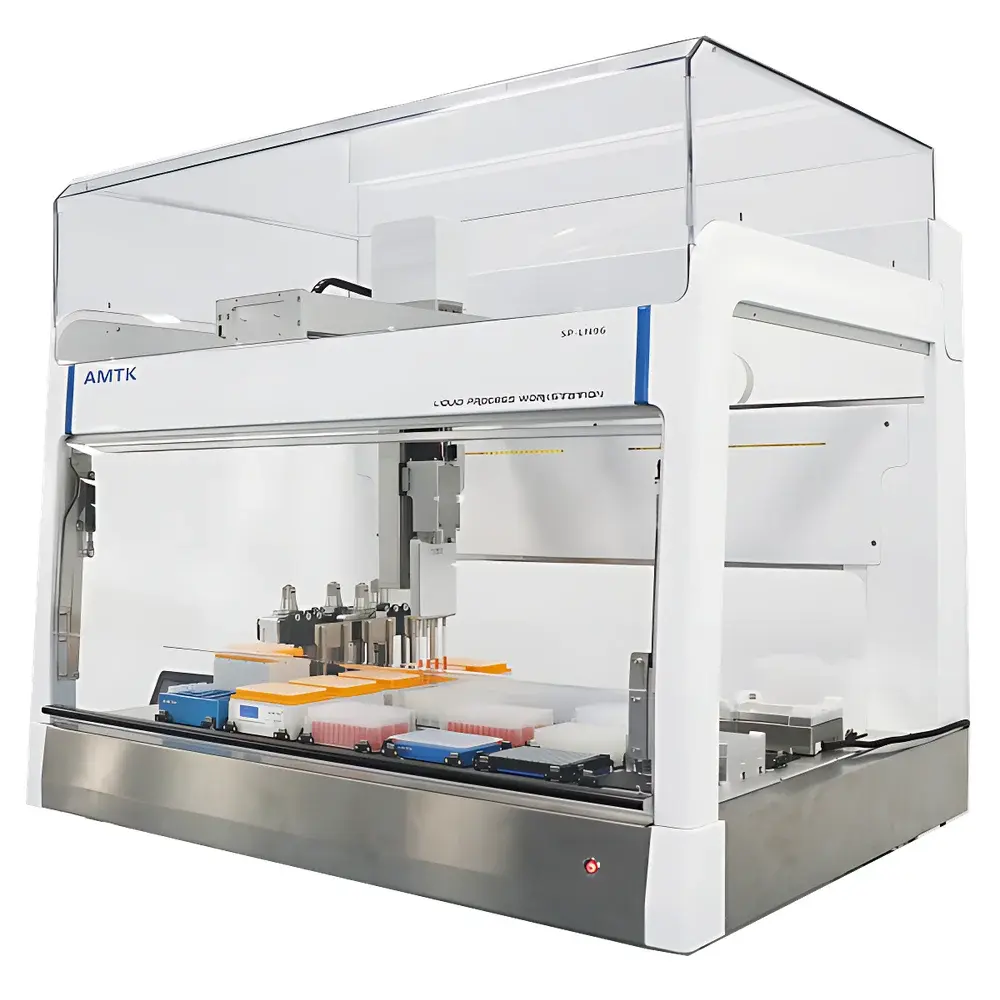
AMTK SP-LN96 NGS Library Preparation Workstation
| Brand | AMTK |
|---|---|
| Origin | Jiangsu, China |
| Manufacturer Type | Authorized Distributor |
| Country of Origin | China |
| Model | SP-LN96 |
| Instrument Category | NGS Library Construction System |
| Library Construction Type | Automated NGS Library Prep Platform |
| Liquid Handling Range | 0.5–1000 µL |
| Channel Configurations | 1/4/8/16/32-channel pipetting heads |
| Pipetting Precision | CV ≤5% at 1 µL |
| Integrated Modules | Barcode Scanner + Ultrasonic Liquid Level Detection, Heating & Vortexing Module, Magnetic Separation Module, Hematocrit Disc Module, Three-Zone Temperature-Controlled Enclosure (6–110 °C), Air-Driven Positive Displacement Pipetting System |
| Software | Embedded modular control with breakpoint resume, SBS-compliant and non-SBS layout support, liquid class calibration, real-time liquid level feedback loop |
| Compliance Ready | Designed for GLP/GMP-aligned workflows |
Overview
The AMTK SP-LN96 NGS Library Preparation Workstation is an integrated, benchtop-scale automation platform engineered for end-to-end nucleic acid library construction in next-generation sequencing (NGS) workflows. It operates on a positive displacement air-injection pipetting principle—eliminating reliance on air cushions or variable surface tension effects—to deliver high reproducibility across viscous, volatile, or low-volume samples (0.5–1000 µL). Unlike conventional robotic liquid handlers that enforce rigid SBS footprint constraints, the SP-LN96 features a reconfigurable 30-position deck architecture, enabling flexible integration of functional modules—including barcode scanning, ultrasonic liquid level detection, magnetic bead separation, hematocrit-based plasma isolation, and a patented three-zone thermal enclosure—without compromising positional accuracy or throughput scalability. The system is validated for direct tube-to-plate and plate-to-plate transfers from primary collection tubes (e.g., EDTA, serum, or PAXgene tubes), minimizing manual intervention and reducing carryover risk in sensitive molecular applications such as cfDNA library prep, targeted panel enrichment, and single-cell RNA-seq sample indexing.
Key Features
- Modular deck design supporting up to 30 standard or custom-configured positions, accommodating diverse module combinations including heating/vortexing, magnetic separation, and hematocrit disc units.
- Multi-channel pipetting head options (1/4/8/16/32) with unified mechanical interface—enabling automated tool loading/unloading via robotic arm under software control.
- Ultrasonic liquid level detection synchronized with 1D/2D barcode scanning in a single compact module; real-time height data acquisition enables dynamic aspiration depth adjustment and prevents under-aspiration or tip crash.
- Four-tube leveling mechanism: calculates reference meniscus height across a quartet of sample tubes and actuates individual lift stages to align all four liquid surfaces prior to simultaneous multi-channel aspiration—critical for consistent recovery in low-volume blood-derived samples.
- Three-zone temperature-controlled enclosure (Patent No. ZL201810277127.1): Zone 1 maintains ambient conditions; Zone 2 regulates between 6 °C and ambient for cold enzyme storage; Zone 3 provides precise incubation from ambient to 110 °C in a sealed chamber—ideal for enzymatic fragmentation, A-tailing, adapter ligation, and PCR amplification steps.
- Air-driven positive displacement pipetting system with hardened alloy barrels and wear-resistant coating ensures long-term mechanical stability and minimal maintenance intervals.
- Custom-manufactured, QC-validated pipette tips designed for zero residual volume, leak-free dispensing, and optimal tip-fit consistency across all channel configurations.
Sample Compatibility & Compliance
The SP-LN96 accepts primary sample containers—including 13 mm × 100 mm EDTA tubes, 16 mm × 100 mm serum tubes, and PAXgene Blood RNA tubes—without decanting or secondary transfer. Its hematocrit disc module employs CCD-based optical imaging to identify and exclude leukocyte layers during plasma aspiration, ensuring high-purity supernatant recovery. For NGS library prep, the platform supports input materials ranging from fragmented genomic DNA (≥50 ng) to low-input FFPE extracts and cell-free DNA (as low as 1 ng). All firmware and software modules are architected to support configurable audit trails, electronic signatures, and session logging—laying the foundation for compliance with ISO/IEC 17025, CLIA, CAP, and FDA 21 CFR Part 11 requirements when deployed in regulated environments. While not pre-certified, the system’s architecture allows integration into laboratory information management systems (LIMS) and alignment with GLP/GMP documentation standards through user-defined SOP templates and version-controlled protocol libraries.
Software & Data Management
The embedded control software utilizes a nested modular framework: core motion control, liquid class calibration, and module-specific drivers operate independently yet interlock seamlessly during runtime. Users define liquid classes based on viscosity, volatility, and surface tension—adjusting acceleration profiles, blow-out volumes, and touch-off parameters to optimize transfer fidelity. Deck layout is defined visually via drag-and-drop interface; non-SBS-compatible fixtures (e.g., custom tube racks or microcentrifuge adapters) are supported through coordinate-based positioning. Real-time liquid level feedback triggers adaptive path planning—e.g., lowering aspiration height as volume depletes—and automatically logs deviations for post-run review. The breakpoint resume function preserves pipetting coordinates, thermal setpoints, and module states following power interruption or emergency stop, allowing uninterrupted continuation without manual recalibration. Exportable log files include timestamped events, error codes, and raw sensor outputs—compatible with third-party analytics platforms for trend analysis and preventive maintenance scheduling.
Applications
- Automated NGS library construction: shearing (via integrated Covaris-compatible acoustic module or enzymatic fragmentation), end-repair, A-tailing, adapter ligation, size selection (magnetic bead-based), and index PCR—all executed in sequence on a single platform.
- High-throughput qPCR assay setup: direct transfer from primary tubes to 96- or 384-well plates with integrated thermal cycler module, including probe-based master mix dispensing and template addition with cross-contamination safeguards.
- Plasma and PBMC isolation: combined use of hematocrit disc and magnetic separation modules enables fully automated plasma harvesting, buffy coat extraction, and CD4+ T-cell enrichment prior to RNA/DNA extraction.
- Enzyme reaction profiling: multi-step kinetic assays requiring precise temperature ramping, mixing, and timed reagent addition—leveraging the three-zone thermal enclosure and vortex-heating module.
- CRISPR guide RNA library normalization: accurate low-volume (≤2 µL) dilution series generation across 96-well formats using calibrated 1-channel or 8-channel heads with liquid class optimization for DMSO-containing stocks.
FAQ
Does the SP-LN96 support integration with third-party LIMS or ELN systems?
Yes—the workstation exposes RESTful API endpoints for bidirectional communication with LIMS, ELN, and instrument tracking systems. Protocol initiation, status polling, and result export can be triggered programmatically.
Can the system handle viscous samples such as glycerol-stored bacterial lysates or protein-rich plasma?
Yes—liquid class calibration allows users to define custom aspiration/dispense parameters for high-viscosity fluids, including delayed dispense timing, reduced speed profiles, and increased blow-out pressure.
Is the three-zone thermal module compatible with standard PCR plates and deep-well plates?
Yes—both 96-well PCR plates (semi-skirted or full-skirted) and 96-well deep-well plates (up to 2.2 mL capacity) fit within Zone 3’s heated chamber; Zone 2 accommodates 1.5 mL microcentrifuge tubes and 24-position rack formats.
What validation documentation is provided for installation qualification (IQ) and operational qualification (OQ)?
AMTK supplies a comprehensive IQ/OQ protocol template aligned with ISO 8655-6 and CLSI EP15-A3 guidelines, including test scripts for pipetting accuracy, temperature uniformity mapping, barcode read reliability, and liquid level detection repeatability.
How frequently must the pipetting system be recalibrated?
Under normal usage (≤8 hrs/day, ambient lab conditions), recalibration is recommended every 6 months—or after any mechanical service event—using gravimetric verification per ISO 8655-6 Annex B procedures.
Related Products





