
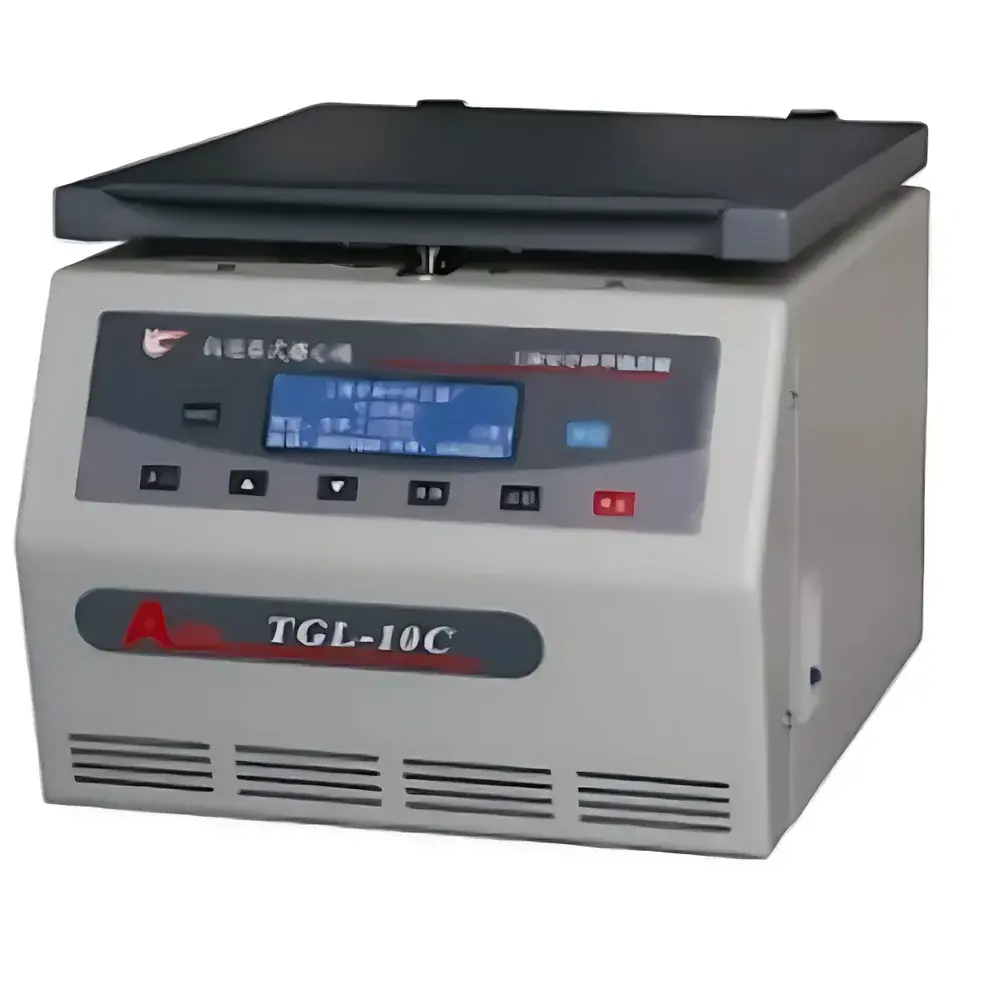
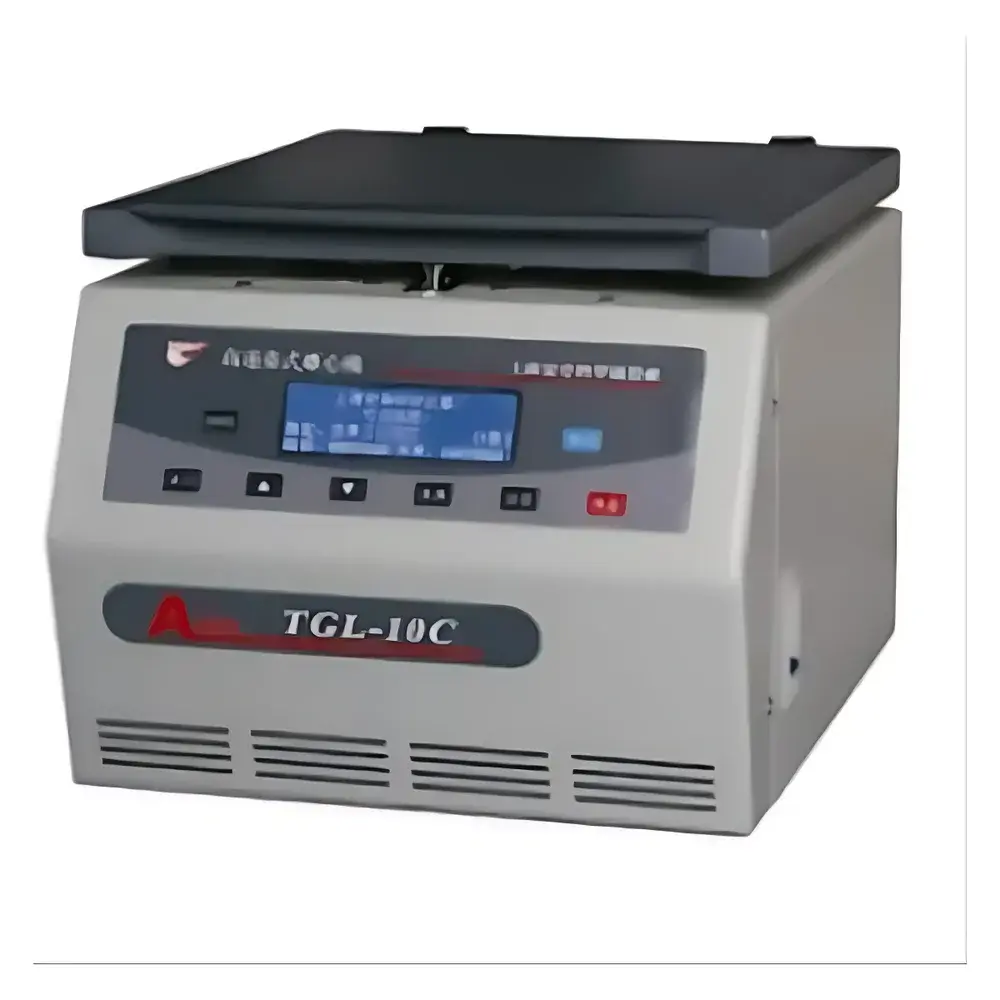
An亭 TGL-10C High-Speed Benchtop Centrifuge
| Brand | Anting |
|---|---|
| Origin | Shanghai, China |
| Model | TGL-10C |
| Type | Benchtop Centrifuge |
| Category | High-Speed Centrifuge (10,000–30,000 rpm) |
| Max Speed | 10,000 rpm |
| Max RCF | 8,950 ×g |
| Max Capacity | 50 mL × 6 (Angle Rotor) / 100 mL × 4 (Angle Rotor) |
| Timer Range | 0–99 min |
| Power Supply | 220 V, 50 Hz, 400 VA |
| Dimensions (L×W×H) | 620 × 420 × 385 mm |
| Weight | 57 kg |
| Rotor Configurations | Five interchangeable angle rotors (1.5/2 mL × 12 |
| Drive System | Frequency-Controlled Motor |
| Safety | Electronic Door Lock |
| Construction | Reinforced Polymer Housing |
Overview
The Anting TGL-10C High-Speed Benchtop Centrifuge is an engineered solution for routine and demanding separation tasks in life science laboratories, quality control environments, and applied research settings. Designed around a precision frequency-controlled induction motor and rigid polymer-reinforced chassis, the TGL-10C delivers stable rotational dynamics up to 10,000 rpm with a maximum relative centrifugal force (RCF) of 8,950 ×g—sufficient for pelleting mammalian cells, precipitating nucleic acids, clarifying crude lysates, and separating subcellular organelles. Its benchtop footprint (620 × 420 × 385 mm) and 57 kg mass ensure operational stability without requiring floor mounting, while the electronic interlocked lid prevents accidental operation during rotor acceleration or deceleration—complying with IEC 61010-2-020 safety requirements for laboratory centrifuges.
Key Features
- Frequency-controlled AC motor enabling precise speed regulation across the full 0–10,000 rpm range with ±50 rpm speed accuracy at setpoint
- Five standardized angle rotor options pre-calibrated for RCF consistency: 1.5/2 mL × 12 (6,037 ×g), 5 mL × 12 (6,820 ×g), 10 mL × 12 (8,950 ×g), 50 mL × 6 (7,012 ×g), and 100 mL × 4 (3,824 ×g)
- Microprocessor-based timer with 1-minute resolution and automatic brake release after run completion
- Reinforced polymer housing providing structural rigidity, vibration damping, and chemical resistance to common lab solvents
- Electronic door lock system with mechanical override and status LED indicator—prevents lid opening during operation and enforces safe rotor deceleration protocols
- Low-noise operation (<65 dB[A] at 1 m distance) achieved through balanced rotor coupling and optimized airflow design
Sample Compatibility & Compliance
The TGL-10C supports standard polypropylene, polycarbonate, and stainless-steel centrifuge tubes conforming to ISO 8573-1 (compressed air purity) and ASTM D4169 (transport packaging performance). All rotors are certified per ISO 15195:2019 for centrifuge rotor validation, including fatigue life assessment under cyclic loading at maximum rated speed. The unit meets CE marking requirements under the EU Machinery Directive 2006/42/EC and EMC Directive 2014/30/EU. While not FDA 21 CFR Part 11–compliant out-of-the-box (lacking audit trail or electronic signature functionality), its operational parameters—including speed, time, and rotor ID—are manually recordable in GLP/GMP-compliant logbooks. Routine maintenance intervals follow ISO/IEC 17025:2017 guidelines for calibration traceability of rotational speed and timer accuracy.
Software & Data Management
The TGL-10C operates via embedded firmware without external software dependency. All user inputs—including speed (rpm), time (min), and rotor selection—are stored in non-volatile memory for repeat-run recall. No USB, Ethernet, or Bluetooth interfaces are integrated; data export is manual via handwritten logs or external camera-based documentation. For laboratories requiring digital integration, third-party LIMS-compatible data capture can be implemented using programmable logic controllers (PLCs) interfaced via dry-contact relay outputs (optional accessory). Firmware updates are performed exclusively by authorized Anting service engineers using proprietary diagnostic hardware.
Applications
- Cell culture processing: Harvesting suspension-adapted CHO or HEK293 cells at 1,500–3,000 ×g for downstream lysis or cryopreservation
- Molecular biology workflows: Pellet recovery of plasmid DNA from alkaline lysis supernatants (≥10,000 ×g, 10 min, 4 °C)
- Clinical diagnostics: Serum/plasma separation from whole blood using 10 mL conical tubes (3,000 ×g, 10 min)
- Environmental testing: Concentration of microplastics or microbial aggregates from aqueous samples using 50 mL polypropylene tubes
- Pharmaceutical QC: Clarification of protein formulations prior to HPLC or DLS analysis (8,000 rpm, 50 mL rotor, 4 °C)
FAQ
What is the maximum allowable imbalance tolerance for the TGL-10C?
The maximum permissible load imbalance is ±0.5 g per tube position when using symmetrically loaded angle rotors—verified during factory balancing per ISO 21501-4.
Can the TGL-10C operate continuously for extended periods?
Yes, with mandatory 15-minute cooldown intervals after every 60 minutes of continuous operation at ≥8,000 rpm to maintain thermal stability of the motor windings and bearing assembly.
Are rotor certificates provided with each unit?
Each rotor ships with a serialized calibration certificate indicating nominal RCF values at specified speeds, traceable to NIM (National Institute of Metrology, China) standards.
Is refrigeration available as an option?
No. The TGL-10C is a non-refrigerated model. Ambient temperature operation (10–32 °C) is required; sample pre-chilling is recommended for thermolabile applications.
Does the unit support rotor auto-detection?
No. Rotor identification is manual—users must select the correct rotor profile from the front-panel menu to ensure accurate RCF calculation and speed limitation enforcement.



