
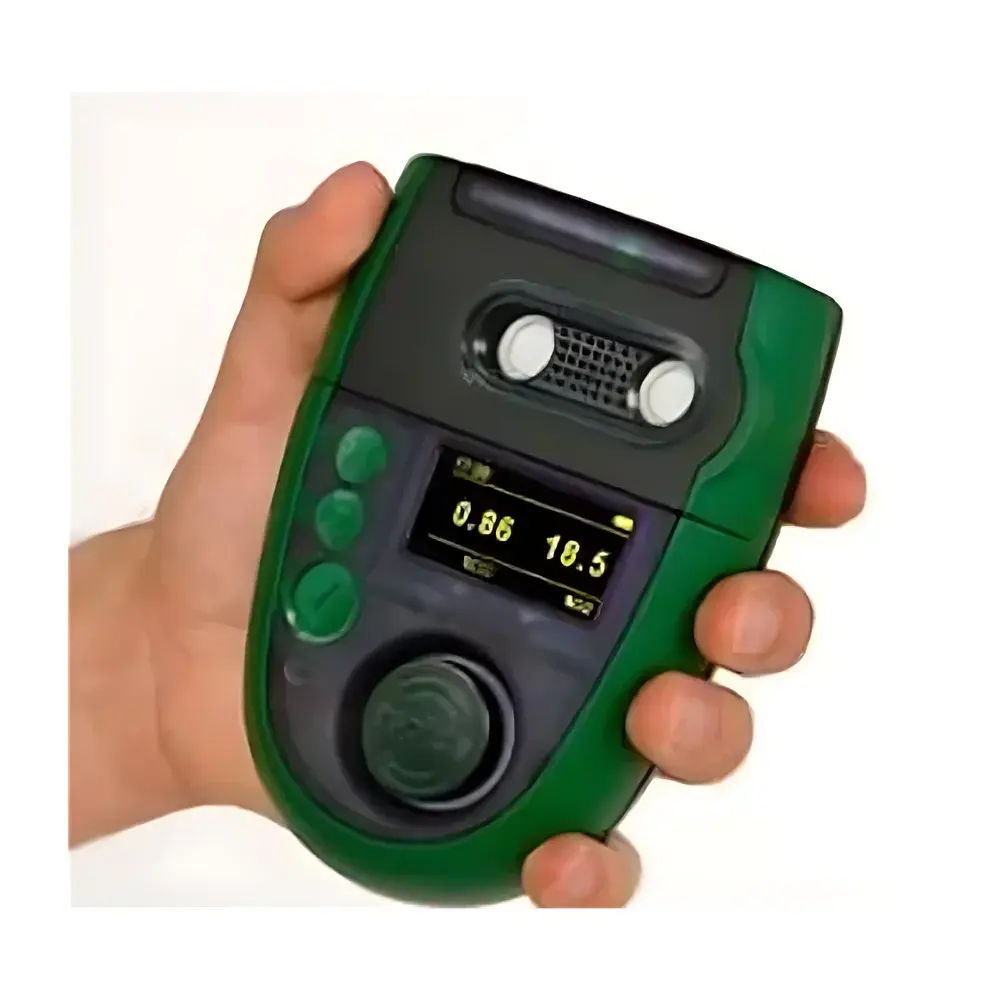
Analox Aspida O2 Personal Oxygen Monitor
| Brand | Analox |
|---|---|
| Origin | United Kingdom |
| Model | Aspida O2 |
| Instrument Type | Portable |
| Sensor Range | 0.1–25% O₂ |
| Accuracy | ±0.0075% O₂ |
| Visual Alarm Indicators | 1× green (normal), 1× amber (fault), 3× red (alarm) |
| Audible Alarm | 95 dB @ 30 cm |
| Emergency Alarm | 110 dB @ 30 cm |
| Response Time (T90) | <30 s |
| Operating Temperature | −5 to +50 °C |
| IP Rating | IP65 |
| Dimensions | 127 × 44 × 90 mm |
| Weight | 355 g |
| Power | Dual-mode — rechargeable Li-ion battery or two standard AA alkaline cells |
| TWA Calculation | Yes |
| Vibration Alert | Yes |
| Multi-user Support | Up to 2 users with individual calibration & usage logs |
Overview
The Analox Aspida O₂ is a certified personal oxygen (O₂) monitor engineered for continuous, real-time detection of ambient oxygen concentration in occupational environments where oxygen deficiency poses an acute safety hazard. It operates on electrochemical sensing principles, utilizing a high-stability, temperature-compensated galvanic cell optimized for long-term reliability and low-drift performance in variable field conditions. Unlike fixed-point gas analyzers, the Aspida O₂ is designed as a wearable, intrinsically safe device compliant with IEC 60079-0 and ATEX Directive 2014/34/EU for use in potentially explosive atmospheres (Zone 1/21). Its primary function is to safeguard personnel in confined spaces—such as tanks, silos, tunnels, ship holds, and fermentation chambers—where inert gas purging, combustion, or microbial respiration may deplete ambient O₂ below the OSHA-defined safe threshold of 19.5% v/v.
Key Features
- Electrochemical O₂ sensor with factory-calibrated span and zero stability, delivering consistent accuracy across its full 0.1–25% measurement range.
- Dual-mode power architecture: supports both rechargeable lithium-ion battery operation and hot-swap capability with two standard AA alkaline cells—ensuring uninterrupted deployment during shift transitions or emergency battery replacement.
- Triple-stage visual alarm system: green LED indicates normal operation; amber signals sensor fault or calibration due date; three synchronized red LEDs activate during alarm events for immediate peripheral visibility.
- Multi-modal alerting: 95 dB audible alarm at 30 cm distance, tactile vibration feedback, and integrated emergency panic button triggering a 110 dB distress signal—designed to meet ISO 8570:2022 requirements for worker rescue signaling in low-audibility environments.
- Smart maintenance scheduling: embedded firmware tracks sensor age, exposure history, and calibration intervals, automatically prompting service actions via display and logging events to internal memory for GLP-compliant audit trails.
- Ruggedized housing rated IP65 for dust ingress protection and resistance to low-pressure water jets—validated per EN 60529, suitable for industrial outdoor and offshore applications.
Sample Compatibility & Compliance
The Aspida O₂ is intended for ambient air sampling only and is not designed for direct insertion into process streams or high-humidity (>95% RH) or corrosive gas environments without optional filtration. It complies with multiple international occupational health and safety standards, including EN 50104:2018 (oxygen deficiency detectors), BS EN 61000-6-2 (immunity), and BS EN 61000-6-3 (emissions). Device firmware supports time-weighted average (TWA) calculation over 8-hour and 15-minute reference periods in accordance with OSHA 29 CFR 1910.120 and EU Directive 2004/37/EC (carcinogens and mutagens). Data logging and user authentication features are structured to align with FDA 21 CFR Part 11 requirements for electronic records and signatures when used in pharmaceutical or biomanufacturing settings.
Software & Data Management
Data retrieval is performed via USB-C interface using Analox’s proprietary Aspida Configurator software (Windows-compatible), enabling download of timestamped O₂ concentration logs, alarm event histories, battery status reports, and sensor diagnostic metrics—including zero drift, span loss, and response decay trends. Each unit maintains independent user profiles for up to two operators, storing individual calibration dates, exposure summaries, and maintenance acknowledgments. All logged entries include cryptographic hash timestamps to prevent post-hoc modification—supporting traceability under ISO/IEC 17025:2017 clause 7.7.2 for accredited laboratories. Export formats include CSV and PDF for integration into enterprise EHS platforms.
Applications
- Confined space entry monitoring in oil & gas, utilities, and wastewater treatment facilities.
- Personal safety backup for workers performing nitrogen purging, CO₂ blanketing, or argon welding in fabrication shops.
- Biopharmaceutical cleanroom environmental monitoring during sterilization cycles involving inert gas sparging.
- Maritime cargo hold inspection prior to crew entry after fumigation or dry ice transport.
- Research laboratory support for hypoxic or hyperoxic chamber validation and operator safety oversight.
- Emergency response team deployment in fire-damaged structures where thermal decomposition may have consumed ambient oxygen.
FAQ
What is the recommended calibration frequency for the Aspida O₂?
Calibration is required before each day’s use (bump test) and full span calibration every 30 days—or immediately following exposure to O₂ concentrations outside 19–23% for >2 hours. The device logs all calibration events and warns users 72 hours prior to scheduled recalibration.
Can the Aspida O₂ be used in explosive atmospheres?
Yes—certified to ATEX II 2G Ex ib IIC T4 Gb and IECEx Ex ib IIC T4 Gb for Group II, Category 2G hazardous areas. It is approved for use in Zone 1 and Zone 21 locations where flammable gases or combustible dusts may be present.
Does the device support data export for regulatory reporting?
Yes—CSV exports include ISO 8601 timestamps, O₂ ppm equivalents, alarm activation flags, user ID, and firmware version. Audit logs retain 32,000+ events with tamper-evident hashing for compliance with HSE INDG384 and OSHA 1910.146 recordkeeping mandates.
Is the sensor replaceable by the end user?
No—the electrochemical sensor is sealed and field-replaceable only by authorized Analox service centers to maintain metrological integrity and certification validity.
How does the emergency alarm differ from the standard gas alarm?
The emergency alarm is manually triggered via dedicated panic button or auto-activated upon sustained motionlessness (>30 s), emitting a distinct 110 dB tone modulated at 2 Hz—differentiated acoustically and visually from standard O₂ deficiency alarms per EN 45545-2:2020 Annex D requirements.







