
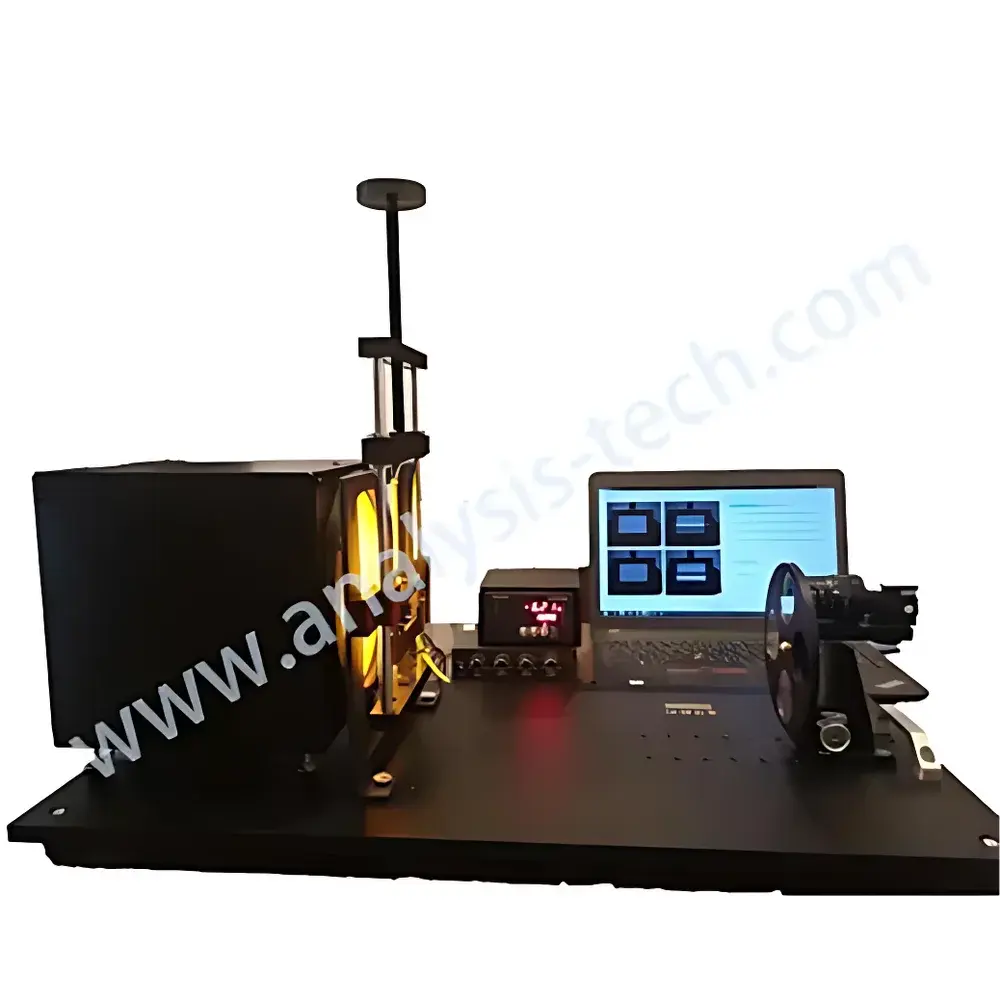
Analysis ANA6000P-H Horizontal Photoelastic Coefficient Tester
| Brand | Analysis |
|---|---|
| Origin | Beijing, China |
| Manufacturer Type | Authorized Distributor |
| Origin Category | Domestic (China-made) |
| Model | ANA6000P-H |
| Pricing | Available Upon Request |
| Test Area (Illumination Field) | 70–180 mm |
| Stress Birefringence Range | Basic Mode: λ/4 @ 630 nm (157.5 nm) |
| Enhanced Mode | 2296 nm (via dual-wavelength blue/green interferometry with phase unwrapping) |
| Stress Birefringence Resolution | 0.05 nm |
| Accuracy | ±0.5 nm |
| Photoelastic Coefficient Resolution | 0.1 nm·cm⁻¹·MPa⁻¹ |
| Accuracy | ±0.2 nm·cm⁻¹·MPa⁻¹ |
Overview
The Analysis ANA6000P-H Horizontal Photoelastic Coefficient Tester is a precision optical metrology instrument engineered for quantitative determination of the photoelastic coefficient (C) of transparent isotropic dielectric materials—primarily optical glasses, fused silica, PMMA, and polycarbonate models—under controlled mechanical loading. It operates on the fundamental principle of stress-induced birefringence combined with polarized light interferometry. When a photoelastic material is subjected to mechanical stress, it develops temporary anisotropy, resulting in a spatially varying phase retardation (ϕ) between orthogonal polarization components. This retardation is linearly proportional to the principal stress difference (σ₁ − σ₂) via the stress-optic law: ϕ = (2π/λ)·C·d·(σ₁ − σ₂), where λ is the illumination wavelength, d is specimen thickness, and C is the photoelastic coefficient in units of nm·cm⁻¹·MPa⁻¹. The ANA6000P-H implements this relationship rigorously using calibrated diametral compression of standardized circular discs (e.g., ASTM E1781-compliant geometry), enabling traceable, absolute measurement of C without reliance on reference standards. Its horizontal configuration minimizes gravitational sag and thermal convection artifacts inherent in vertical setups—critical for sub-nanometer retardation stability over extended acquisition periods.
Key Features
- Horizontal optical layout with rigid granite base and kinematic optical mounts, ensuring long-term alignment stability and minimizing vibration-induced phase noise.
- High-fidelity polarization optics: λ/20 surface flatness waveplates, extinction ratio > 10⁵:1 polarizers, and AR-coated broadband achromatic lenses optimized for 450–650 nm spectral range.
- Dual-mode illumination: Sodium D-line (589.3 nm) source for high-contrast monochromatic fringes; optional tunable LED or laser module (473 nm / 532 nm) for enhanced sensitivity and dual-wavelength phase unwrapping.
- Telecentric imaging path with f/5.6 aperture and 1:1 magnification, delivering diffraction-limited resolution across the full 180 mm field—enabling uniform pixel-level retardation calibration.
- Automated load-controlled compression stage with closed-loop force feedback (0.1 N resolution), synchronized with camera acquisition for time-resolved stress mapping.
- Incremental photoelastic coefficient calculation algorithm: computes C from multiple discrete load steps, rejecting zero-point drift and systematic offset errors inherent in single-point measurements.
Sample Compatibility & Compliance
The ANA6000P-H accommodates disc-shaped specimens (Ø 25–100 mm, thickness 3–25 mm), U-bend flexure bars, and custom-machined plastic models replicating structural geometries (e.g., turbine blades, gear teeth, bridge cross-sections). All sample holders conform to ISO 11475:2009 (optical plastics testing) and ASTM C1350M-18 (photoelastic analysis of glass). The system supports GLP-compliant operation: audit trails log user ID, timestamp, load history, calibration parameters, and raw interferogram metadata. Data files comply with HDF5 format (H5PY-compatible), embedding embedded calibration certificates per NIST SP 800-53 Rev. 5 requirements for scientific instrumentation integrity.
Software & Data Management
Bundled PhotoElastic Studio v4.2 provides full acquisition-to-report workflow: real-time fringe visualization, automatic isoclinic/isochromatic separation via Fourier transform demodulation, pixel-wise retardation mapping, and stress-optic inversion using user-defined material geometry and boundary conditions. Software enforces 21 CFR Part 11 compliance with electronic signatures, role-based access control (admin/operator/auditor profiles), and immutable audit logs. Export options include CSV (retardation vs. position), TIFF (8-/16-bit phase maps), and PDF reports containing test parameters, uncertainty budget (per GUM Guide to Uncertainty in Measurement), and annotated fringe diagrams with ISO/IEC 17025 traceability statements.
Applications
- Quantitative certification of optical glass batches (e.g., Schott BK7, Ohara S-BSL7) for lens manufacturing quality control.
- Validation of finite element models (FEM) in civil engineering—stress analysis of dam abutment analogs, arch dam segments, and reinforced concrete beam models under simulated hydrostatic loading.
- Residual stress mapping in tempered glass used in architectural façades and automotive glazing, per EN 12150-1.
- R&D of novel photoelastic polymers for additive manufacturing, where layer-by-layer residual stress governs part warpage and fatigue life.
- Educational use in advanced mechanics labs: direct visualization of stress singularities at crack tips, hole edges, and fillet transitions—complementing theoretical elasticity coursework (Timoshenko & Goodier).
FAQ
What is the minimum measurable photoelastic coefficient using the ANA6000P-H?
The system achieves a detection limit of 0.3 nm·cm⁻¹·MPa⁻¹ under optimal conditions (100 mm Ø disc, 10 MPa applied stress, 532 nm illumination), limited by photon shot noise and mechanical stability.
Can the instrument measure dynamic or cyclic loading?
Yes—when paired with the optional high-speed CMOS camera (100 fps) and programmable load controller, it supports quasi-static ramp-and-hold protocols up to 1 Hz frequency, suitable for creep and relaxation studies.
Is third-party calibration support available?
Analysis provides ISO/IEC 17025-accredited calibration services through partner metrology labs (e.g., NIM Beijing, PTB Braunschweig), including uncertainty budgets for both retardation and C-value outputs.
Does the software support batch processing of multiple specimens?
Yes—batch mode enables unattended sequential testing of up to 24 samples with auto-generated report templates, filename tagging, and QC pass/fail flagging based on user-defined C-tolerance thresholds.
How is thermal drift compensated during long-duration tests?
The optical bench incorporates passive thermal mass stabilization and real-time reference beam monitoring; software applies adaptive background subtraction using dark-field and zero-load baselines acquired every 15 minutes.



