
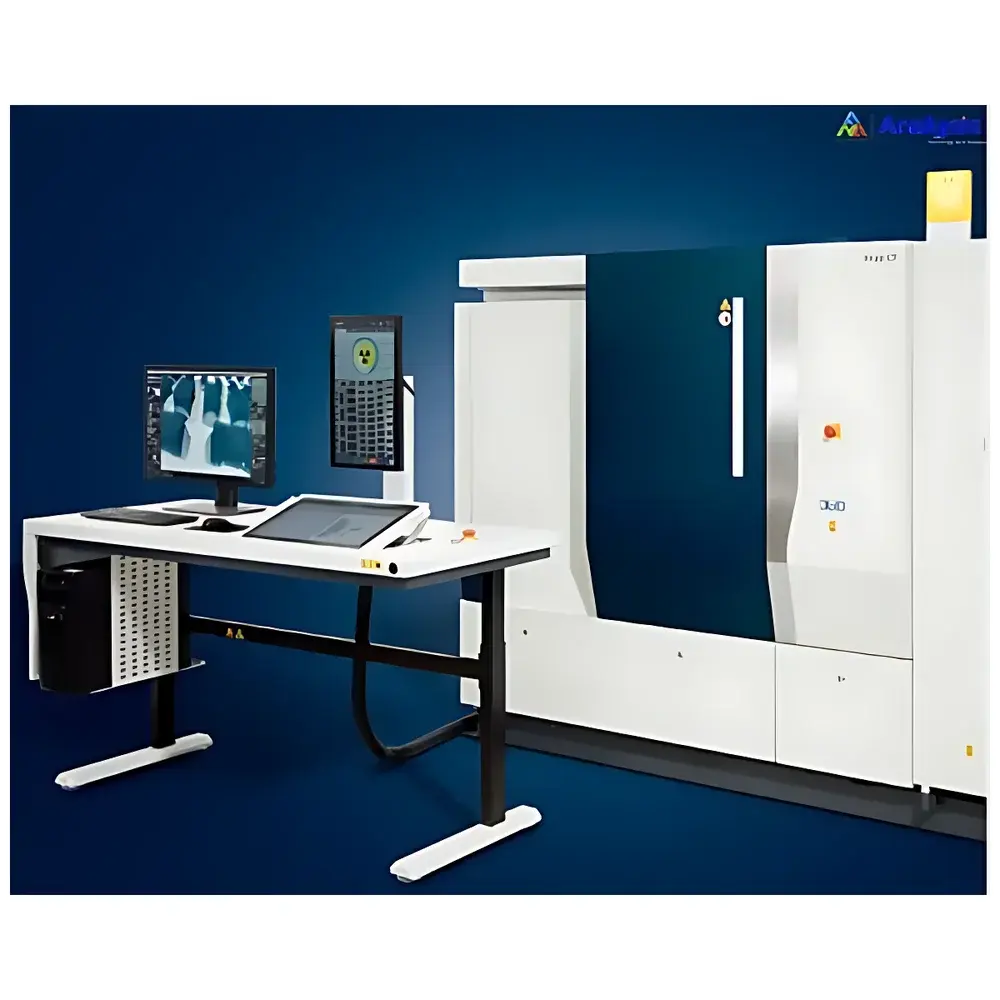
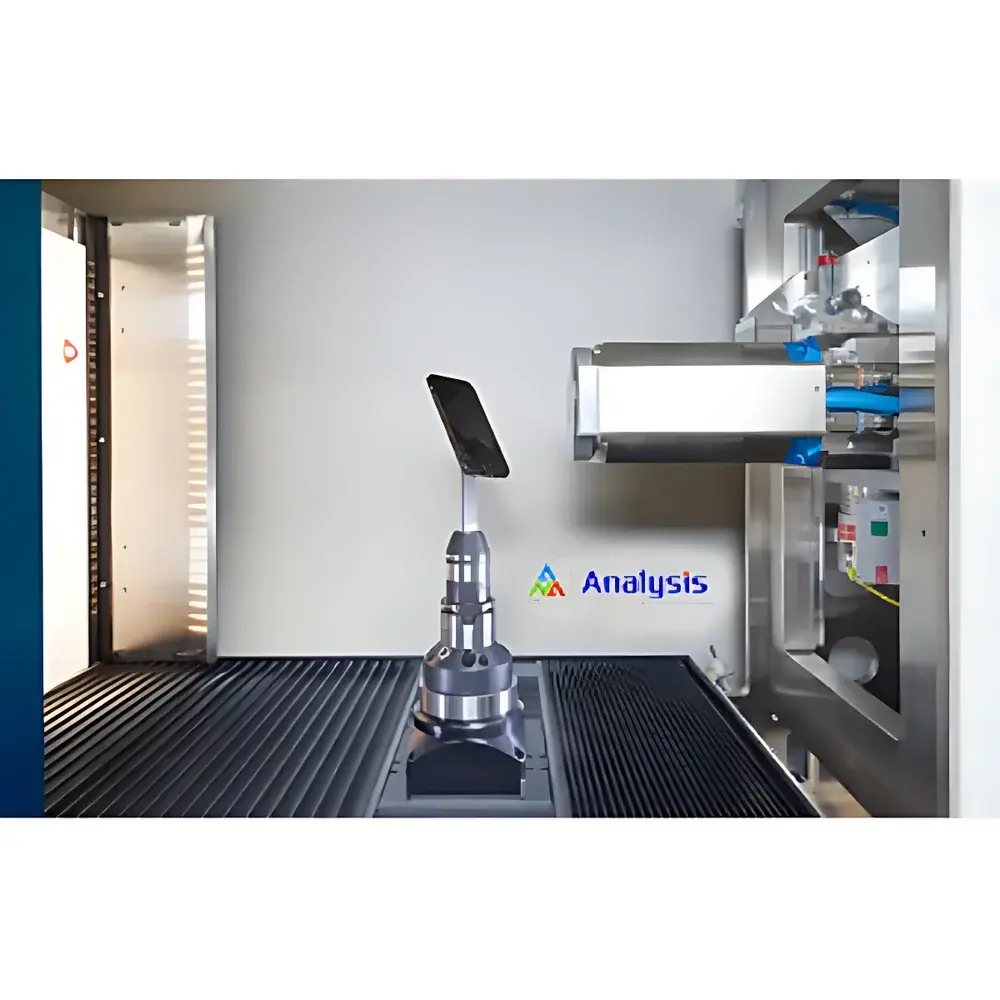
Analysis FF20 CT High-Resolution Industrial Micro-CT System
| Brand | Analysis |
|---|---|
| Origin | Germany |
| Manufacturer | Analysis GmbH |
| Type | Industrial Micro-CT System |
| Model | FF20 CT |
| Detector Type | Flat-Panel Detector |
| Scan Mode | Translation-Rotation (TR) |
| X-ray Source | 190 kV Water-Cooled Nanofocus Transmission Tube |
| Spatial Resolution (2D) | ≤150 nm |
| Sample Size Capacity | Small to Medium |
| System Dimensions | 2380 × 945 × 2180 mm |
| Base Material | Precision Granite |
| User Interface | Gemini Touchscreen GUI |
| Software Features | HeliExtend Spiral CT, Virtual Rotation Axis, Field-of-View Extension (Horizontal/Vertical), QuickScan & QualityScan Modes |
| Measurement Capabilities | Dimensional Metrology (CT-based GD&T), Defect Detection (<1 µm), Density Quantification, Assembly Verification, Porosity & Inclusion Analysis |
Overview
The Analysis FF20 CT is a high-resolution laboratory-grade industrial micro-computed tomography (micro-CT) system engineered for non-destructive 3D internal inspection, dimensional metrology, and materials characterization at sub-micron detail levels. Based on cone-beam X-ray computed tomography principles, the system employs a water-cooled 190 kV nanofocus transmission tube with an effective focal spot size adjustable across four power modes—enabling optimal trade-offs between flux, resolution, and thermal stability. Its rigid granite base minimizes mechanical drift and thermal expansion, ensuring long-term repeatability in both research and regulated quality assurance environments. Designed specifically for small-to-medium components—such as semiconductor packages, MEMS devices, battery cells, additively manufactured parts, and precision injection-molded assemblies—the FF20 CT delivers quantitative volumetric data compliant with international standards for non-destructive testing (NDT) and computed tomography metrology.
Key Features
- 190 kV water-cooled nanofocus transmission X-ray source with o-focus geometry, supporting 2D radiographic resolution down to ≤150 nm
- Thermally stable granite motion platform with ultra-low coefficient of thermal expansion (CTE < 2 µm/m·K), enabling sub-pixel registration accuracy over extended scan durations
- Flat-panel detector architecture optimized for high dynamic range and low electronic noise, facilitating high-fidelity reconstruction of low-contrast features
- Gemini touchscreen graphical user interface with intuitive symbol-based workflow navigation—designed for rapid operator ramp-up without specialized radiography training
- Advanced acquisition trajectories including HeliExtend spiral scanning, virtual rotation axis alignment, and horizontal/vertical field-of-view extension for flexible sample positioning
- Built-in metrology engine supporting ISO 10360-compliant CT-based dimensional analysis—including GD&T evaluation (position, concentricity, parallelism), wall thickness mapping, and porosity quantification
Sample Compatibility & Compliance
The FF20 CT accommodates a broad spectrum of non-radioactive, solid-state samples up to medium size (typical max Ø 200 mm × H 300 mm). It is routinely deployed for failure analysis of solder joints in SMD assemblies, void detection in molded plastic housings, fiber orientation assessment in CFRP laminates, and pore network characterization in metal AM builds. The system meets essential regulatory and technical requirements for industrial CT metrology: compliance with ASTM E1441 (Standard Guide for Computed Tomography Imaging), ISO/IEC 17025 (for accredited calibration labs), EN 16018 (Industrial CT for dimensional measurement), and supports audit-ready documentation per GLP/GMP frameworks. While not FDA 21 CFR Part 11–certified out-of-the-box, its software architecture allows integration with validated electronic signature and audit trail modules upon customer-specific qualification.
Software & Data Management
Data acquisition, reconstruction, visualization, and metrology are unified within the native Gemini software suite. Raw projection data is stored in DICOM-compliant format, while reconstructed volumes support standard formats including TIFF stack, NRRD, and VTK. The software includes automated beam hardening correction, ring artifact suppression, and iterative reconstruction algorithms (SART, OS-SART) for improved signal-to-noise ratio in dense or heterogeneous samples. Metrology workflows generate traceable reports with uncertainty budgets aligned to VDI/VDE 2630 Part 1.1 and ISO 15530-3 methodologies. All user actions—including parameter changes, reconstruction settings, and measurement annotations—are logged with timestamps and operator IDs, forming a complete digital chain-of-custody suitable for internal QA audits or external accreditation reviews.
Applications
- Failure analysis of electronic interconnects and encapsulated ICs
- Quantitative porosity and inclusion analysis in castings, sintered metals, and additive manufacturing parts
- Non-destructive validation of internal geometries in medical device components (e.g., catheter lumens, stent strut integrity)
- Material science investigations—including phase distribution in composites, crack propagation tracking, and grain boundary imaging
- Reverse engineering and digital twin generation via surface mesh export (STL, PLY) with sub-voxel surface fitting
- Process control feedback for powder bed fusion and binder jetting—monitoring layer-wise defect formation and density uniformity
FAQ
What is the minimum detectable defect size in metallic samples?
Defects smaller than 1 µm can be resolved in high-Z materials (e.g., copper, tungsten) under optimized acquisition conditions; typical practical detection limits for voids in aluminum alloys range from 2–5 µm depending on part geometry and contrast.
Does the FF20 CT support automated batch scanning?
Yes—via programmable macro sequences and hardware-triggered sample loading interfaces compatible with third-party robotic arms or turntable stages.
Can CT metrology results be used for PPAP submission?
Yes—when performed under documented procedures, calibrated against traceable reference standards, and reported with full uncertainty budgets per ASME Y14.41 and ISO 17025 guidelines.
Is the system suitable for in-situ or time-resolved CT experiments?
While primarily designed for static high-resolution scanning, optional motorized stage controllers and fast-frame detectors enable limited 4D CT studies (e.g., thermal cycling or compression tests) with temporal resolution down to ~30 seconds per volume.
How is system performance verified post-installation?
Analysis provides a comprehensive acceptance test protocol including spatial resolution verification using line-pair phantoms, dimensional accuracy checks with certified reference artifacts (e.g., NIST-traceable step gauges), and dose consistency measurements per IEC 61223-3-5.



