
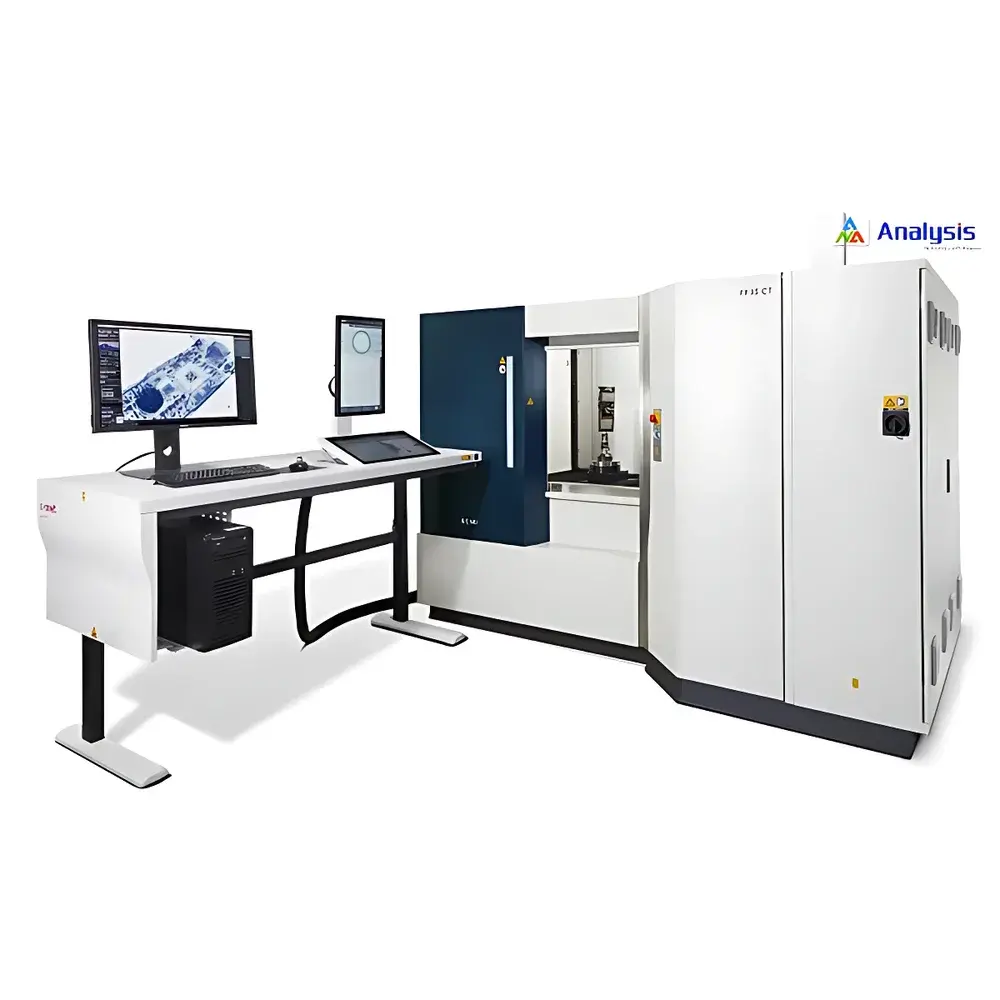
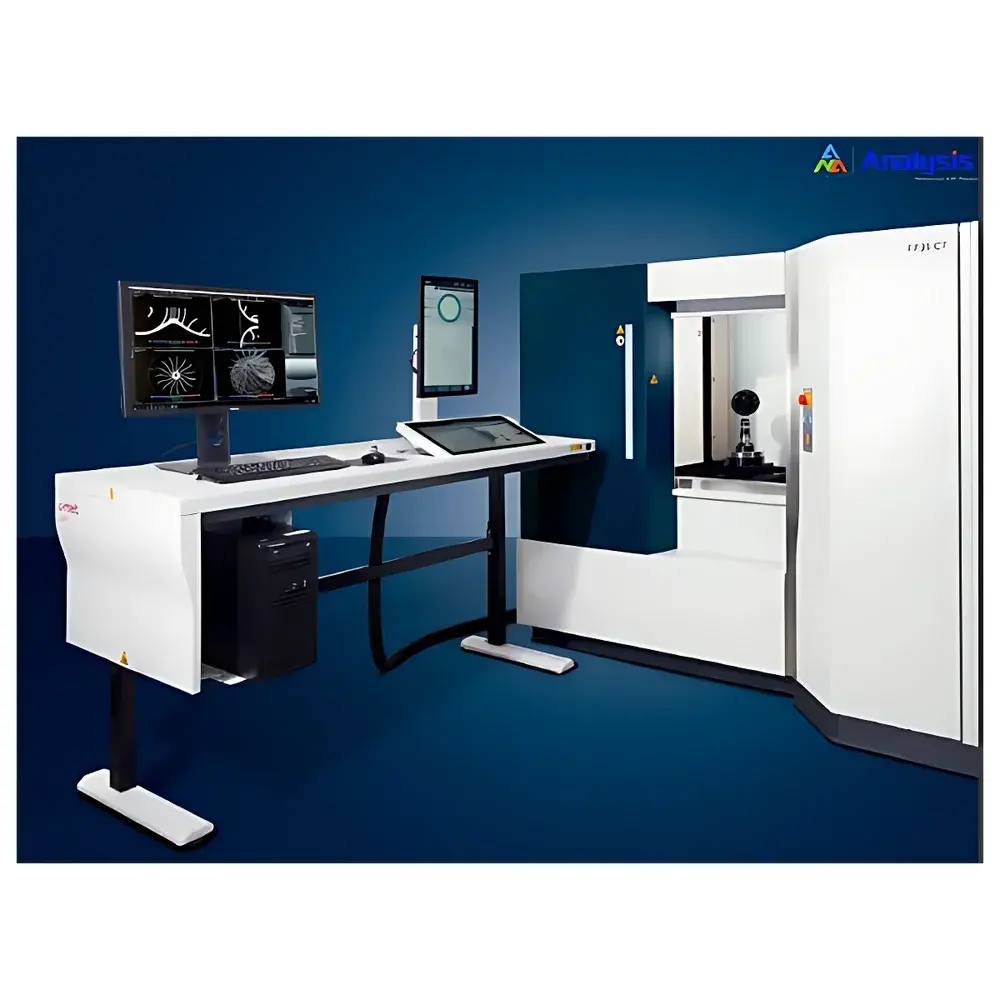
Analysis FF35 Industrial Micro-CT System
| Brand | Analysis |
|---|---|
| Origin | Germany |
| Model | FF35 |
| Detector Type | Flat-Panel Detector |
| Scan Mode | Translation-Rotation (TR) |
| X-ray Energy | 225 kV (microfocus) / 190 kV (nanofocus) |
| Maximum Penetration | 350 mm steel-equivalent |
| Spatial Resolution | up to 2.5 lp/mm |
| Density Resolution | up to 2.5 lp/mm |
| Measurement Accuracy (Metrology Version) | MPESD = 5.9 µm + L/75 [L in mm] |
| Sample Weight Capacity | up to 50 kg |
| Compliant Standards | SEMI® S2-0818, SEMI® S8-0218, VDI/VDE 2630 |
Overview
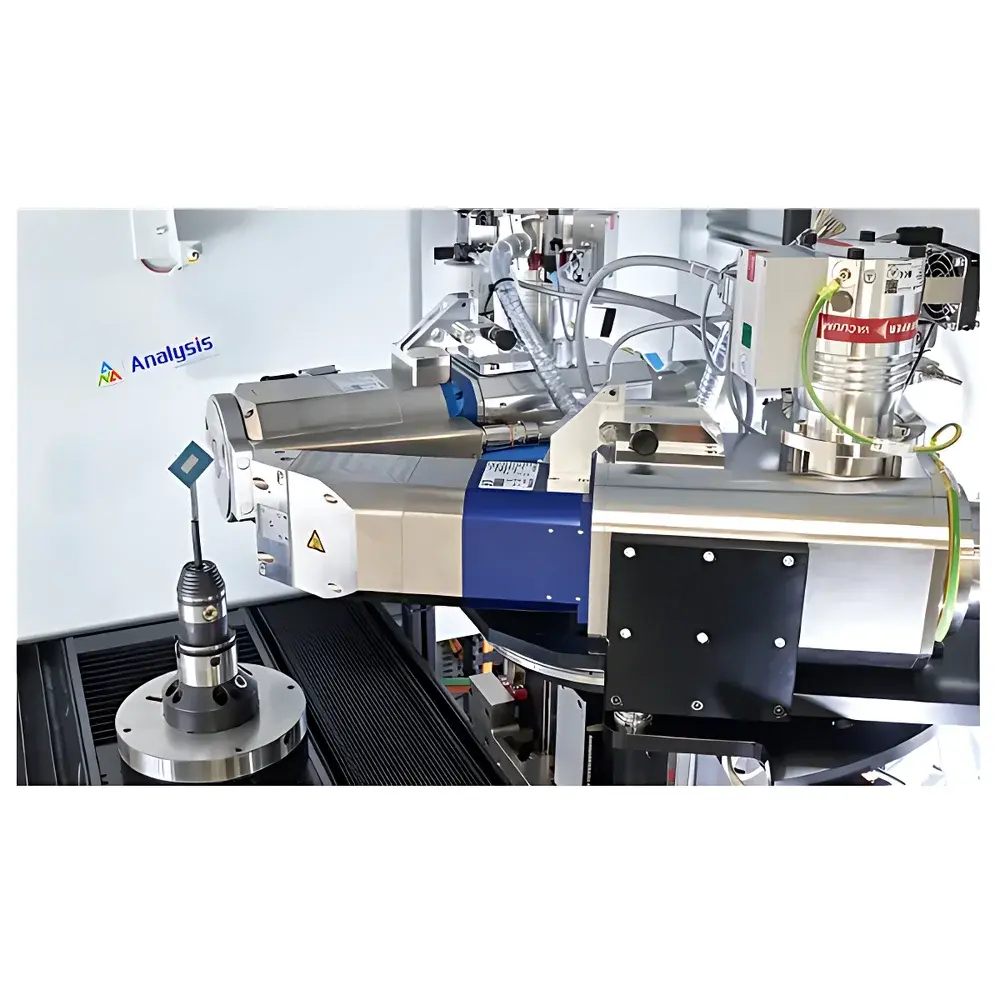
The Analysis FF35 Industrial Micro-CT System is a high-resolution, dual-source X-ray computed tomography platform engineered for precision non-destructive evaluation (NDE) and dimensional metrology in research and industrial quality assurance environments. Based on cone-beam CT reconstruction principles, the system employs a geometrically stable granite base, active thermal management, and dual independently powered X-ray sources — a 225 kV refractive microfocus tube (320 W, water-cooled anode) and a 190 kV transmission nanofocus tube — to deliver adaptive resolution across diverse sample geometries and material densities. Its core architecture supports both 2D radiography and full 3D volumetric reconstruction with isotropic voxel resolution down to sub-micrometer scale for small specimens (<10 mm), and robust penetration capability for larger components up to 350 mm steel-equivalent thickness. Designed for reproducible, traceable measurements under controlled laboratory conditions, the FF35 serves as a reference-grade instrument for failure analysis, internal defect quantification, assembly verification, and digital twin generation.
Key Features
- Dual X-ray source configuration: seamless, software-controlled switching between 225 kV microfocus and 190 kV nanofocus tubes — no hardware reconfiguration required
- Granite mechanical base with integrated temperature stabilization for long-term geometric stability and measurement repeatability
- Geminy software platform featuring intuitive graphical workflow navigation, automated scan planning, and trajectory flexibility including HeliExtend (helical CT), FoV extension (horizontal/vertical), virtual rotation axis definition, and QuickScan/QualityScan protocols
- Metrology-grade variant compliant with VDI/VDE 2630 Part 1.1 for dimensional inspection of internal features; certified MPESD = 5.9 µm + L/75 (L in mm)
- SEMI®-certified FF35 CT SEMI version meeting SEMI S2-0818 (safety) and SEMI S8-0218 (environmental stress) requirements for semiconductor cleanroom integration
- Flat-panel detector with high dynamic range and low electronic noise, optimized for both high-contrast defect detection and quantitative density mapping
- Maximum sample handling capacity of 50 kg, supporting small, medium, and large industrial parts without compromise in spatial fidelity
Sample Compatibility & Compliance
The FF35 accommodates a broad spectrum of industrial and scientific samples: electronic assemblies (SMD, PCBs, power modules), additively manufactured metal and polymer components, lithium-ion battery cells and modules, injection-molded plastics, MEMS/MOEMS devices, medical catheters and implants, light-alloy castings, geological cores, fossil specimens, and biological tissue samples. Its radiation hardening, shielding design, and interlocked enclosure meet IEC 61000-6-3 (EMC) and IEC 61000-6-4 standards. The SEMI-certified variant satisfies stringent cleanroom compatibility requirements, including particle shedding control and electrostatic discharge (ESD) mitigation. All configurations support audit-ready operation per GLP/GMP frameworks, with optional FDA 21 CFR Part 11-compliant electronic signature and data integrity modules available through Geminy software licensing.
Software & Data Management
Geminy provides end-to-end CT workflow management — from geometry-based scan parameterization and real-time projection monitoring to iterative reconstruction (FDK, SART), multi-scale segmentation, and quantitative analysis. It natively exports DICOM, STL, and VTK formats, and integrates with third-party metrology suites (e.g., PolyWorks, VGStudio MAX) via open API. Raw projection data and reconstructed volumes are stored with embedded metadata (scan parameters, calibration logs, operator ID, timestamp), enabling full traceability. The Metrology version includes nominal-actual comparison tools with GD&T annotation, statistical process control (SPC) charting, and automated report generation compliant with ISO 17025 documentation requirements. All data archives support AES-256 encryption and role-based access control.
Applications
- Failure analysis: void, crack, porosity, and delamination detection at <1 µm scale in composites, solder joints, and ceramic substrates
- Dimensional metrology: internal feature measurement (wall thickness, hole position, coaxiality) without sectioning or CMM probe interference
- Process validation: monitoring powder bed fusion consistency, binder jetting density gradients, and thermal distortion in heat-treated castings
- Assembly verification: confirmation of component presence, orientation, and clearance in sealed housings (e.g., automotive actuators, aerospace valves)
- Material characterization: phase distribution analysis in multiphase alloys, fiber orientation mapping in CFRP, and pore network modeling in battery electrodes
- Digital archiving: creation of permanent, searchable 3D reference models for legacy part reverse engineering and regulatory submission packages
FAQ
What is the minimum detectable defect size in metallic samples?
Sub-micrometer defects are resolvable in samples ≤10 mm using the 190 kV nanofocus tube; for larger steel-equivalent parts (up to 350 mm), detectability follows ASTM E2737 guidelines and depends on contrast-to-noise ratio, typically ≥50 µm under standard acquisition protocols.
Does the FF35 support automated batch scanning for production line integration?
Yes — optional conveyor-integrated fixtures and PLC-triggered scan sequences are available; Geminy supports OPC UA connectivity for MES/SCADA synchronization.
Is calibration traceable to national standards?
All metrology configurations include factory calibration against NIST-traceable step gauges and sphere artifacts; on-site recalibration services follow VDI/VDE 2630 procedures.
Can the system perform in-situ mechanical testing during CT scanning?
Mechanical loading stages (tensile, compression, thermal) are supported as modular add-ons; synchronization with projection acquisition is managed via TTL triggers and time-resolved reconstruction pipelines.
What training and support options are included with purchase?
Standard delivery includes two-day on-site operator certification, one-year comprehensive software maintenance, and priority remote diagnostics; extended service contracts cover preventive maintenance, source replacement, and annual performance verification.



