
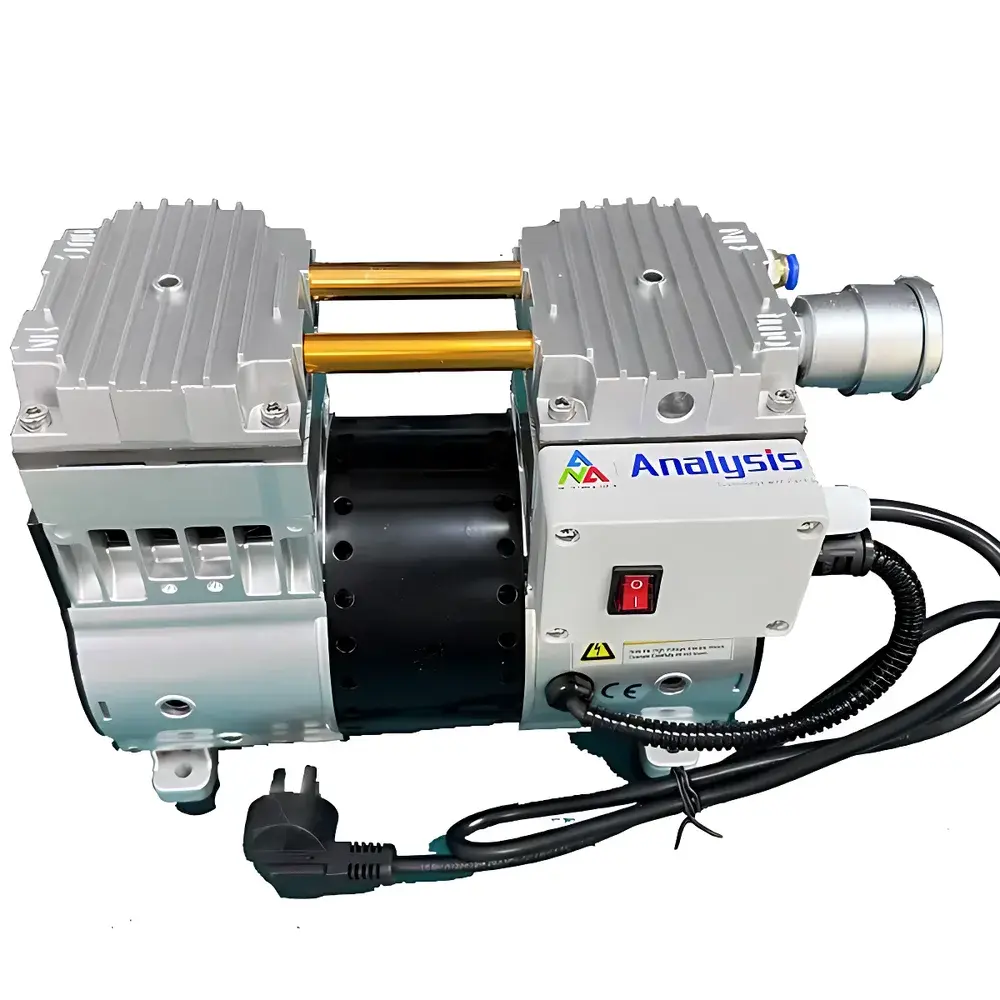
Analysis HCV2000 Oil-Free Vacuum Pump
| Brand | Analysis |
|---|---|
| Origin | Beijing, China |
| Manufacturer Type | Direct Manufacturer |
| Region of Origin | Domestic (China) |
| Model | HCV2000 |
| Instrument Category | Other Vacuum Pumps |
| Product Type | Oil-Free Vacuum Pump |
| Pumping Speed | 200 L/min |
| Ultimate Vacuum | –92 kPa |
| External Dimensions | 244 × 128 × 205 mm (L × W × H) |
| Weight | 9 kg |
| Motor Power | 500 W |
| Rated Voltage/Frequency | 220 V / 50 Hz (customizable) |
| Insulation Class | B |
| Thermal Protector | Auto-resetting at 130 ± 5 °C |
| Operating Ambient Temperature | 5–40 °C |
| Inlet/Outlet Port Thread | G1/4″ NPT |
| Hose Connection Diameter | 6 mm × 4 mm |
Overview
The Analysis HCV2000 Oil-Free Vacuum Pump is a compact, direct-drive diaphragm-type vacuum pump engineered for continuous-duty laboratory and light industrial applications requiring clean, dry, and oil-free vacuum generation. Unlike rotary vane or piston pumps that rely on lubricating oil—posing contamination risks in sensitive processes—the HCV2000 employs a precision-machined, elastomer-reinforced diaphragm actuated by an eccentric cam mechanism. As the motor rotates, the cam drives the connecting rod in reciprocating motion, inducing cyclic expansion and compression of the sealed pumping chamber. This positive displacement principle ensures consistent volumetric flow without internal lubrication, eliminating hydrocarbon vapor backstreaming, oil mist emission, or scheduled oil changes. Designed for stable operation under variable load conditions, the pump delivers reliable vacuum performance across diverse low-to-medium vacuum ranges (typically 1–100 kPa absolute), making it suitable for vacuum filtration, solvent evaporation, vacuum drying ovens, vacuum desiccators, and sample preparation workflows where chemical compatibility and particulate-free exhaust are critical.
Key Features
- Oil-free diaphragm architecture ensures zero hydrocarbon contamination—compliant with ISO 8573-1 Class 0 air purity requirements for critical vacuum paths.
- Low thermal rise design (<15 K above ambient at steady state) enables uninterrupted operation up to 8 hours per day without derating.
- Integrated auto-resetting thermal protector (130 ± 5 °C) safeguards motor windings under overload or restricted airflow conditions.
- Ultra-compact footprint (244 × 128 × 205 mm) and lightweight construction (9 kg) facilitate benchtop integration, mobile cart mounting, or OEM integration into analytical instruments.
- Low-noise operation (<52 dB(A) at 1 m) meets ISO 7779 standards for quiet laboratory environments.
- B-class insulation system provides enhanced dielectric strength and long-term thermal stability under continuous 500 W load.
- G1/4″ NPT inlet/outlet ports with dual 6 mm barbed fittings support rapid connection to standard vacuum tubing (e.g., silicone, Viton®, or polyurethane).
Sample Compatibility & Compliance
The HCV2000 is compatible with non-corrosive, non-condensable gases and vapors commonly encountered in general laboratory vacuum tasks—including water vapor, ethanol, acetone, and nitrogen. It is not rated for use with aggressive solvents (e.g., chlorinated hydrocarbons), acidic or alkaline vapors, or particulate-laden streams without upstream filtration. The pump conforms to IEC 61000-6-3 (EMC emission limits) and IEC 61000-6-2 (immunity requirements) for laboratory equipment. Its oil-free operation supports GLP-compliant documentation workflows where traceability of vacuum source integrity is required. While not certified to UL/CSA or ATEX standards, its design aligns with general safety principles outlined in ISO 12100 for machinery risk reduction.
Software & Data Management
As a standalone mechanical vacuum source, the HCV2000 operates without embedded firmware or digital interfaces. It features no onboard data logging, RS-232/USB connectivity, or remote control capability—consistent with its role as a robust, maintenance-minimized utility device. For integration into automated systems, users may pair the pump with external pressure transducers (e.g., capacitive or piezoresistive gauges) and programmable logic controllers (PLCs) to monitor vacuum level, cycle count, or runtime via analog 0–10 V or 4–20 mA signals. All mechanical components—including diaphragm, valves, and cam bearings—are serviceable using standard tools and factory-specified replacement kits, supporting full traceability of maintenance history per ISO/IEC 17025 Clause 6.4.2.
Applications
- Vacuum-assisted filtration in analytical chemistry (e.g., Büchner funnel setups, membrane filtration for particulate analysis)
- Drying of heat-sensitive biological samples in vacuum desiccators or lyophilizer pre-chamber evacuation
- Evacuation of glove boxes and inert-atmosphere chambers prior to gas purging
- OEM integration into gas chromatography sample injectors, mass spectrometer foreline systems, and vacuum degassing modules
- Industrial vacuum packaging validation testing and small-batch food processing R&D
- Automated vacuum hold tests for leak detection in microfluidic device fabrication
- Support vacuum for electrostatic chucking in semiconductor metrology staging platforms
FAQ
Can the HCV2000 be used with corrosive vapors such as HCl or SO₂?
No. The elastomeric diaphragm and valve materials are optimized for organic solvents and moisture but lack resistance to strong acids, bases, or oxidizers. Use only with chemically compatible gases; install a cold trap or chemical scrubber upstream if trace corrosives are present.
Is the ultimate vacuum of –92 kPa absolute or gauge?
The value –92 kPa is expressed as gauge pressure relative to local atmospheric pressure (~101.3 kPa). Therefore, the absolute pressure achieved is approximately 9.3 kPa abs.
What is the expected service life under continuous operation?
With proper ventilation and ambient temperature control (5–40 °C), the diaphragm and valve assembly typically exceeds 10,000 operating hours before routine replacement—equivalent to ~2 years of 24/7 use.
Does the pump require periodic calibration?
No. As a fixed-speed, mechanically driven vacuum source, it does not incorporate pressure sensing or closed-loop control. Calibration applies only to downstream vacuum gauges used in conjunction with the pump.
Can multiple HCV2000 units be manifolded to increase total pumping speed?
Yes—parallel configuration is permissible provided inlet piping is properly sized (≥12 mm ID) and balanced with equal-length branches to avoid flow asymmetry and acoustic coupling.



