
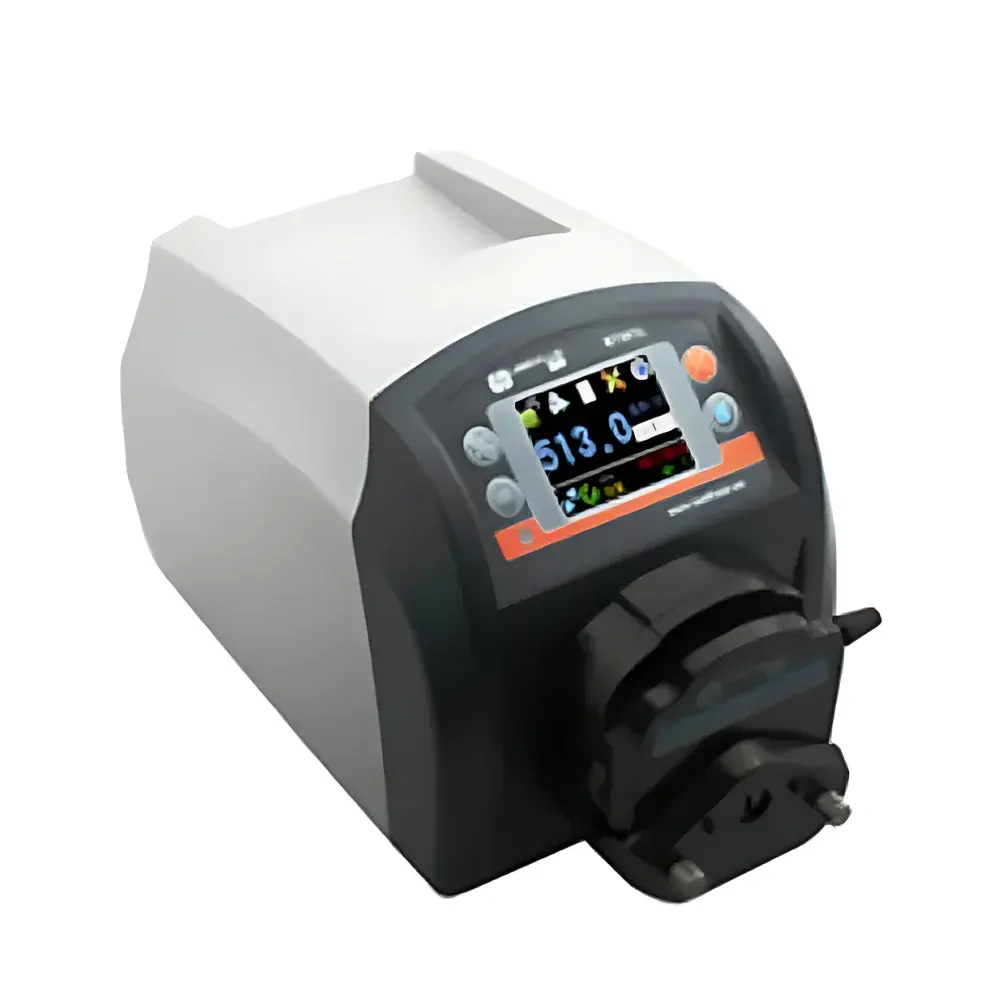
Analysis HDJS20 Peristaltic Pump-Based Dispensing System
| Brand | Analysis |
|---|---|
| Origin | Beijing, China |
| Manufacturer Type | Authorized Distributor |
| Country of Origin | China |
| Model | HDJS20 |
| Instrument Type | Peristaltic Pump |
| Flow Rate Range | 0.006–1340 mL/min |
| Flow Accuracy | <0.5% |
| Speed Range | 0.1–350 rpm |
| Speed Resolution | 0.1 rpm |
| Power Supply | AC 220V±10%, 50/60 Hz (standard) |
| Power Consumption | <40 W |
| External Control Interfaces | TTL-level input (5 V / 12 V standard, 24 V optional), Analog input (0–5 V standard |
| Operating Temperature | 0–40 °C |
| Relative Humidity | <80% RH |
| Enclosure Rating | IP31 |
| Dimensions (L×W×H) | 255 × 181 × 198 mm |
| Weight | 4.7 kg |
Overview
The Analysis HDJS20 Peristaltic Pump-Based Dispensing System is an engineered solution for precise, contamination-free liquid handling in laboratory and pilot-scale R&D environments. Utilizing peristaltic pumping principle—where rollers compress a flexible tubing to generate positive displacement—the system delivers repeatable volumetric dosing without fluid contact with internal mechanical components. This design inherently eliminates risk of cross-contamination, valve clogging, or seal degradation, making it especially suitable for sensitive reagents, biological buffers, photoresists, solvents, and low-to-medium viscosity formulations (typically <10,000 mPa·s). The HDJS20 operates as a flow-controlled dispensing platform, supporting both standalone operation via its integrated color touchscreen interface and synchronized integration into automated workflows through industry-standard analog and digital control signals.
Key Features
- High-precision flow control with accuracy better than ±0.5% across the full range of 0.006–1340 mL/min, validated under ISO 8573-1-compliant calibration conditions
- Intuitive 4.3-inch color LCD touchscreen interface with real-time flow rate display, programmable dispensing cycles, and parameter logging
- Motor-driven roller assembly with adjustable speed range from 0.1 to 350 rpm and 0.1 rpm resolution for fine-tuned process optimization
- Chemically resistant silicone or fluoropolymer-reinforced tubing options compatible with organic solvents, aqueous solutions, UV-curable adhesives, and mild acids/bases
- Robust aluminum alloy chassis with IP31-rated enclosure, ensuring operational reliability in standard laboratory ambient conditions (0–40 °C, <80% RH non-condensing)
- Comprehensive external control architecture: TTL-level trigger inputs, analog voltage/current interfaces (0–5 V standard), and RS485 serial communication supporting MODBUS RTU for SCADA and LIMS integration
Sample Compatibility & Compliance
The HDJS20 accommodates a broad spectrum of liquid samples commonly used in microfabrication, analytical sample preparation, pharmaceutical formulation development, and materials science research. Compatible fluids include but are not limited to: UV-curable optical adhesives (e.g., NOA61, Norland Optical Adhesive), aqueous polymer solutions (PVA, PVP), ethanol/water mixtures, dilute HCl/NaOH solutions (<1 M), and low-viscosity silicone oils. Tubing selection must be verified against chemical compatibility charts prior to use. The system conforms to IEC 61000-6-2 (immunity) and IEC 61000-6-4 (emissions) for electromagnetic compatibility. While not certified for GMP manufacturing, its deterministic flow behavior, audit-ready parameter logging, and traceable external control interfaces support GLP-aligned experimental documentation and FDA 21 CFR Part 11–compatible data integrity practices when deployed with validated software layers.
Software & Data Management
The HDJS20 operates autonomously via its embedded firmware, enabling direct configuration of dispensing volume, flow rate profile (ramp-up/hold/ramp-down), and cycle repetition count. All settings—including timestamped run logs and error codes—are stored internally and exportable via USB mass storage mode. For system-level integration, the RS485 interface allows bidirectional communication with host PCs or PLCs using open MODBUS RTU registers (e.g., holding register 40001 for target RPM, input register 30001 for actual flow feedback). Third-party software platforms such as LabVIEW, MATLAB, Python (pySerial), and industrial HMI systems can implement closed-loop flow regulation, multi-pump synchronization, or time-stamped event triggering—enabling reproducible dispensing protocols compliant with ASTM D1200 (efflux viscosity) or ISO 2556 (permeability testing) method requirements.
Applications
- Micro-dosing of photoresists and encapsulants in semiconductor packaging and MEMS assembly processes
- Precise delivery of calibration standards and internal standards in ICP-MS and HPLC sample introduction systems
- Controlled reagent addition in kinetic studies, enzyme assay development, and titration automation
- Consistent application of conductive inks or binder solutions in printed electronics R&D
- Automated solvent exchange in gel filtration or dialysis sample preparation workflows
- Low-shear transfer of shear-sensitive biologics (e.g., protein solutions, viral vectors) where piston-based pumps may induce aggregation
FAQ
What tubing materials are recommended for organic solvent handling?
Fluorosilicone or perfluoroelastomer-lined tubing (e.g., Pharmed BPT or Tygon® E-3603) is recommended for extended exposure to acetone, IPA, THF, or chlorinated solvents. Always consult the tubing manufacturer’s chemical resistance guide before deployment.
Can the HDJS20 be calibrated to meet ISO/IEC 17025 requirements?
Yes—when used with NIST-traceable flow meters (e.g., Bronkhorst CORI-FLOW or Sierra Instruments SmartTrak) and documented calibration procedures, the system supports metrological traceability for accredited laboratories.
Is pulseless flow achievable at low flow rates?
While peristaltic pumps inherently produce pulsation, the HDJS20 minimizes ripple amplitude through optimized roller geometry and high-resolution speed control; for sub-mL/min applications requiring laminar delivery, downstream dampening modules or syringe pump hybrid configurations are advised.
Does the system support continuous duty operation?
Rated for continuous operation at ≤80% of maximum speed (i.e., ≤280 rpm) with adequate ventilation; thermal derating is recommended above 35 °C ambient temperature.
How is firmware updated?
Firmware upgrades are performed via USB flash drive using Analysis-provided .bin files and version-controlled release notes, with rollback capability and checksum verification.



