
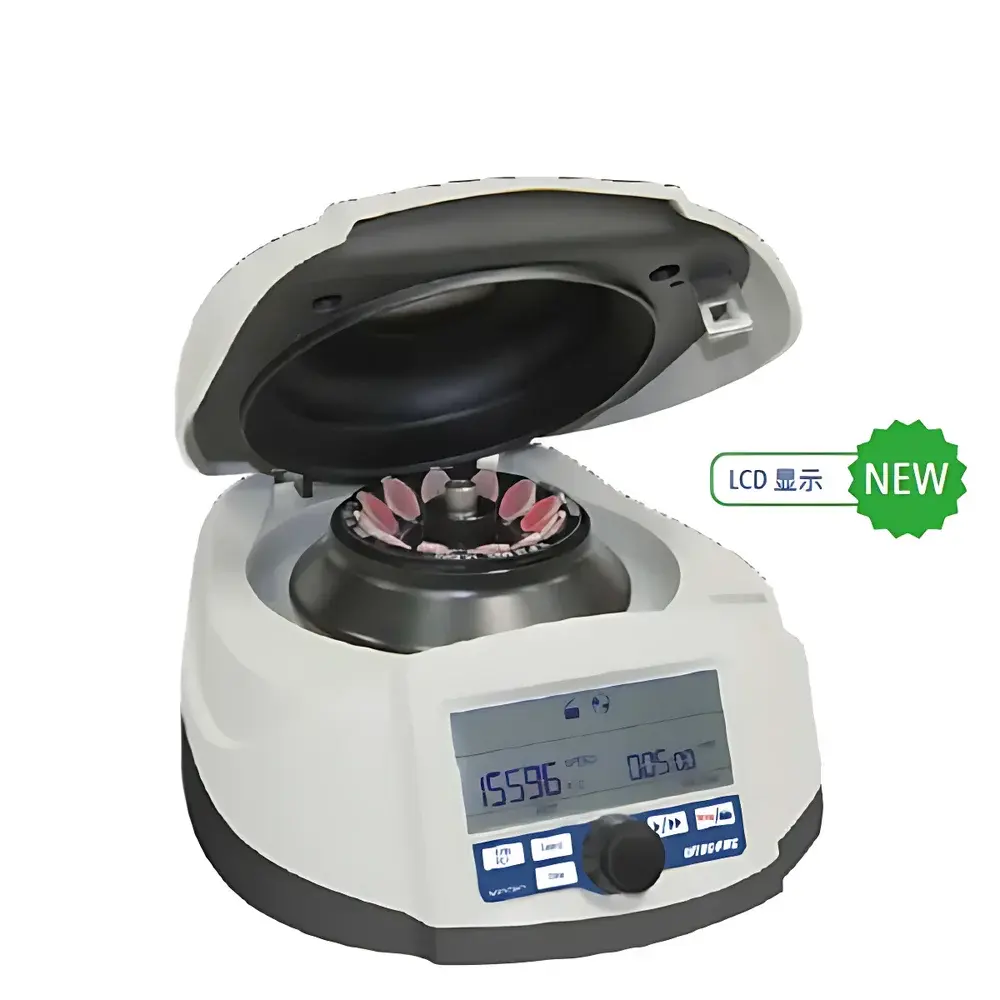
Analysis MINICEN Desktop Microcentrifuge
| Brand | Analysis |
|---|---|
| Origin | Spain |
| Manufacturer Type | Manufacturer |
| Origin Category | Imported |
| Model | MINICEN |
| Instrument Type | Benchtop Centrifuge |
| Speed Range | High-Speed Centrifuge (10,000–30,000 rpm) |
| Function | General-Purpose Centrifuge |
| Configuration | Fixed-Angle Rotor Centrifuge |
| Maximum Capacity | 12 × 1.5–2 mL |
| Maximum Speed | 15,000 rpm |
| Maximum RCF | 15,596 × g |
| Dimensions (W×D×H) | 230 × 270 × 130 mm |
| Net Weight | 5 kg |
| Display | LCD |
| Speed/RCF Increment | 100 rpm / 100 × g |
| Timer Range | 30 s – 999 min (1 s increment) |
| Noise Level | <60 dB(A) |
| Motor | Brushless DC, Maintenance-Free |
| Safety Compliance | EN 61010-1, EN 61010-2-101, EN 61010-2-020, EN 61326-1, EN 61326-2-6 |
| Regulatory Directives | 2011/65/EU (RoHS), 2012/19/EU (WEEE), 2014/30/EU (EMC), 2014/35/EU (LVD), 98/79/EC (IVDD) |
Overview
The Analysis MINICEN Desktop Microcentrifuge is an engineered solution for routine micro-volume separation tasks in molecular biology, clinical diagnostics, and analytical chemistry laboratories. Based on fixed-angle rotor centrifugation physics—where sample tubes are held at a defined angle (typically 45°) relative to the axis of rotation—the instrument delivers rapid sedimentation of particles via precisely controlled centrifugal force (RCF). With a maximum rotational speed of 15,000 rpm and corresponding RCF of 15,596 × g, the MINICEN achieves efficient pelleting of nucleic acids, proteins, cellular debris, and precipitated reagents from volumes ranging from 0.2 mL to 2.0 mL. Its compact footprint (230 × 270 × 130 mm) and lightweight design (5 kg) enable seamless integration onto crowded benchtops without compromising structural rigidity or operational stability.
Key Features
- Brushless DC motor ensures long service life, zero maintenance, and consistent torque delivery across the full speed range (0–15,000 rpm).
- LCD interface displays real-time parameters: rotational speed (rpm), relative centrifugal force (× g), elapsed time, rotor identification, and lid status—including visual and audible feedback for critical states (e.g., acceleration, deceleration, lid open/closed, imbalance detection).
- Precise programmability: speed adjustable in 100 rpm increments; RCF in 100 × g steps; timer resolution of 1 second, supporting durations from 30 seconds to 999 minutes—ideal for gradient-based protocols or multi-step spin-wash cycles.
- Intuitive operation with instant-spin (short pulse), ramp control, and pause/resume functions; speed can be modified dynamically during active runs without stopping the rotor.
- Automatic lid lock mechanism complies with EN 61010-2-020 safety requirements: mechanical interlock prevents operation with lid open; emergency manual release allows safe access during power failure; impact-resistant transparent lid includes observation window for process monitoring.
- Integrated imbalance detection halts rotation immediately upon detecting >0.5 g mass asymmetry—preventing rotor damage and ensuring operator safety.
- Thermal management system employs forced-air convection to limit temperature rise to ≤5 °C above ambient during extended 15,000 rpm operation—critical for heat-sensitive biomolecules.
- Rotor and tube adapters are autoclavable (121 °C, 20 min, 1 bar), supporting ISO 13485-aligned workflows in regulated environments.
Sample Compatibility & Compliance
The MINICEN accommodates standard microcentrifuge tubes (1.5 mL and 2.0 mL), as well as smaller formats including 0.5–0.6 mL and 0.2–0.4 mL PCR tubes—enabling flexibility across DNA extraction, RNA purification, column-based clean-up, and small-volume precipitation protocols. All rotors are balanced and certified for use with polypropylene, polycarbonate, and polyethylene terephthalate (PET) tubes rated for ≥15,000 rpm. The device conforms to key European harmonized standards: EN 61010-1 (safety requirements for electrical equipment), EN 61010-2-101 (particular requirements for laboratory centrifuges), EN 61010-2-020 (requirements for centrifuges used in medical laboratories), EN 61326-1 and -2-6 (EMC immunity and emission performance), and relevant directives including RoHS (2011/65/EU), WEEE (2012/19/EU), EMC (2014/30/EU), LVD (2014/35/EU), and IVDD (98/79/EC). It is CE-marked and suitable for GLP-compliant laboratories requiring documented traceability and repeatable performance.
Software & Data Management
While the MINICEN operates as a standalone instrument, its embedded USB port enables connection to Windows- or macOS-based PCs for firmware updates and parameter logging. The device stores up to 10 user-defined protocols with full recall functionality—including speed, time, acceleration/deceleration profiles, and rotor ID—eliminating manual re-entry errors between users or shifts. Audit trails are maintained locally via non-volatile memory, recording start/stop timestamps, final RCF achieved, and any fault events (e.g., imbalance, lid breach, overtemperature). For laboratories subject to FDA 21 CFR Part 11 or ISO/IEC 17025 requirements, optional third-party data capture software may be deployed to generate electronic records with electronic signatures and version-controlled protocol archives.
Applications
- Routine pelleting of genomic DNA, plasmid preparations, and PCR products.
- Clarification of cell lysates prior to chromatography or electrophoresis.
- Separation of antibody-antigen complexes in ELISA wash steps.
- Microfiltration support for HPLC sample preparation.
- Concentration of low-abundance analytes in environmental or forensic extracts.
- Pre-analytical processing in point-of-care diagnostic platforms requiring miniaturized sample handling.
FAQ
Is the MINICEN compatible with PCR strip tubes and 8-tube racks?
Yes—the fixed-angle rotor accepts both individual microtubes and standard 8-strip configurations when used with appropriate adapters.
Can the rotor be sterilized using ethylene oxide (EtO)?
No—only autoclaving (121 °C, 20 min) is validated for rotor and adapter sterilization per manufacturer specifications.
Does the instrument support variable acceleration and deceleration rates?
Yes—three preset ramp profiles (fast, medium, slow) are available to minimize resuspension of delicate pellets or prevent foaming in viscous samples.
What is the minimum detectable imbalance mass before automatic shutdown?
The system triggers immediate stop if mass asymmetry exceeds ±0.5 g across opposing positions in the rotor.
Is remote monitoring or network connectivity supported?
No native Ethernet or Wi-Fi interface is included; however, USB-connected host software can log and export run data in CSV format for LIMS integration.



