
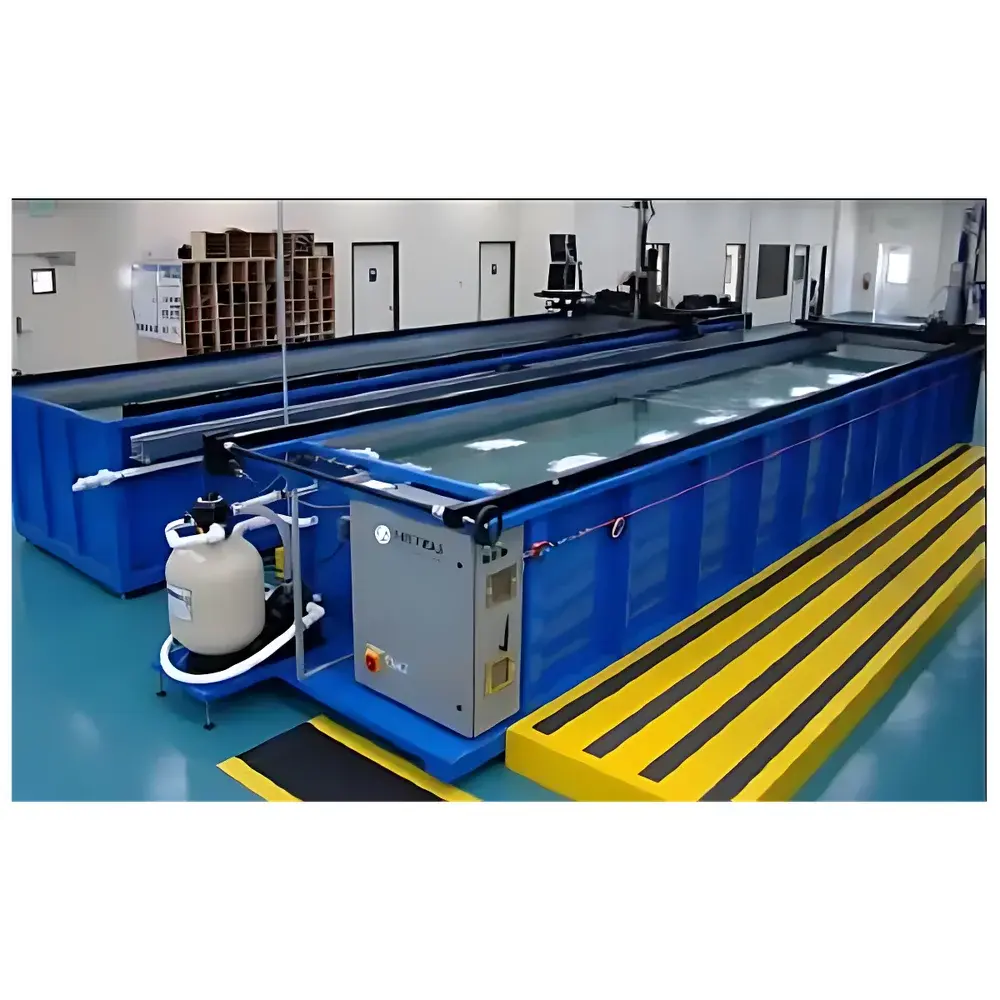
Analysis T156/T240/T264/T480 Large-Scale Water Immersion Ultrasonic C-Scan System
| Brand | Analysis |
|---|---|
| Origin | Beijing, China |
| Manufacturer Type | Manufacturer |
| Country of Origin | China |
| Models | T156, T240, T264, T480 |
| Pricing | Upon Request |
Overview
The Analysis T156/T240/T264/T480 Large-Scale Water Immersion Ultrasonic C-Scan System is an industrial-grade, multi-channel automated ultrasonic testing (AUT) platform engineered for high-resolution volumetric inspection of large-format metallic and composite components. Based on pulse-echo and through-transmission ultrasonic principles, the system employs water-coupled immersion scanning to eliminate air-gap interference and ensure consistent acoustic coupling across extended surface areas. It utilizes focused or unfocused broadband transducers operating in the 1–15 MHz range, enabling detection of subsurface discontinuities—including inclusions, porosity, delaminations, and planar cracks—as small as 0.2 mm in equivalent reflector size under optimized conditions. The system’s modular gantry architecture supports customizable travel envelopes up to 20 m (L) × 1.3 m (W) × 0.9 m (H), accommodating flat plates, rolled sheets, pressure vessel segments, and large-diameter cylindrical forgings used in aerospace, energy, and heavy manufacturing sectors.
Key Features
- Multi-axis precision motion control with servo-driven linear stages and high-repeatability encoders (±5 µm positional accuracy over full travel)
- Configurable channel count: 4-, 8-, or 16-channel parallel acquisition architecture supporting simultaneous A-scan, B-scan, and C-scan generation
- Water tank integration with temperature-stabilized recirculation, filtration, and degassing subsystems to maintain consistent acoustic velocity (1482 ± 0.5 m/s at 20°C)
- Ruggedized structural frame fabricated from stress-relieved aluminum extrusions and stainless-steel load-bearing components, rated for continuous industrial operation
- Real-time C-scan imaging with dynamic gain compensation, time-gain compensation (TGC), and threshold-based defect mapping algorithms
- Independent channel gating and delay tuning for phased array compatibility and beam steering in optional configurations
Sample Compatibility & Compliance
The system accommodates flat and slightly curved specimens up to 20 m in length and 1.3 m in width, including aluminum alloy plates (e.g., 2024-T3, 7075-T73), titanium billets (Ti-6Al-4V), stainless steel weldments, carbon fiber reinforced polymer (CFRP) laminates, and nickel-based superalloy forgings. All hardware and software modules are designed to support compliance with ASTM E127, ASTM E317, ISO 16810, and EN 12668-1/2/3 standards for ultrasonic instrument performance and calibration. Optional traceable calibration kits—certified per ISO/IEC 17025—enable verification of sensitivity, resolution, and linearity per ASME BPVC Section V, Article 4 requirements. Data acquisition workflows can be configured to meet GLP/GMP documentation rigor, including audit trails and electronic signatures aligned with FDA 21 CFR Part 11 readiness.
Software & Data Management
The proprietary ScanView™ software suite provides integrated control, visualization, and analysis capabilities. It supports synchronized multi-channel waveform capture at up to 100 MS/s sampling rate, real-time C-scan rendering at ≥30 fps, and post-processing functions including depth slicing, amplitude thresholding, dimensional measurement (with pixel-to-mm calibration), and report generation in PDF, CSV, and XML formats. Raw RF data is stored in HDF5 format for long-term archival and third-party algorithm integration (e.g., MATLAB, Python-based machine learning pipelines). Role-based user access control, encrypted database storage, and configurable data retention policies ensure secure handling of sensitive inspection records across enterprise deployments.
Applications
- Automated thickness mapping and corrosion assessment of ship hull plating and offshore platform decks
- Porosity and inclusion detection in thick-section aluminum extrusions for railcar body structures
- Delamination screening in bonded CFRP wing skins and fuselage panels during aerospace OEM acceptance testing
- Weld integrity evaluation in API 650 storage tank bottom plates and ASME Section VIII pressure vessel shells
- Heat-affected zone (HAZ) characterization in high-strength steel pipeline girth welds
- Quality gate inspection of large-diameter turbine shafts and generator rotor forgings prior to final machining
FAQ
What is the maximum scan area supported by the T480 configuration?
The T480 variant supports a standard envelope of 6.7 m × 1.3 m × 0.9 m; custom extensions up to 20 m in X-axis travel are available upon engineering review.
Does the system support phased array transducers?
Yes—hardware and software are compatible with linear and matrix array probes; optional PAUT modules enable sectorial scanning and synthetic aperture focusing.
Is NIST-traceable calibration documentation provided?
Calibration certificates compliant with ISO/IEC 17025 are available as an add-on service, including reference block certification and system performance verification reports.
Can raw A-scan data be exported for external analysis?
All acquired waveforms are saved in open HDF5 format with metadata headers, enabling direct import into MATLAB, Python (h5py), or commercial NDT analytics platforms.
What level of technical support is offered post-installation?
Analysis provides on-site commissioning, operator training, annual preventive maintenance contracts, and remote diagnostics support with SLA-backed response times.



