
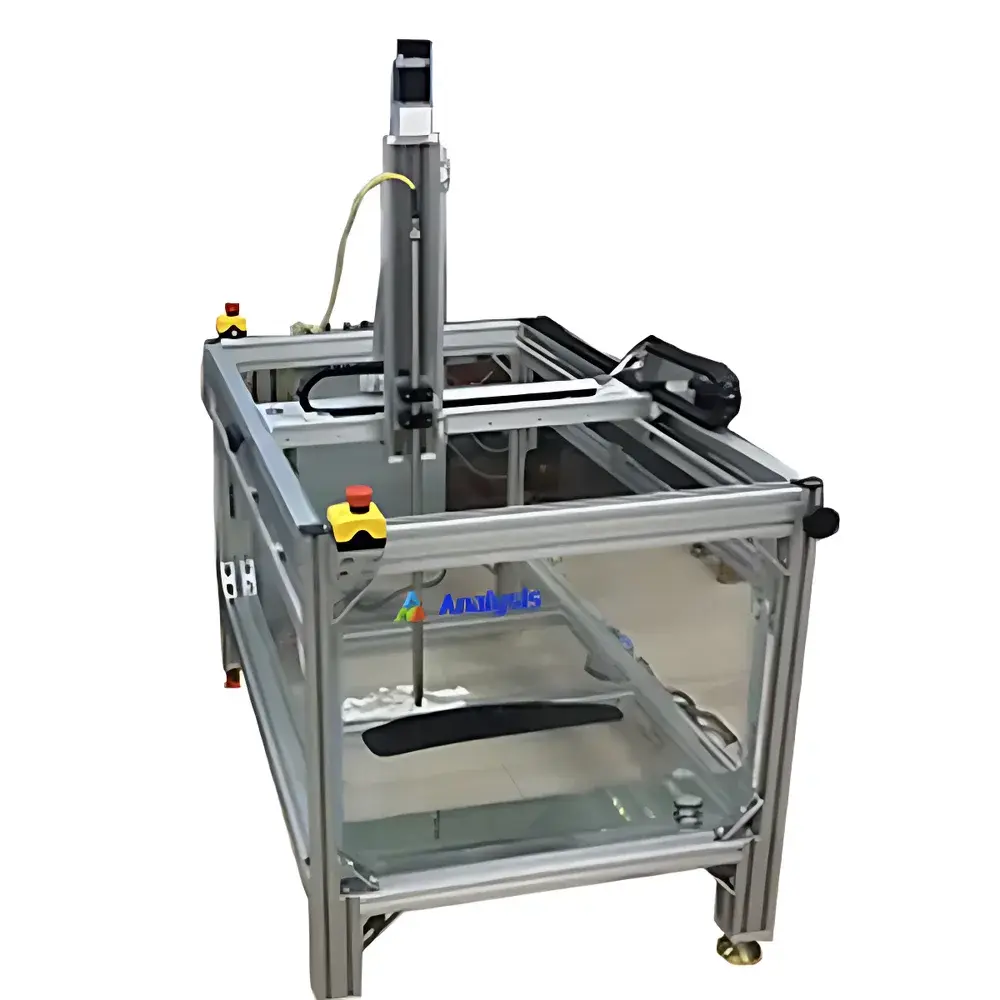
Analysis TCP Ultrasonic C-Scan System for Transducer Beam Profiling
| Brand | Analysis |
|---|---|
| Origin | USA |
| Manufacturer | Analysis, Inc. |
| Product Type | Imported |
| Model | TCP Ultrasonic C-Scan System |
| Pricing | Available Upon Request |
Overview
The Analysis TCP Ultrasonic C-Scan System is a precision-engineered platform designed for quantitative beam profiling and acoustic characterization of ultrasonic transducers used in non-destructive testing (NDT), medical ultrasound development, and advanced materials evaluation. Built upon automated water-coupled immersion scanning architecture, the system employs high-resolution positional control and calibrated hydrophone-based signal acquisition to map spatial pressure distribution across the acoustic near-field and far-field. It operates on the principle of pulse-echo or through-transmission measurement using standardized reflectors (e.g., flat-bottom holes, steel blocks per ASTM E1065) or reference transducers, enabling traceable, repeatable quantification of beam parameters including focal spot size, focal length, beam width at −6 dB, lateral and axial resolution, center frequency deviation, and relative sensitivity distribution. The system is engineered for metrology-grade compliance and supports full alignment with ISO/IEC 17025-accredited calibration workflows.
Key Features
- Motorized 3-axis (X-Y-Z) immersion scanning stage with sub-10 µm positional repeatability and programmable scan area up to 300 × 300 × 150 mm
- Integrated calibrated broadband PVDF hydrophone (1–50 MHz bandwidth) with NIST-traceable sensitivity certificate
- Dual-mode acquisition: pulse-echo and pitch-catch configurations for comprehensive field mapping
- Real-time A-scan waveform capture synchronized with stage position for time-of-flight and amplitude analysis
- Automated beam parameter extraction: focal depth calculation, −6 dB beamwidth, main lobe width, side lobe suppression ratio, and spatial impulse response modeling
- Rugged, corrosion-resistant stainless-steel tank with temperature-stabilized deionized water circulation (±0.1 °C)
- Compliant with ASTM E1065 “Standard Guide for Evaluating Characteristics of Ultrasonic Search Units” for transducer characterization
Sample Compatibility & Compliance
The TCP system accommodates single-element, linear array, phased array, and focused transducers ranging from 1 MHz to 20 MHz nominal frequency and element diameters from 3 mm to 50 mm. It supports both contact and immersion coupling modalities via interchangeable fixtures and custom mounting adapters. All measurement procedures adhere to ASTM E1065 requirements for beam profile documentation, including mandatory reporting of test medium properties (temperature, sound speed), transducer identification, scan grid resolution (≤ λ/4), and uncertainty budgeting per ISO/IEC Guide 98-3 (GUM). The system’s hardware and software architecture are structured to support GLP/GMP environments, with optional audit trail logging and electronic signature capability aligned with FDA 21 CFR Part 11 requirements.
Software & Data Management
The proprietary TCP Control Suite provides intuitive GUI-driven operation with preconfigured test templates for common transducer types and standards-compliant reporting modules. Raw RF data is stored in HDF5 format with embedded metadata (timestamp, position, gain, pulse voltage, medium properties). Post-processing tools include B-scan/C-scan rendering, 2D/3D beam intensity projection, cross-sectional slice analysis, and export to CSV, MATLAB (.mat), or DICOM-SR for integration into enterprise QA databases. Calibration certificates generated by the software include full traceability statements referencing NIST-traceable hydrophone calibration and ASTM E1065 clause references. Data integrity is ensured via SHA-256 hashing and version-controlled configuration files.
Applications
- Transducer qualification and incoming inspection for OEM ultrasound probe manufacturers
- Design validation of focused and annular array transducers in R&D laboratories
- Periodic performance verification of clinical and industrial transducers under ISO 13485 quality systems
- Beam modeling validation for simulation software (e.g., Field II, K-Wave, COMSOL)
- Supporting regulatory submissions requiring documented beam characterization (FDA 510(k), CE-IVDR)
- Academic research in acoustic radiation force, nonlinear propagation, and tissue-mimicking phantom characterization
FAQ
What standards does the TCP system comply with?
ASTM E1065 is the primary standard implemented; additional alignment with IEC 61267, ISO 10375, and EN 12668-2 is supported via configurable test protocols.
Can the system characterize phased array transducers?
Yes — it supports element-by-element beam mapping and group-delay compensated synthetic aperture reconstruction for multi-element arrays.
Is hydrophone calibration included with the system?
A factory-calibrated PVDF hydrophone with NIST-traceable certificate is supplied; annual recalibration services are available through Analysis, Inc.’s ISO/IEC 17025-accredited metrology lab.
Does the software support automated report generation for quality audits?
Yes — PDF and XML reports include digital signatures, revision history, instrument calibration status, and full measurement traceability per ISO/IEC 17025 Clause 7.8.
What is the minimum resolvable beam dimension?
Spatial resolution is limited by wavelength and hydrophone active element size; typical lateral resolution is ≤ 0.15 mm at 5 MHz in water (λ ≈ 0.3 mm).



