
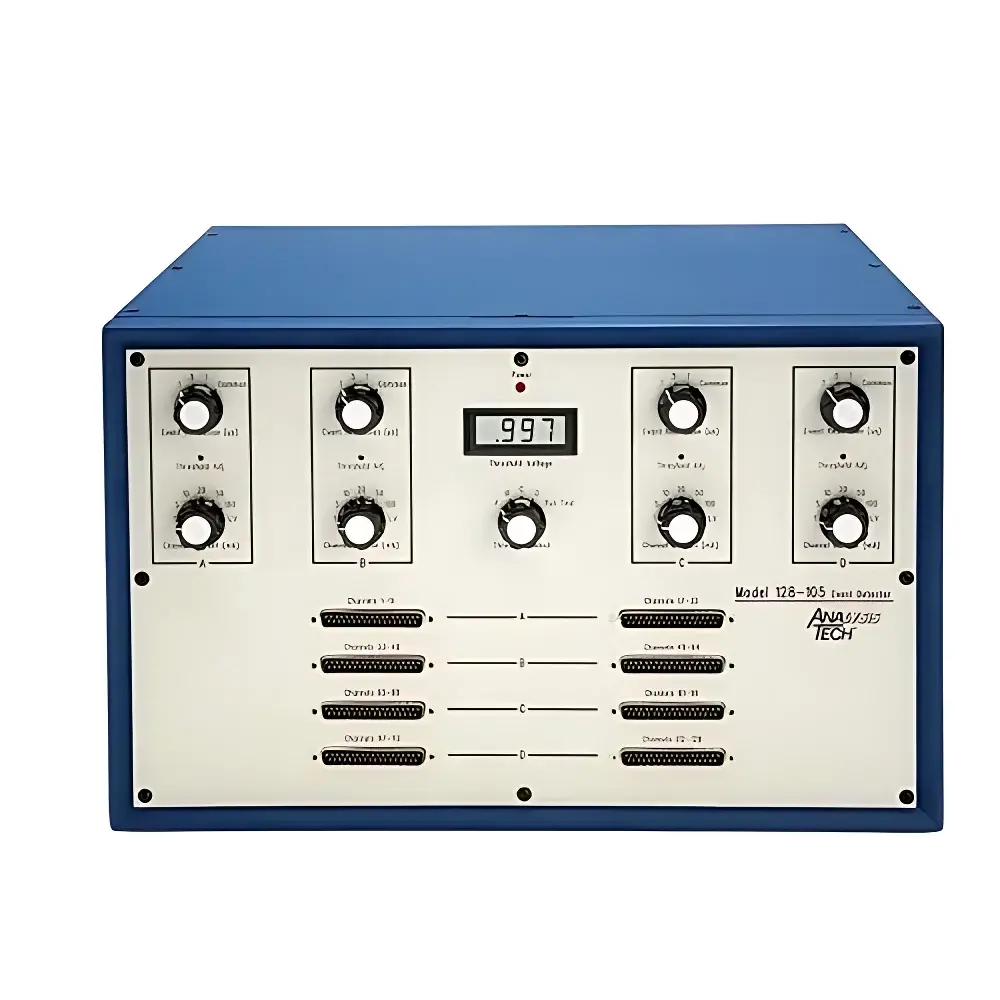
Analysis Tech 128-105 High-Density Transient Interrupter
| Brand | Analysis Tech |
|---|---|
| Origin | USA |
| Model | 128-105 |
| Channel Capacity | 128 independent DC resistance monitoring channels |
| Minimum Event Duration | 0.1 / 0.5 / 1.0 µs (field-replaceable clock modules support additional durations) |
| Threshold Resistance Range | 0.1–2000 Ω |
| Sensing Current Options | 1, 5, 10, 20, 50, 100 mA |
| Max Compliance Voltage | 2.5 V |
| Threshold Tolerance | ±5% |
| Event Detection Sensitivity | 100 ns |
| Operating Temperature | ≤35 °C |
| Power Supply | 120 VAC, 60 Hz, 6 A |
| Dimensions | 11.5" H × 18" W × 15.5" D |
| Weight | 51 lb |
| Interface | USB or RS-232C |
| Software | WinDatalog v5.x for data acquisition, event logging, and statistical analysis |
| Compliance | Designed for GLP/GMP-aligned test environments |
Overview
The Analysis Tech 128-105 High-Density Transient Interrupter is a precision-engineered, modular DC continuity monitoring system designed for high-fidelity detection of transient open-circuit events in electrical and electro-mechanical assemblies. It operates on the principle of real-time resistive continuity surveillance: each of its 128 independently configurable channels applies a programmable DC sensing current across a test loop and continuously monitors voltage drop to detect deviations exceeding a user-defined resistance threshold. When the measured resistance exceeds the setpoint for a duration longer than the selected Minimum Event Duration (MED), the system records a discrete interrupt event with microsecond-level timestamp resolution. Unlike passive continuity testers, the 128-105 delivers deterministic, repeatable detection of intermittent faults—critical for qualification testing of aerospace harnesses, automotive connectors, fiber-optic terminations, MEMS switches, and safety-critical relays. Its architecture supports parallel monitoring of up to 128 discrete circuits without multiplexing latency, enabling simultaneous fault capture across complex multi-point interconnect systems.
Key Features
- 128-channel capacity distributed across four hot-swappable 32-channel plug-in modules—enabling granular configuration per module group
- Independent per-module parameter control: Minimum Event Duration (0.1 / 0.5 / 1.0 µs standard; extended ranges via optional custom clock modules), channel sensing current (1–100 mA), and threshold voltage/resistance (0.1–2000 Ω)
- High-resolution event timing with 100 ns detection sensitivity and sub-microsecond MED repeatability
- HLV (High-Low Voltage) amplifier compatibility for ultra-low-level resistance detection (<10 mΩ resolution) and improved signal-to-noise ratio in high-impedance or noisy EMI environments
- Robust mechanical design: aluminum chassis with EMI-shielded internal layout, front-panel tactile controls, and LED status indicators per channel group
- Compliance with industrial power standards: 120 VAC, 60 Hz, 6 A input; optional configurations available for 230 VAC/50 Hz operation upon request
Sample Compatibility & Compliance
The 128-105 is engineered for broad sample adaptability across physical form factors and electrical characteristics. It accommodates normally-open (NO), normally-closed (NC), and hybrid NO/NC configurations—including fiber-optic link break detection via conductive jacket monitoring, high-resistance ceramic substrates (>1 MΩ), and low-voltage micro-relay contacts. Standard PVC-shielded ribbon cable (rated to 105 °C) ensures reliable connection for benchtop and environmental chamber applications; high-temperature variants (up to 180 °C) are available for thermal cycling validation. The system meets electromagnetic compatibility requirements per FCC Part 15 Class A and IEC 61000-4-3 (radiated immunity). When deployed with WinDatalog’s secure mode and external time-server synchronization, it satisfies traceability and data integrity expectations under ISO/IEC 17025, ASTM F2413 (electrical hazard testing), and USP analytical instrument qualification protocols.
Software & Data Management
WinDatalog v5.x serves as the native acquisition and analysis platform, providing synchronized timestamping, event filtering, histogram-based duration distribution analysis, and pass/fail reporting per channel or group. Raw binary event logs (.wdl) are stored with embedded metadata—including operator ID, calibration certificate ID, ambient temperature/humidity (when interfaced with optional sensors), and hardware configuration snapshot. Export options include CSV, XML, and PDF formats compatible with LIMS integration. For regulated environments, WinDatalog supports role-based access control, electronic signatures, and full audit trail generation compliant with FDA 21 CFR Part 11 Annex 11 and EU GMP Annex 11 requirements. Optional calibration management modules track due dates, historical drift trends, and uncertainty budgets per channel.
Applications
- Aerospace wire harness validation under MIL-STD-883 Method 2005 (intermittent fault detection)
- Automotive connector durability testing per SAE J2344 and ISO 16750-4 (mechanical shock and vibration-induced opens)
- Medical device cable assembly qualification per IEC 60601-1 Clause 8.8.3 (patient circuit continuity verification)
- Micro-electromechanical switch life-cycle testing with sub-millisecond event capture
- Thermal cycling validation of solder joints and flex circuits using integrated temperature actuator modules
- Production line final test stations requiring 100% channel-level continuity verification with automated go/no-go output
FAQ
What is the difference between the 128-105 and the 32-106 models?
The 128-105 hosts four 32-channel modules in a single chassis, offering identical per-channel performance to the 32-106 but with consolidated rack-space usage, shared power supply, and unified software interface. The 32-106 remains suitable for distributed or portable deployments.
Can the 128-105 detect events shorter than 0.1 µs?
The base unit achieves 100 ns detection sensitivity, but the Minimum Event Duration (MED) setting determines the shortest recordable event. Custom clock modules supporting 50 ns and 25 ns MED are available as factory-configured options.
Is calibration traceable to NIST standards?
Yes—each unit ships with a NIST-traceable calibration certificate covering resistance threshold accuracy (±5%), current source stability (±0.5% FS), and timing resolution. Annual recalibration services include uncertainty budget documentation.
How does the HLV amplifier integrate with the 128-105?
The HLV amplifier mounts inline between the test sample and the 128-105 input terminals, providing gain-controlled low-noise amplification and configurable offset compensation—essential for detecting sub-ohm resistance shifts in high-impedance or long-cable setups.
Does the system support remote triggering or synchronization with other test equipment?
Yes—TTL-compatible trigger I/O ports enable external start/stop control and phase-locked event capture with oscilloscopes, environmental chambers, or shaker controllers via IEEE-488 (GPIB) or Ethernet-based SCPI commands.



