
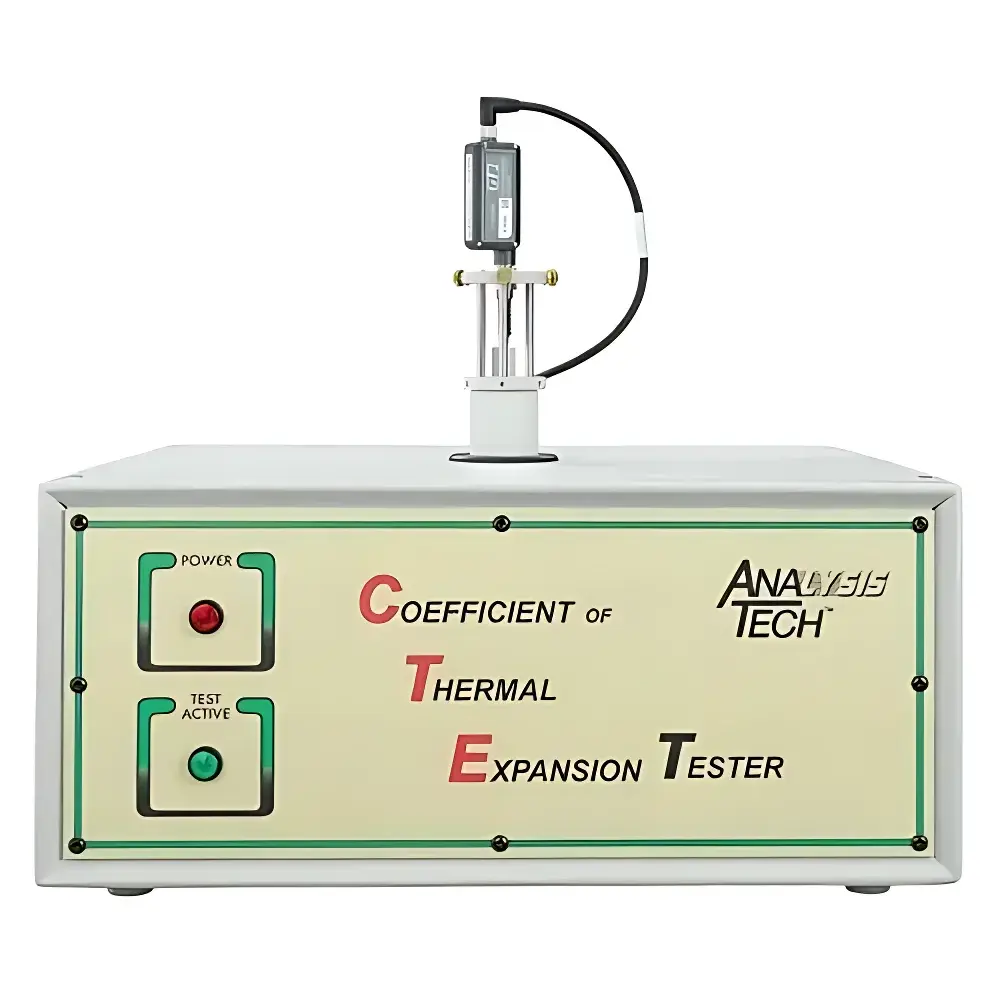
Analysis Tech CTE-360 Thermal Dilatometer
| Brand | Analysis Tech |
|---|---|
| Origin | USA |
| Model | CTE-360 |
| Temperature Range | –25 °C to +100 °C |
| Compliance | ASTM D696, ASTM E228 |
| Sample Max Cross-Section | 12.5 mm (0.5 in) |
| Recommended Sample Length | 50 mm (2 in) |
| CTE Accuracy | ±3% (full 100 °C range) |
| Power Supply | 100–230 VAC, 50/60 Hz, ≤400 W |
| Dimensions | 43 × 43 × 43 cm (17 × 17 × 17 in) |
| Weight | 9 kg (20 lb) |
| Software | WinCTE v1.x (Windows 7–11, 32/64-bit) |
Overview
The Analysis Tech CTE-360 Thermal Dilatometer is a precision-engineered instrument designed for the quantitative determination of linear and volumetric coefficients of thermal expansion (CTE) in solid, semi-solid, and viscous liquid materials. It operates on the principle of contact-based high-resolution displacement measurement—using a calibrated quartz pushrod coupled with a high-stability linear variable differential transformer (LVDT) or capacitive displacement sensor—to detect minute dimensional changes as a function of controlled temperature. Unlike optical dilatometers, the CTE-360 employs direct mechanical coupling between the sample and sensing system, ensuring robust signal integrity and minimal thermal lag. Its operational temperature range spans from –25 °C to +100 °C, making it especially suited for characterizing polymers, epoxies, solder alloys, underfills, encapsulants, and phase-change materials widely used in microelectronics packaging, PCB manufacturing, and advanced battery module development. The instrument implements standardized test protocols defined in ASTM D696 (for plastics) and ASTM E228 (for metals and ceramics), enabling traceable, inter-laboratory comparable results required for R&D validation, process qualification, and quality assurance workflows.
Key Features
- Self-contained, solid-state architecture requiring no external chiller, cryogen, or forced-air cooling system—reducing infrastructure dependencies and operational overhead.
- Modular sample holder design supporting multiple material forms: cylindrical or prismatic solids (max cross-section 12.5 mm), thin films/sheets (via XY-plane adapter), gels, pastes, and sealed viscous liquids (using disposable quartz capillary tubes).
- Integrated temperature control with programmable ramp rates, isothermal holds, and multi-segment heating profiles—all executed autonomously under WinCTE software supervision.
- In-situ length monitoring with sub-micrometer resolution; raw displacement data synchronized with thermocouple-recorded temperature at ≥10 Hz sampling rate.
- Automatic uncertainty propagation: each reported CTE value includes a statistically derived confidence interval (e.g., ±3.2% at 95% confidence), calculated per ASTM E228 Annex A2 guidelines.
- Fail-safe real-time diagnostics including displacement sensor saturation detection, overtemperature lockout, and thermal gradient violation alerts—ensuring data integrity and operator safety.
- Compact footprint (43 cm cube) and low power consumption (<400 W) enable deployment in fume hoods, cleanrooms, or shared lab benches without dedicated HVAC support.
Sample Compatibility & Compliance
The CTE-360 accommodates a broad spectrum of physical states and geometries without requiring vacuum or inert gas purging. Solid samples must fit within a 12.5 mm maximum diameter or width constraint and exhibit sufficient compressive stability to maintain contact with the quartz pushrod during thermal cycling. For anisotropic materials such as laminated composites or oriented polymer films, the optional planar sample holder enables independent measurement of in-plane (X–Y) CTE components. Viscous or low-viscosity liquids—including thermal interface materials (TIMs) and paraffin-based PCMs—are tested in hermetically sealed, low-thermal-mass quartz capillaries to prevent evaporation and minimize convection artifacts. All measurements adhere strictly to the procedural requirements of ASTM D696 and ASTM E228, including specimen conditioning, thermal equilibration dwell times, and data reduction algorithms. The system supports GLP-compliant operation when paired with WinCTE’s audit-trail-enabled logging mode (user login, parameter change history, electronic signature fields), satisfying documentation requirements for ISO/IEC 17025-accredited laboratories and FDA-regulated environments governed by 21 CFR Part 11.
Software & Data Management
WinCTE is a Windows-native application (compatible with Windows 7 through Windows 11, both 32- and 64-bit editions) that serves as the sole interface for instrument configuration, test execution, real-time visualization, and post-processing. Its intuitive graphical workflow guides users—from novice technicians to senior materials scientists—through method setup, calibration verification, and report generation. During acquisition, WinCTE logs synchronized time-series data in three native formats: ASCII-delimited text (.dat), Excel-ready CSV (.csv), and annotated vector graphics (.png/.svg). Built-in analysis tools compute first-derivative CTE(α) curves, perform piecewise linear regression across user-defined temperature intervals (e.g., 25–60 °C vs. 60–95 °C), and export summary tables compliant with internal QA templates or external LIMS ingestion schemas. Optional calibration kits—including NIST-traceable reference standards with certified CTE values—enable periodic performance verification without third-party service intervention. All software updates, context-sensitive help files, and protocol wizards are distributed directly via Analysis Tech’s secure customer portal.
Applications
- Electronics packaging: CTE matching validation of die attach adhesives, mold compounds, underfill resins, and substrate laminates to mitigate thermo-mechanical stress-induced delamination or solder joint fatigue.
- Battery R&D: Characterization of electrode binder swelling behavior, separator thermal shrinkage thresholds, and pouch cell laminate dimensional stability under charge/discharge thermal cycling.
- Automotive composites: Quantifying hygrothermal expansion in CFRP body panels and thermoplastic matrix systems exposed to under-hood thermal transients.
- Medical device materials: Verifying dimensional stability of silicone elastomers, hydrogels, and radiopaque polymer blends across sterilization temperature profiles (e.g., autoclave, EtO, gamma).
- Academic materials science: Teaching labs use the CTE-360 to demonstrate fundamental relationships between crystal structure, free volume, and thermal expansivity in polymer glasses, metallic alloys, and ceramic oxides.
FAQ
Does the CTE-360 require liquid nitrogen or external refrigeration to achieve –25 °C?
No. The instrument uses a thermoelectric (Peltier) cooling module integrated into its baseplate assembly, enabling stable sub-ambient operation without cryogens or compressor-based chillers.
Can I measure CTE of thin films deposited on rigid substrates?
Yes—using the optional planar sample holder, which isolates in-plane expansion of freestanding foils or coated wafers while suppressing substrate interference through differential constraint geometry.
Is WinCTE compatible with modern Windows 11 systems and 64-bit architectures?
Yes. WinCTE v1.0.0 and later releases are digitally signed, UAC-compliant, and validated on Windows 11 Pro (22H2 and 23H2) with full USB 3.0 enumeration support.
How is measurement uncertainty quantified and reported?
Each CTE result includes a confidence interval derived from Type A (statistical scatter of repeated measurements) and Type B (sensor linearity, temperature uniformity, and reference standard uncertainty) components per GUM (JCGM 100:2008) methodology.
What sample preparation is required for gel or paste materials?
Gels and pastes are loaded into supplied quartz capillary tubes (ID = 2.0 mm), sealed with a low-outgassing epoxy plug, then inserted vertically into the test chamber—ensuring axial force transmission without lateral shear distortion.



