
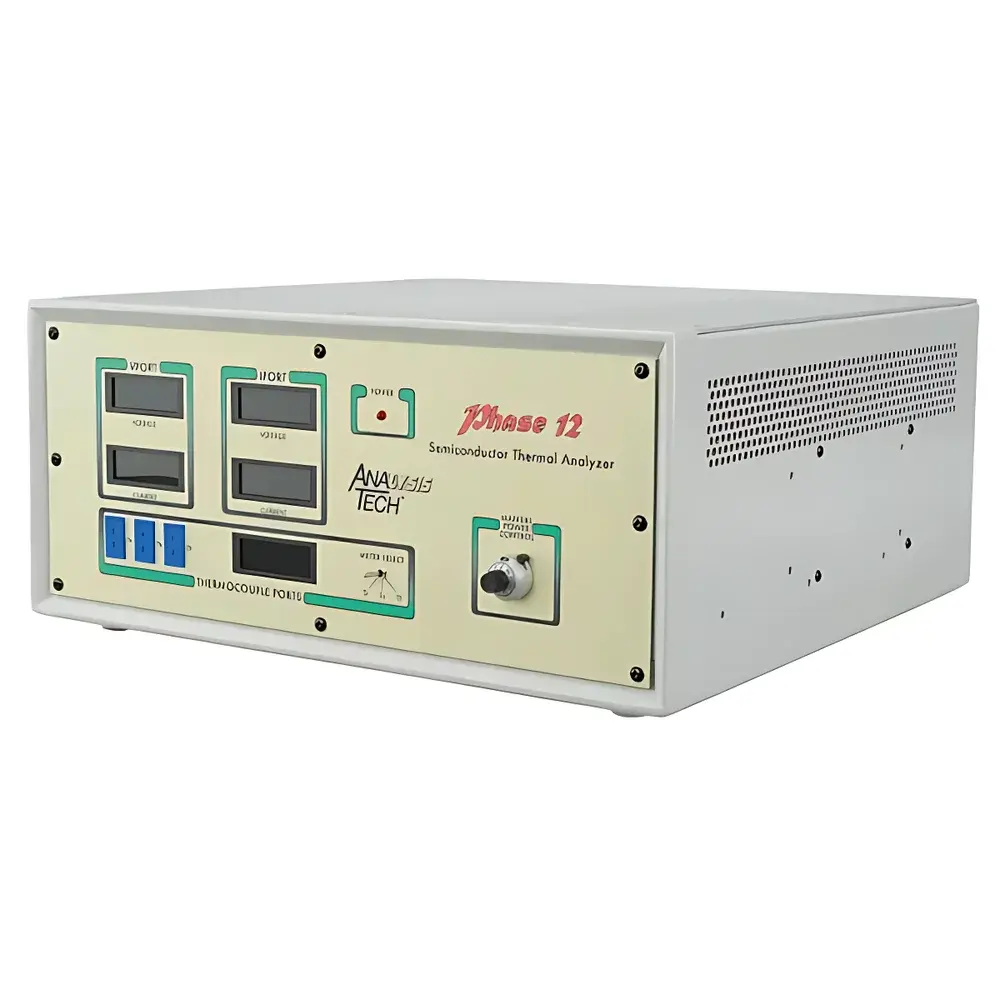
Analysis Tech Phase12 Thermal Analyzer
| Brand | Analysis Tech |
|---|---|
| Origin | USA |
| Model | Phase12 |
| Heating Current Options | 2 A / 10 A / 20 A / 100 A (Phase12B) |
| Sampling Rate | 1 MHz |
| Temperature Resolution | ±0.007°C (Tj digital), ±0.1°C (display), ±0.2–0.5°C (absolute) |
| Thermocouple Accuracy | ±0.15°C (typ.), ±0.3°C (max.) |
| Heating Voltage Accuracy | ±0.2% rdg + 0.025% FS (50 V) for Phase12 |
| Transient Time Resolution | 1 µs |
| Transient Span | 1 µs – 1000 s |
Overview
The Analysis Tech Phase12 Thermal Analyzer is a high-precision, benchtop semiconductor thermal characterization system engineered for rigorous transient and steady-state junction temperature (Tj) measurement in R&D, qualification, and high-volume production environments. It operates on the principle of electrical test-based thermal transient analysis (ETTA), leveraging the well-established correlation between semiconductor forward voltage (Vf) and junction temperature under controlled low-current sensing conditions. By applying calibrated heating pulses and acquiring microsecond-resolved voltage–time responses—combined with high-fidelity thermocouple reference data—the system reconstructs thermal impedance networks (Zth(t)) and derives compact dynamic thermal models (e.g., optimized Foster/Cauer RC ladders) per JEDEC Standard JESD51-14. Its architecture supports full 2-terminal and 3-terminal device configurations, enabling accurate thermal resistance extraction (Rjc, Rjb, Rth) for discrete power devices—including MOSFETs, IGBTs, bipolar transistors, LEDs, diodes, and multi-die ICs—without requiring optical access or destructive packaging modifications.
Key Features
- 1 MHz real-time data acquisition with 1 µs temporal resolution for both heating and cooling transients
- Kelvin (4-wire) voltage sensing to eliminate lead resistance errors during Tj monitoring
- Configurable heating current ranges: 2 A, 10 A, 20 A standard; 100 A via Phase12B variant; scalable to 1000 A with optional Power Booster module
- JEDEC JESD51-1, JESD51-14, and MIL-STD-750E compliant test methodology support
- Automated structural function analysis for generation of high-order RC network models in both Cauer and Foster topologies
- Integrated WinTherm software with GLP/GMP-ready audit trail, user-access control, and 21 CFR Part 11–compliant electronic signatures (optional)
- Self-calibrating hardware architecture with traceable NIST-traceable thermocouple inputs (Type T)
- Multi-junction temperature mapping capability for stacked-die and multi-chip modules (MCMs)
- Programmable surge testing mode: pulse width (5–20 ms), amplitude (up to 1000 A), count (1–100), interval (0–1000 s), and inter-pulse DC bias (0–1000 A)
- Chip attach quality assessment via transient thermal signature analysis and histogram-based pass/fail binning
Sample Compatibility & Compliance
The Phase12 accommodates a broad spectrum of semiconductor packages—from TO-220 and D²PAK discrete devices to QFN, LGA, and flip-chip ICs—using standardized and custom-engineered test fixtures. All fixtures maintain mechanical and thermal repeatability across thermal cycling and power cycling tests. The system complies with ISO/IEC 17025 requirements for calibration traceability, supports ASTM E2865 for thermal resistance measurement uncertainty quantification, and delivers documentation suitable for FDA pre-submission reviews and automotive AEC-Q100/Q200 qualification reports. Its firmware and software architecture are validated for use in regulated environments requiring full data integrity, version-controlled configuration management, and tamper-evident raw data archiving.
Software & Data Management
WinTherm v5.x (included) provides a deterministic, scriptable test environment supporting automated batch execution, statistical process control (SPC) charting, and export to CSV, MATLAB (.mat), HDF5, and PDF formats. Raw transient waveforms, structural functions, RC model parameters, and thermal resistance metrics are stored in a relational SQLite database with timestamped metadata (operator ID, fixture ID, ambient conditions, calibration status). Audit logs record all user actions—including parameter edits, file exports, and report generation—with immutable timestamps. Optional validation packages include IQ/OQ documentation, 21 CFR Part 11 compliance add-ons, and integration with LabVantage and Thermo Fisher SampleManager LIMS platforms.
Applications
- Transient thermal resistance (Rth, Rjc) extraction per JEDEC JESD51-14 for power semiconductor qualification
- Thermal interface material (TIM) performance evaluation under dynamic load profiles
- Package-level thermal model validation for electro-thermal co-simulation (e.g., ANSYS Icepak, Cadence Celsius)
- Chip attach void detection and bond-line thickness estimation via transient thermal fingerprinting
- Reliability stress screening: power cycling, thermal cycling, and surge current endurance testing
- Production line sorting of die-attach quality using histogrammed Tj response metrics
- Thermal characterization of wide-bandgap devices (SiC, GaN) under high dv/dt and di/dt conditions
- Multi-die thermal crosstalk analysis in heterogeneous integration platforms
FAQ
What standards does the Phase12 support for thermal resistance reporting?
It fully implements JEDEC JESD51-1 (steady-state), JESD51-14 (transient dual-interface), and MIL-STD-750E Method 1082 for thermal resistance measurement.
Can the Phase12 characterize multi-die packages?
Yes—it supports independent Tj tracking across up to four electrically isolated junctions using programmable sensing current routing and synchronized multi-channel acquisition.
Is external calibration required?
No. The system performs self-calibration of current sources, voltage references, and thermocouple inputs prior to each test sequence using internal metrology-grade shunts and cold-junction compensation circuits.
How is data integrity ensured in regulated labs?
WinTherm offers configurable audit trails, electronic signatures, role-based access control, and write-once archival modes compliant with FDA 21 CFR Part 11 and EU Annex 11 requirements.
What is the minimum measurable thermal time constant?
With 1 µs sampling resolution and sub-microsecond trigger latency, the system resolves thermal time constants down to ~5 µs—enabling accurate modeling of near-junction thermal paths in advanced packaging.



