
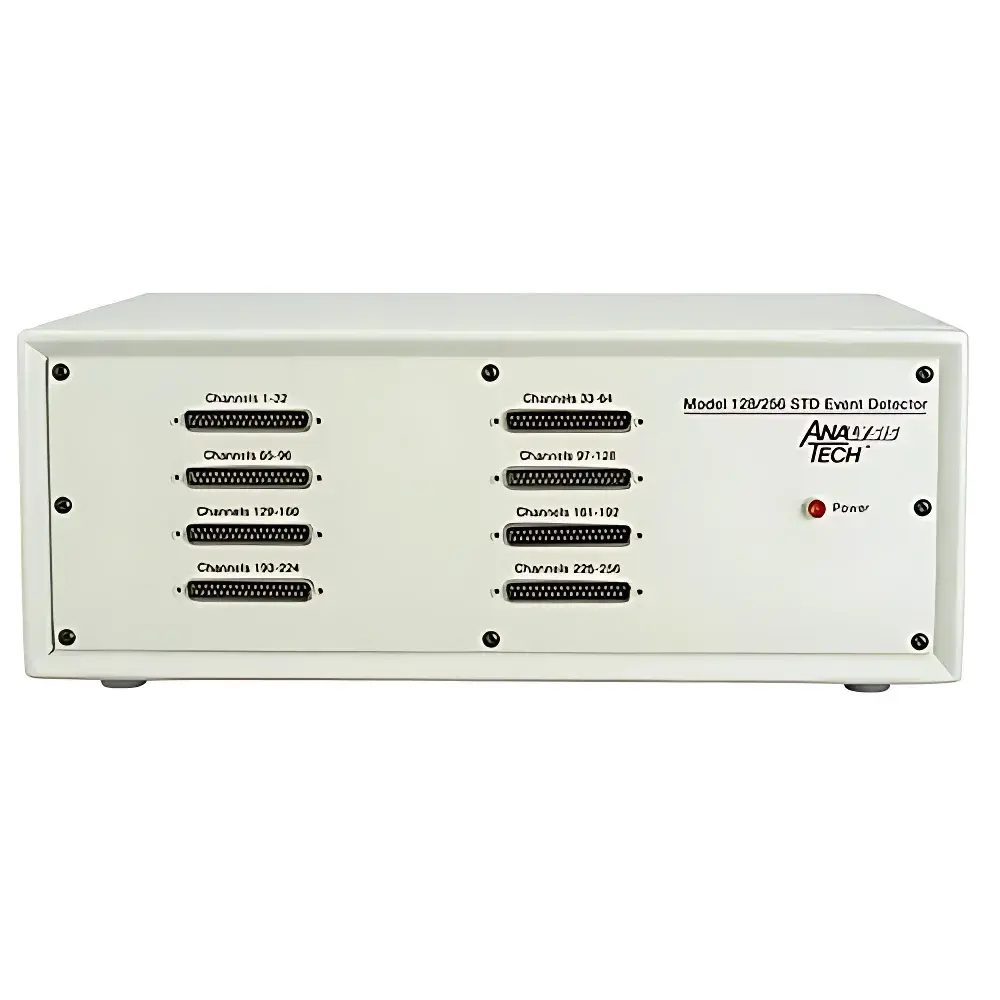
Analysis Tech STD Event Detector
| Brand | Analysis Tech |
|---|---|
| Origin | USA |
| Manufacturer Type | Authorized Distributor |
| Product Category | Imported |
| Model | STD Event Detectors |
| Pricing | Upon Request |
Overview
The Analysis Tech STD Event Detector is a high-channel-count, cost-optimized electrical continuity monitor engineered for real-time detection of transient open-circuit events in interconnect reliability testing. Operating on the principle of continuous low-current resistive monitoring, the STD series detects momentary resistance excursions exceeding user-defined threshold values—enabling precise identification of intermittent faults with nanosecond-scale temporal resolution. Its core architecture employs galvanically isolated channel sensing with fixed current sources (≤1.2 mA per channel), ensuring minimal thermal perturbation to test specimens while maintaining robust immunity to electromagnetic interference (EMI) and ground-loop noise. Designed primarily for solder joint reliability assessment under accelerated stress conditions—including thermal cycling, mechanical bending, vibration, and drop testing—the STD system captures event timestamps, cycle counts, and environmental correlation data with traceable metrological integrity. Unlike optical or manual inspection methods, this electrical monitoring approach delivers quantitative, repeatable failure onset detection, supporting statistically valid comparisons across process variations, material selections, and design iterations.
Key Features
- Scalable channel capacity: 64, 128, 192, or 256 independently monitored channels per unit; up to 1024 channels via daisy-chained configuration using optional 4-port linking cables
- User-adjustable resistance thresholds: Dual-range selection—100–400 Ω (low range) and 300–5,000 Ω (high range)—with ±4% typical tolerance and ±10% maximum tolerance
- Sub-microsecond event resolution: Fixed minimum detectable event duration of 200 ns, with ±10% typical sensitivity tolerance
- Integrated temperature module: Co-located within the main chassis; provides synchronized thermal logging, thermal cycle counting, and mechanical cycle tracking for correlated failure analysis
- Low-power, low-disturbance sensing: Channel current sources feature compliance voltages of 0.6 V (low range) and 9.8 V (high range); total system power draw: 120 VAC, 60 Hz, 3 A
- Multiple Threshold Resistance Adjustment option: Enables independent threshold setting for each group of 64 channels—critical for heterogeneous interconnect arrays with varying baseline resistances
- Standard accessories included: 10-ft PVC-insulated test cable (rated to 105 °C), USB/RS232 communication cable, WinDatalog software license, comprehensive operator manual, and 1-year limited warranty covering parts and labor
Sample Compatibility & Compliance
The STD Event Detector supports a broad range of interconnect geometries and packaging configurations, including wire-bonded die-on-PCB “daisy-chain” structures, surface-mount solder joints, flex circuit traces, biomedical sensor leads, automotive harness connectors, and MEMS switch contacts. Its electrical interface accommodates standard single-ended inputs with impedance-matched termination, minimizing signal reflection artifacts during high-speed transient capture. The system meets functional requirements outlined in industry-standard reliability test methods—including JEDEC JESD22-A104 (thermal cycling), JESD22-B111 (mechanical bending), and IPC-9701 (solder joint performance). While not certified to formal safety standards (e.g., UL/IEC 61010), its design adheres to laboratory-grade electromagnetic compatibility (EMC) practices per FCC Part 15 Class B and CISPR 22 limits. Data acquisition and storage workflows are compatible with GLP/GMP-aligned documentation protocols when used with WinDatalog’s audit-trail-enabled operation mode.
Software & Data Management
WinDatalog software serves as the primary interface for instrument control, real-time visualization, post-test analysis, and report generation. It supports time-synchronized multi-channel event logging with metadata tagging—including absolute timestamps (UTC), thermal cycle index, mechanical cycle count (from integrated temperature module), and user-defined test identifiers. Raw binary event files are stored in a proprietary but documented format; export options include CSV, Excel-compatible XML, and PDF summary reports with configurable pass/fail criteria. Version 4.2+ includes optional 21 CFR Part 11 compliance features—electronic signatures, role-based access control, and immutable audit trails—for regulated environments. All software updates, firmware patches, and technical documentation are distributed exclusively through Analysis Tech’s secure customer portal, requiring validated login credentials and annual maintenance subscription for priority support.
Applications
- Solder joint reliability validation under JEDEC-compliant thermal cycling profiles
- Flex circuit fatigue characterization during repeated bending or torsional loading
- Automotive ECU connector integrity assessment under shock/vibration spectra per ISO 16750-3
- Biomedical cable assembly testing for intermittent failures in implantable device leads
- Switch contact bounce and chatter analysis in high-reliability relay systems
- Failure root cause analysis in accelerated life testing of microelectronic packaging
- Process qualification of reflow profiles, solder paste formulations, and substrate metallization
FAQ
What is the maximum number of channels supported in a single STD system?
Up to 256 channels per unit; multiple units can be linked to achieve up to 1024 channels in a unified logical system.
Can the STD Event Detector operate in high-temperature environments?
The base unit operates at ambient temperatures up to 50 °C; optional high-temp input cables rated to 200 °C enable testing inside environmental chambers.
Is WinDatalog compliant with FDA 21 CFR Part 11?
Yes—when configured with electronic signature modules and audit-trail logging enabled, WinDatalog supports Part 11 requirements for electronic records and signatures.
Does the system support custom threshold settings per individual channel?
No—thresholds are set per group of 64 channels via the Multiple Threshold Resistance Adjustment option; fully per-channel thresholding is not supported.
How is thermal cycle data synchronized with electrical event logs?
The integrated temperature module shares the same internal clock and timestamping engine as the event detector, ensuring sub-millisecond synchronization between thermal transitions and resistance excursions.



