
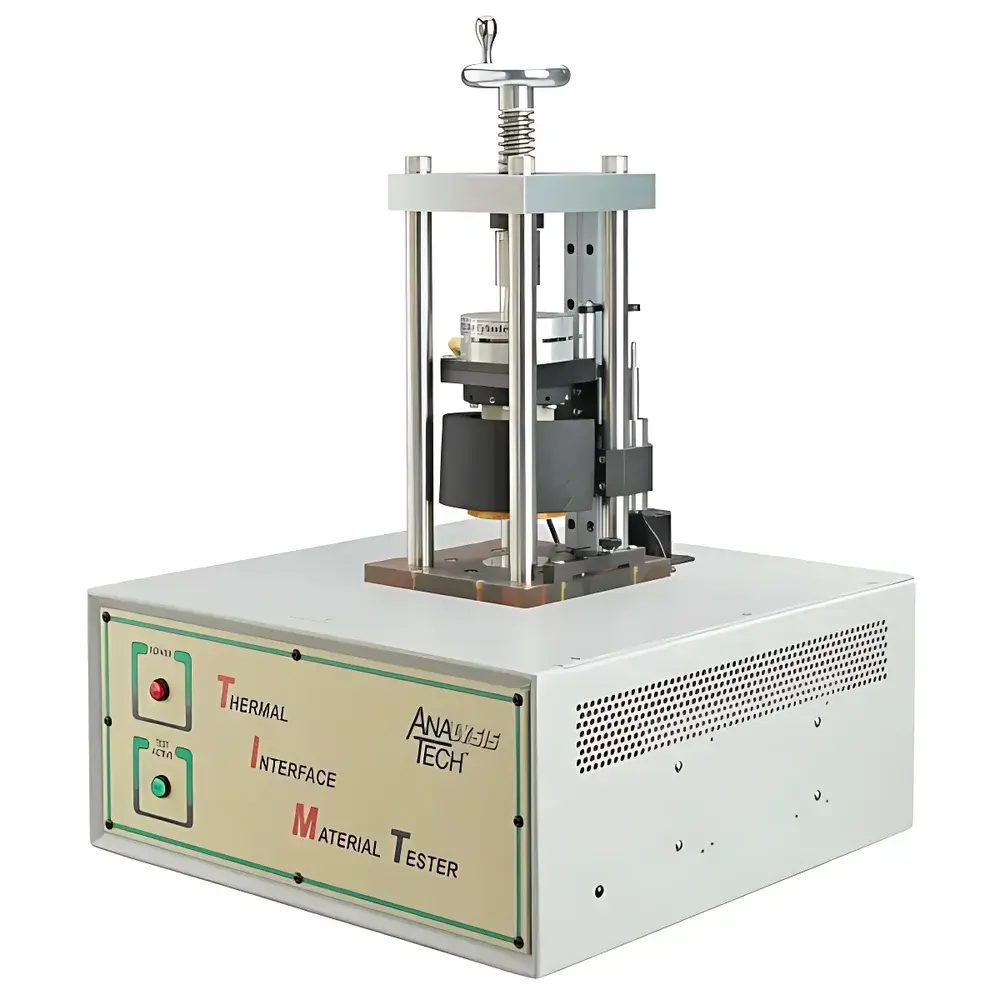
Analysis Tech TIM1300/1400 Thermal Interface Material Tester
| Brand | Analysis Tech |
|---|---|
| Origin | USA |
| Model | TIM1300 / TIM1400 |
| Test Method | ASTM D5470 |
| Sample Diameter | 1.3 in (33 mm) |
| Thickness Range | 0–20 mm |
| Temperature Range | 20–65°C (TIM1300), 20–130°C (TIM1400) |
| Contact Pressure Range | 5–380 psi (34–2600 kPa) |
| Thickness Measurement Accuracy | ±1% + 0.001 in (±25 µm) |
| Thermal Resistance Range | 0.005–8 K/W |
| Power Supply | 100–230 VAC, 50/60 Hz |
| Cooling Requirement | 6 L/min @ 10–35°C, ±0.1°C stability |
| Compressed Air | ≥90 psi (600 kPa), 10 µm filtration |
| Dimensions (H×W×D) | 58×41×43 cm |
| Weight | 19 kg (TIM1300), 21 kg (TIM1400) |
Overview
The Analysis Tech TIM1300 and TIM1400 Thermal Interface Material Testers are precision-engineered, automated instruments designed to measure thermal resistance (R-value) and thermal conductivity (k-value) of thin, compressible materials in accordance with ASTM D5470–22, “Standard Test Method for Thermal Transmission Properties of Thermally Conductive Electrical Insulation Materials.” These systems implement the guarded-hot-plate principle under controlled uniaxial compression, where a sample is clamped between two parallel, temperature-controlled metal plates — one actively heated, the other actively cooled — establishing a steady-state one-dimensional heat flux across the specimen. The thermal conductivity is derived from Fourier’s law: k = q × d / ΔT, where q is the measured heat flux (W/m²), d is the in-situ electronically measured sample thickness (m), and ΔT is the differential temperature across the sample (K). Unlike comparative or transient methods, ASTM D5470 provides absolute, traceable measurements without reliance on reference standards — enabling direct compliance with ISO/IEC 17025-accredited laboratory requirements.
Key Features
- Full automation via WinTIM v5.x graphical user interface — supports test setup, real-time parameter control, data acquisition, and post-processing in a single integrated environment
- In-situ electronic thickness measurement with ±1% + 25 µm accuracy — eliminates manual micrometer error and enables dynamic correction of k for compression-induced thickness change
- Dual operational modes: constant-pressure testing (ASTM D5470 Type II/III materials) and constant-thickness testing (Type I/II), configurable per test sequence
- Four interchangeable pressure kit options (0–380 psi / 0–2600 kPa), each calibrated to ±3% full-scale accuracy; software auto-detects installed kit and applies appropriate gain compensation
- Programmable pre-heat (“bake”) cycle for phase-change thermal interface materials (PC-TIMs), with ramp-and-soak profiles up to 70°C
- Integrated safety monitoring: low coolant flow detection, compressed air pressure loss alarm, plate overtemperature lockout, and mechanical overload protection
- USB 2.0 interface compliant with Windows 7/10 (32- and 64-bit Professional editions); no external DAQ hardware required
- Onboard self-calibration routines for force, temperature, and thickness sensors — validated using NIST-traceable reference samples included in the Calibration Kit
Sample Compatibility & Compliance
The TIM1300/1400 accommodates rigid, flexible, and semi-viscous solids including silicone greases, phase-change pads, graphite films, metal-filled elastomers, solder alloys, and ceramic-filled polymer composites. Sample diameter must be 33 mm (1.3 in) for nominal accuracy; non-standard diameters require custom area adapters and result in reduced uncertainty specification per ASTM D5470 Annex A3. Both models comply fully with ASTM D5470–22 Section 7 (Apparatus Requirements) and Section 9 (Test Procedure), and support GLP/GMP-aligned audit trails through WinTIM’s built-in 21 CFR Part 11-compliant electronic signature module (optional license). All thermal data files include embedded metadata: timestamp, operator ID, environmental conditions, pressure/temperature setpoints, raw sensor outputs, and uncertainty budget per ISO/IEC Guide 98-3 (GUM). Reference samples supplied with each system are certified for long-term stability and used for periodic verification — not for calibration transfer, as ASTM D5470 defines an absolute method.
Software & Data Management
WinTIM software delivers deterministic test execution, real-time visualization of thermal transients, and export-ready reporting. Each test generates a structured .csv file containing time-stamped records of heat flux, ΔT, thickness, contact pressure, and plate temperatures at ≥1 Hz resolution. Graphical overlays enable rapid identification of interfacial contact resistance (Rc) via extrapolation of Rtotal vs. thickness plots. Batch analysis tools compute statistical summaries (mean, SD, CV%) across pressure or temperature sweeps. Data exports support Excel (.xlsx), MATLAB (.mat), and generic ASCII formats. Audit logs record all user actions, parameter changes, and system events with immutable timestamps — essential for FDA-regulated environments. Software updates are distributed via secure HTTPS portal; version history and release notes comply with IEC 62304 Class B medical device software requirements.
Applications
These instruments serve critical roles in electronics thermal management R&D and manufacturing quality assurance. Primary use cases include: qualification of TIMs for CPU/GPU cooling modules; validation of thermal performance under varying bondline thicknesses and clamping loads; comparative evaluation of grease pump-out resistance; screening of die-attach materials for power semiconductor packaging; and reliability assessment of PC-TIMs during thermal cycling. In academic and national labs, the TIM1400 supports high-temperature studies of emerging nanocomposites and metal matrix TIMs up to 130°C. Automotive suppliers utilize pressure-batch mode to correlate thermal impedance with mechanical compression curves for battery pack thermal pads. All applications benefit from the system’s ability to decouple bulk conduction from interfacial resistance — a capability central to optimizing thermal interface design in multi-layer assemblies.
FAQ
Does the TIM1300/1400 require reference standards for calibration?
No. ASTM D5470 is an absolute measurement method; calibration relies on traceable sensor metrology (NIST-traceable thermistors, load cells, and LVDTs), not comparative reference materials.
What external utilities are mandatory for operation?
A recirculating chiller (6 L/min, 10–35°C, ±0.1°C stability), shop-grade compressed air (≥90 psi, ≤10 µm particulates), and a Windows PC (7/10 Pro, USB 2.0) are required. AC power must match local grid specifications (100–230 VAC, 50/60 Hz).
Can the system test liquids or powders?
No. ASTM D5470 applies only to solid or semi-solid materials capable of sustaining uniaxial compressive load without extrusion or flow under test conditions.
How is thermal contact resistance quantified?
By performing thickness sweeps at fixed pressure and plotting total thermal resistance (Rtotal) versus measured thickness; the y-intercept yields Rc, while slope yields bulk resistivity (R″).
Is remote operation or network integration supported?
WinTIM supports local USB control only. For networked lab environments, users deploy virtual desktop infrastructure (VDI) or terminal server solutions — though all real-time control loops remain host-local per USB latency constraints.



