
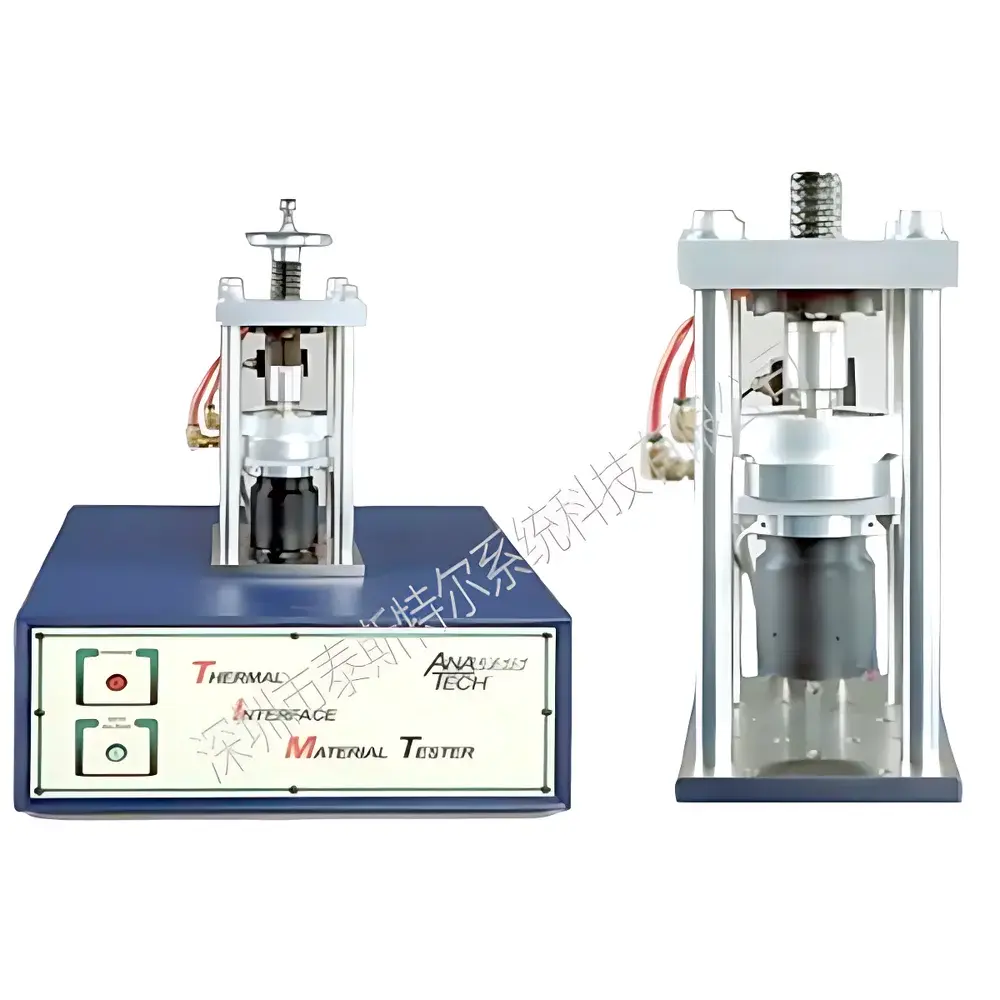
ANALYSIS TECH TIMTester 1300 & 1400 Thermal Interface Material Tester
| Brand | ANALYSIS TECH |
|---|---|
| Origin | USA |
| Manufacturer Type | Authorized Distributor |
| Origin Category | Imported |
| Model Series | TIMTester 1300, TIMTester 1400 |
| Pricing | Upon Request |
Overview
The ANALYSIS TECH TIMTester 1300 and 1400 are fully automated, steady-state thermal resistance and thermal conductivity measurement systems engineered for precision characterization of thermal interface materials (TIMs) used in high-performance electronics packaging. These instruments operate on the guarded hot plate principle—compliant with ASTM D5470 “Standard Test Method for Thermal Transmission Properties of Thermally Conductive Electrical Insulation Materials”—where a sample is compressed between two parallel, temperature-controlled plates: a heated upper platen and a cooled lower platen. A known heat flux is driven vertically through the specimen under controlled interfacial pressure, while high-accuracy thermocouples (Type T or calibrated RTDs) measure the temperature differential across the sample thickness. Thermal conductivity (k, W/m·K) is calculated from Fourier’s law: k = q × t / ΔT, where q is the applied heat flux (W/m²), t is the measured sample thickness (m), and ΔT is the steady-state temperature gradient (K). Thermal resistance (R, K/W) is derived directly as R = ΔT / Q, where Q is the total heat flow (W). The system’s architecture ensures traceable, reproducible measurements essential for R&D validation, process control, and qualification per IPC-4104, JEDEC JESD51-14, and IEC 60990 requirements.
Key Features
- Fully automated test execution via proprietary Windows-based software—no manual intervention required for thickness measurement, pressure ramping, temperature stabilization, or data acquisition.
- Real-time, non-contact electronic thickness measurement using dual linear variable differential transformers (LVDTs) mounted on both platens—eliminates operator error and enables dynamic correction of k-value calculations during compression.
- Three interchangeable pressure kits (Kit 1: 5–95 psi; Kit 2: 10–170 psi; Kit 3: 20–380 psi) with ±2.7% full-scale accuracy—supports evaluation of TIM performance across industry-relevant mechanical loading conditions.
- Programmable temperature control (20 °C to 65 °C, ±0.1 °C stability) with active cooling via integrated chiller (RS232-controlled) and optional external recirculating coolant loop.
- Dual operational modes: Thickness-Controlled Mode (constant t, variable P) and Pressure-Controlled Mode (constant P, variable t)—enabling systematic study of compressibility effects on thermal transport.
- Comprehensive real-time fault monitoring: low coolant flow detection, low pneumatic supply pressure alarm, over-temperature lockout, and platen misalignment safeguard.
- Robust mechanical frame with hardened stainless steel platens, precision-ground surfaces (Ra < 0.4 µm), and ISO 9001-certified calibration traceability.
Sample Compatibility & Compliance
The TIMTester 1300/1400 accommodates solid, semi-solid, viscous, phase-change, and elastomeric TIMs—including greases, gels, pads, films, solder preforms, and metal-filled pastes. Sample diameter range: 22–33 mm (0.9–1.3 in); minimum thickness: ≥0.1 mm. All measurements adhere strictly to ASTM D5470, with additional alignment to ISO 22007-2 for polymer-based insulators and JEDEC JESD51-14 Annex B for transient-compression thermal resistance profiling. System firmware and software support 21 CFR Part 11-compliant audit trails, electronic signatures, and secure user role management—meeting GLP/GMP documentation requirements for regulated electronics manufacturing environments.
Software & Data Management
The TIMControl Suite provides intuitive workflow-driven operation with customizable test protocols, multi-step pressure/temperature ramps, and batch processing. Raw sensor data (heat flux, ΔT, thickness, pressure, time) are logged at 10 Hz and stored in encrypted .tdms format. Automated report generation includes PDF exports containing: test parameters, raw curves (k vs. P, R vs. t), statistical uncertainty analysis (±1σ confidence intervals per NIST SP 958 guidelines), and comparative overlays across multiple samples or lots. Export options include CSV, Excel, and XML for LIMS integration. Calibration certificates (including platen flatness, thermocouple drift, and load cell linearity) are embedded and version-controlled within the software database.
Applications
- Qualification of TIMs for CPU/GPU heatsink interfaces, power module substrates, and battery thermal management systems.
- Development of low-void, high-compliance thermal pastes for automotive ADAS ECUs and EV inverters.
- Validation of compressible gap fillers under cyclic thermal-mechanical stress (e.g., -40 °C to 125 °C, 5–1000 cycles).
- Correlation studies between TIM microstructure (via SEM/EDS) and macroscopic thermal resistance under varying interfacial pressures.
- Support for DOE-based optimization of TIM formulation parameters (filler loading, particle size distribution, binder rheology).
- Third-party certification testing per UL 746C, MIL-STD-883 Method 1012.1, and AEC-Q200 stress screening protocols.
FAQ
What standards does the TIMTester 1300/1400 comply with?
ASTM D5470, ISO 22007-2, JEDEC JESD51-14, and IPC-4104—full compliance documentation and test method validation reports are provided with each system.
Can the system measure phase-change materials (PCMs) during their transition?
Yes—the instrument supports isothermal hold sequences at user-defined temperatures within 20–65 °C, enabling thermal resistance mapping before, during, and after phase transition under constant pressure.
Is thickness measurement performed before or during compression?
Thickness is measured dynamically and continuously throughout the entire compression cycle using dual LVDTs—enabling real-time k-correction and eliminating reliance on pre-test calipers.
How is system calibration maintained over time?
Annual NIST-traceable recalibration services are available; built-in self-diagnostic routines verify platen parallelism, thermocouple offset, and load cell hysteresis prior to every test run.
Does the software support automated pass/fail criteria against specification limits?
Yes—users can define upper/lower specification limits for k, R, and compressibility; the software flags outliers and generates deviation reports compliant with ISO/IEC 17025 reporting requirements.



