
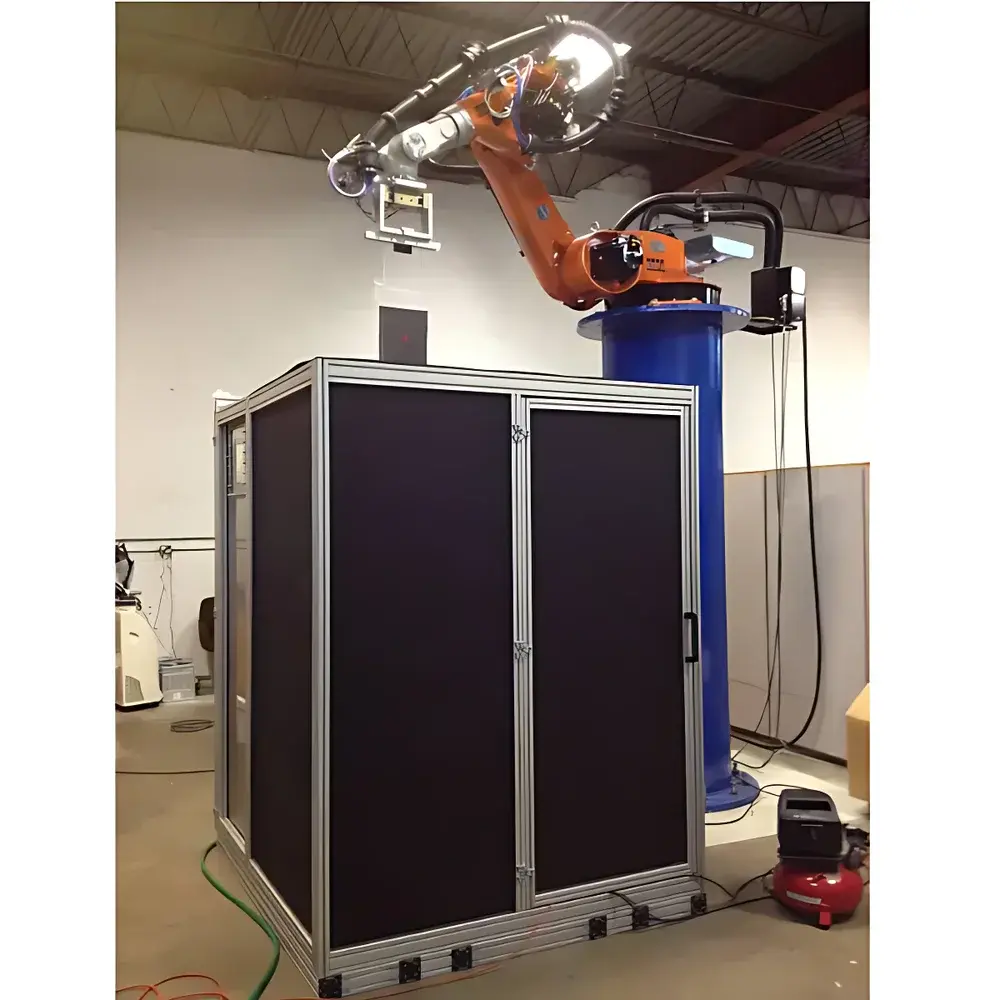
Analysis U-AT Ultrasonic Camera
| Brand | Analysis |
|---|---|
| Origin | USA |
| Manufacturer Type | Manufacturer |
| Origin Category | Imported |
| Model | U-AT |
| Instrument Type | Digital |
| Flaw Detection Method | Pulse-Echo |
| Waveform | Pulsed Ultrasonic |
Overview
The Analysis U-AT Ultrasonic Camera is a paradigm-shifting digital ultrasonic imaging system engineered for rapid, full-field, non-destructive evaluation (NDE) of complex composite and metallic components. Unlike conventional C-scan systems requiring point-by-point raster scanning or mechanical probe traversal, the U-AT operates on a single-shot, area-based acquisition principle analogous to digital radiography (DR). It employs a planar ultrasonic transducer array as the source and a high-resolution, wide-area piezoelectric sensor panel as the detector—both positioned on opposite faces of the test object. Acoustic energy propagates through the material, and variations in transmission—caused by delaminations, porosity, disbonds, or fiber misalignment—are captured simultaneously across the entire field of view. The system reconstructs quantitative ultrasonic transmission images in real time, delivering immediate visual feedback without motion artifacts or alignment dependencies. This architecture eliminates the need for precision positioning stages, significantly reducing inspection cycle time while maintaining metrological traceability aligned with ASTM E2700 and ISO 16810 standards for ultrasonic NDT.
Key Features
- Single-shot, full-field ultrasonic transmission imaging—no mechanical scanning required
- High spatial resolution optimized for small-form-factor aerospace structures including ribs, stringers, and contoured sandwich panels
- Angle-insensitive detection: robust performance across variable incidence angles due to wide-aperture parallel beam illumination
- Digital signal acquisition with 16-bit dynamic range and synchronized time-of-flight gating for depth-resolved contrast enhancement
- Integrated hardware-accelerated reconstruction engine enabling sub-second image generation post-acquisition
- Compact, portable form factor designed for shop-floor integration and field-deployable inspections
- Compliance with FAA AC 20-108B guidelines for composite NDI method qualification
Sample Compatibility & Compliance
The U-AT is validated for use on carbon-fiber-reinforced polymer (CFRP), fiberglass laminates, aluminum honeycomb cores, and hybrid metal-composite assemblies up to 25 mm thick. Its transmission-mode architecture ensures consistent sensitivity across curved surfaces—including convex, concave, and doubly curved geometries—where conventional pulse-echo methods suffer from coupling variability and beam skewing. The system meets the technical requirements outlined in Boeing D6-17487 Rev. R for ultrasonic transmission imaging qualification and has been formally endorsed by Boeing Commercial Airplanes for use in production-level inspection of winglet root joints, empennage fairings, and fuselage doublers. All firmware and calibration protocols adhere to AS9100D quality management system requirements and support GLP/GMP audit readiness, including full electronic record retention per FDA 21 CFR Part 11.
Software & Data Management
The U-AT is operated via Analysis’ proprietary NDE Studio software platform, which provides intuitive workflow-driven inspection sequencing, automated defect annotation, and comparative overlay analysis against reference standards. Image data are stored in vendor-neutral DICOM-SR format with embedded metadata—including transducer frequency, gain settings, gate parameters, and environmental conditions—to ensure long-term archival integrity and interoperability with enterprise PLM systems. Software modules support statistical process control (SPC) charting, batch report generation compliant with ASME BPVC Section V Article 4, and export to PDF/A-2b for regulatory submission. Audit trails log all user actions, parameter changes, and calibration events with timestamped, tamper-evident digital signatures.
Applications
- Rapid screening of CFRP aircraft structural joints (e.g., L-joints, T-joints, and scarf repairs)
- In-process verification of adhesive bond integrity in multi-layer assemblies
- Porosity and microcrack mapping in thermoplastic composites used in next-generation airframes
- Validation of automated fiber placement (AFP) layup quality prior to curing
- Field inspection of radome and antenna housing integrity without disassembly
- Supporting FAA/EASA continued airworthiness programs through repeatable baseline comparison
FAQ
How does the U-AT differ from conventional ultrasonic C-scan systems?
It replaces sequential point scanning with simultaneous full-field transmission capture—reducing inspection time from minutes to seconds while eliminating mechanical drift errors.
Is couplant required?
Yes, water-based or gel couplant is used between the transducer array and part surface; however, no couplant is needed at the detector side due to the dry-coupled sensor panel design.
Can the U-AT detect subsurface defects in thick-section composites?
It is optimized for thin-to-medium thicknesses (≤25 mm); deeper penetration requires lower-frequency configurations, which may be available under custom engineering engagement.
Does the system support automated pass/fail decision logic?
Yes—threshold-based defect classification rules can be configured and locked down per inspection procedure, with configurable alarms and exportable compliance reports.
What calibration standards are supported?
Boeing BMS 8-263 Type I & II reference blocks, ASTM E2491 phased array validation standards, and customer-specific artificial flaw sets均可 imported and registered within the software.



