
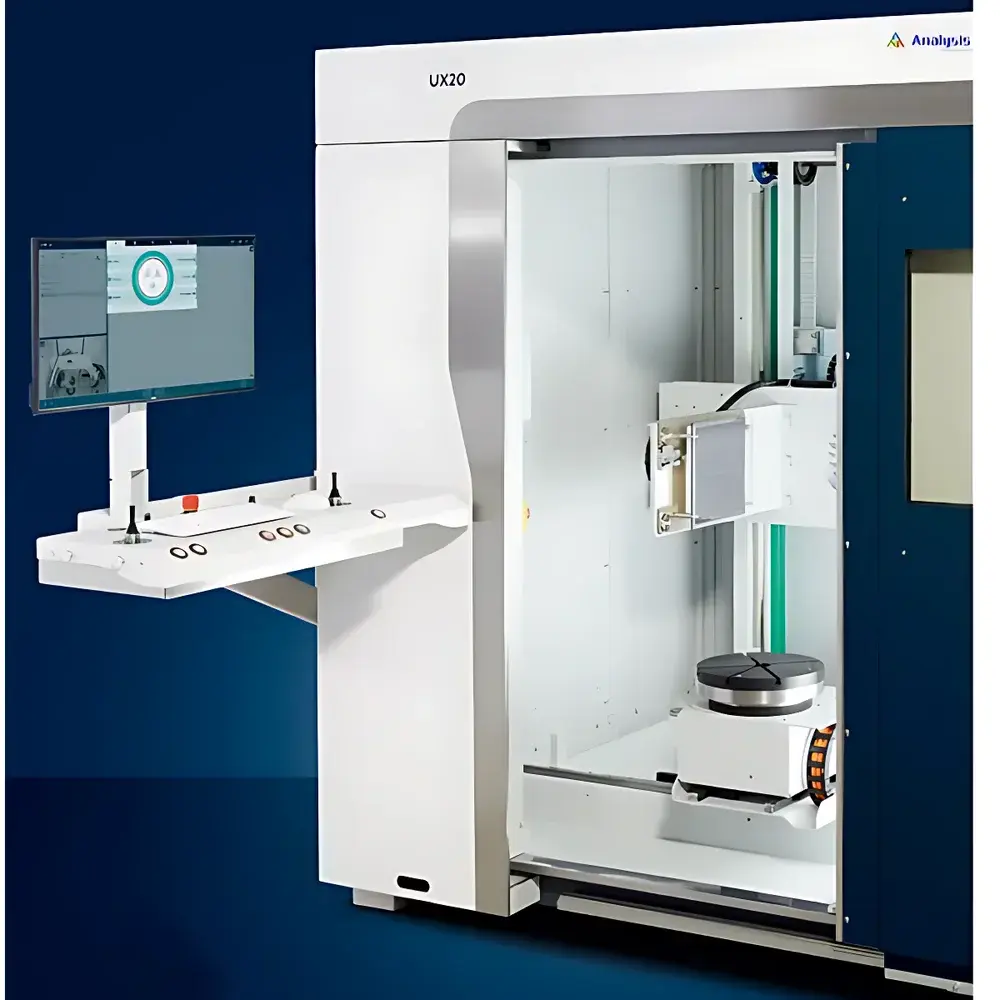
Analysis UX20 Industrial Micro-CT System
| Brand | Analysis |
|---|---|
| Origin | Germany |
| Manufacturer | Analysis GmbH |
| Origin Category | Imported |
| Model | UX20 |
| Price | Upon Request |
| Detector Type | Flat-Panel Detector |
| Scanning Mode | Translation-Rotation (TR) |
| Accuracy | Micron-Level |
| Sample Load Capacity | 100 kg |
| Dimensions (W×D×H) | 2240 × 1770 × 2350 mm |
Overview
The Analysis UX20 Industrial Micro-CT System is a high-performance, benchtop-integrated X-ray computed tomography platform engineered for non-destructive evaluation (NDE) of medium-to-large industrial components. Leveraging cone-beam geometry and a translation-rotation (TR) scanning trajectory, the UX20 acquires volumetric datasets with micron-level spatial resolution—enabling quantitative 3D metrology, defect characterization, and internal structural analysis without sample sectioning. Designed specifically for foundries, aerospace suppliers, and additive manufacturing facilities undergoing rapid digital transformation, the system delivers robust performance across diverse material systems—including aluminum and magnesium alloys, titanium, nickel-based superalloys, fiber-reinforced polymers, ceramics, and hybrid assemblies. Its integrated radiation shielding meets IEC 61331-1 and DIN 54113 standards, supporting safe operation in production environments without dedicated vaults.
Key Features
- Field-proven “Casting Insights” ADR software suite with configurable automation levels—from guided operator-assisted inspection to fully autonomous defect classification per ISO 10893-11 and ASTM E2864.
- Dual-mode imaging architecture supporting both real-time 2D radiography and high-fidelity 3D CT reconstruction within a single workflow.
- ScatterFix 2.0 scatter correction algorithm optimized for large-volume scans, improving surface definition and reducing beam-hardening artifacts in thick-section castings.
- SmartGuard collision avoidance system integrated into the Geminy user interface—dynamically calculates safe motion envelopes during part positioning, especially critical for asymmetric or overhanging geometries.
- MesoFocus X-ray source technology offering three selectable focal spot sizes (≤5 µm to ≥50 µm), balancing resolution, flux, and tube longevity for mixed-use production labs.
- ScanExtend and FlexCenter software modules enabling field-of-view extension and virtual rotation axis alignment—eliminating physical repositioning for ROI-centric scanning of complex assemblies.
- HealthMonitor dashboard providing real-time system diagnostics, tube usage tracking, detector calibration status, and thermal stability metrics aligned with GLP/GMP operational logging requirements.
Sample Compatibility & Compliance
The UX20 accommodates specimens up to 100 kg and dimensions compatible with standard automotive powertrain housings, turbine blades, brake calipers, and AM-built structural brackets. It supports multi-material inspection workflows across metallics (including high-Z alloys), composites, and ceramics—without requiring contrast agents or destructive preparation. All software modules comply with FDA 21 CFR Part 11 for electronic records and signatures; audit trails are enabled by default. Image acquisition protocols adhere to ASTM E1441 (Standard Guide for Computed Tomography), ISO/IEC 17025:2017 (for accredited labs), and VDI/VDE 2630-1.2 for dimensional CT validation.
Software & Data Management
Geminy serves as the unified control interface for both radiographic and tomographic operations, featuring role-based access control (administrator, technician, operator) with parameter locking and guided workflow templates. TrueInspect ADR engine performs automated void, porosity, crack, and inclusion detection using supervised machine learning models trained on certified reference standards. Reports export in PDF/A-1b, DICOM-CT, and VGStudio MAX-compatible formats. Automatic data transmission integrates with enterprise file servers via SMB/CIFS or SFTP—assigning metadata including part ID (manual entry or barcode-scanned), timestamp, operator ID, and inspection parameters. All raw projections and reconstructed volumes are stored with SHA-256 checksums for integrity verification.
Applications
- Cast component QA: Detection and quantification of sub-millimeter shrinkage pores, gas porosity, inclusions, and cold shuts in aluminum cylinder heads, gearbox casings, and structural nodes.
- AM process validation: Layer-wise defect mapping, powder residue identification, and lattice structure fidelity assessment per ASTM F3122 and ISO/ASTM 52900.
- Weld integrity analysis: Fusion zone geometry, lack-of-penetration, and solidification cracking in robotic TIG/MIG joints.
- Assembly verification: Positional accuracy of embedded sensors, fastener seating depth, gasket compression, and interference fits.
- Failure root cause analysis: Corrosion propagation pathways, fatigue crack initiation sites, and interfacial delamination in bonded or brazed joints.
- First-article inspection and PPAP compliance: Traceable dimensional reporting with GD&T overlays against CAD nominal geometry.
FAQ
What is the maximum detectable defect size under standard operating conditions?
Sub-1 mm volumetric defects (e.g., spherical pores ≥0.3 mm) are reliably resolved in aluminum castings ≤300 mm in diameter using default TR scan protocols.
Does the UX20 support automated pass/fail decisioning per automotive OEM specifications?
Yes—Casting Insights implements configurable ADR rules aligned with VW 60315, Ford WSS-M1A302-B, and GM 1927G, including statistical process control (SPC) output for trend analysis.
Can the system be integrated into an Industry 4.0 production line?
Native OPC UA server support enables bidirectional communication with MES/SCADA platforms; PLC-triggered scan initiation and result feedback are factory-configurable.
Is remote monitoring and troubleshooting supported?
Analysis Remote Assist provides encrypted screen-sharing and diagnostic telemetry with customer-controlled session authorization—fully compliant with GDPR and ISO/IEC 27001.
What maintenance intervals are recommended for the MesoFocus X-ray tube?
Predictive maintenance alerts are generated based on cumulative tube-on time and thermal cycling history; typical service intervals range from 12–18 months under continuous shift operation.



