
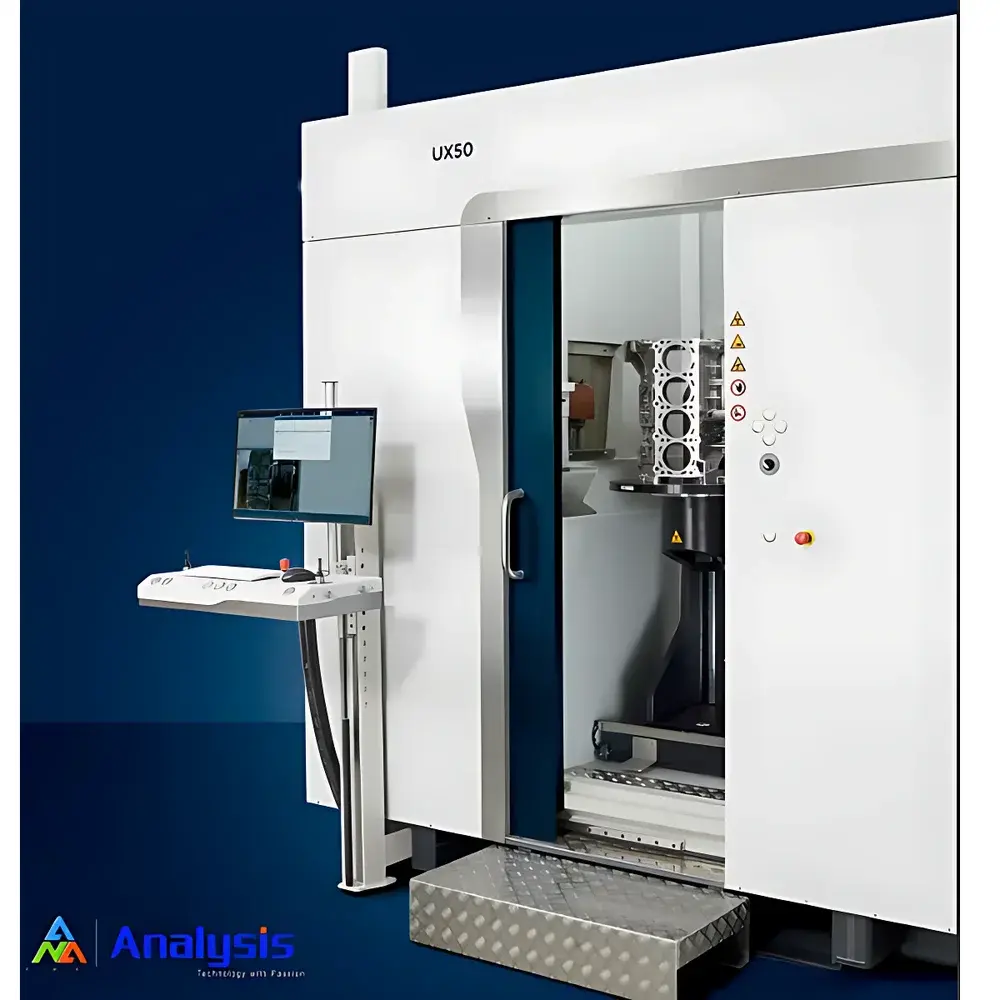
Analysis UX50 Industrial X-ray Imaging System
| Brand | Analysis |
|---|---|
| Origin | Germany |
| Manufacturer | Analysis GmbH |
| Origin Category | Imported |
| Model | UX50 |
| Pricing | Upon Request |
| Detector Type | Flat-Panel Detector (FPD) |
| Scanning Mode | Translation-Rotation (TR) |
| Accuracy | Micron-Level |
| Maximum Sample Weight | 100 kg |
| Dimensions (L×W×H) | 2250 × 1770 × 2350 mm |
Overview
The Analysis UX50 Industrial X-ray Imaging System is a high-performance, dual-mode (2D radiography and 3D computed tomography) non-destructive testing (NDT) platform engineered for precision metrology, defect analysis, and internal structural validation across demanding industrial environments. Built upon a robust 450 kV microfocus X-ray source and modular detector architecture, the UX50 implements both cone-beam CT (CBCT) and fan-beam CT (FBCT) acquisition geometries—enabling adaptive trade-offs between scan speed, spatial resolution, and volumetric fidelity. Its core measurement principle relies on differential X-ray attenuation through heterogeneous materials, reconstructed via filtered back-projection (FBP) and iterative algorithms to generate quantitative 3D voxel datasets with isotropic resolution down to the micron level. Designed for integration into quality assurance workflows compliant with ISO 17025, ASTM E1441, and EN 13660, the UX50 supports traceable dimensional metrology, porosity quantification, wall thickness analysis, and assembly verification without sample preparation or destruction.
Key Features
- Modular detector compatibility: Supports interchangeable flat-panel detectors (e.g., Y.Panel 4343N) and line-detector arrays (LDA, e.g., CTScan 3), enabling optimization for throughput (LDA) or full-field detail (FPD)
- Advanced CT acquisition modes: Includes QuickScan® (continuous rotation), QualityScan® (step-and-shoot with ring artifact suppression), and HeliExtend® (helical field-of-view extension to mitigate cone-beam artifacts)
- Geminy software platform: Intuitive, workflow-driven user interface with automated detector calibration, real-time image sharpness assessment, and sequence-based inspection programming
- Field-of-view expansion capabilities: Horizontal and vertical FOV extension—both individually and in combination—to accommodate large or irregularly shaped components up to 100 kg
- Image enhancement suite: Integrated ScatterFix 2.0 (scattering correction), beam hardening correction (BHC), and metal artifact reduction (MAR) algorithms for improved contrast-to-noise ratio and geometric accuracy
- Future-proof hardware design: On-site upgrade path from single-detector to dual-detector configuration; firmware and software updates delivered regularly via Geminy’s update framework
Sample Compatibility & Compliance
The UX50 accommodates a broad spectrum of industrial specimens—including aluminum alloy castings, stainless steel weldments, nickel-based superalloy turbine blades, EV battery modules, MEMS assemblies, geological cores, and paleontological fossils. Its 100 kg load capacity and TR scanning geometry support parts ranging from small electronics to large powertrain components (e.g., motor housings, gearbox casings). The system complies with IEC 61000-6-3 (EMC), IEC 61000-6-4 (industrial emission), and meets radiation safety requirements per IEC 62495. All CT reconstruction and measurement routines are auditable and support GLP/GMP documentation protocols, including 21 CFR Part 11–compliant electronic signatures and full audit trails when deployed with validated Geminy configurations.
Software & Data Management
Geminy serves as the unified control, reconstruction, and analysis environment for the UX50. It provides DICOM-compliant data export, STL mesh generation, GD&T evaluation (per ASME Y14.5 and ISO 1101), and volumetric defect classification (pores, inclusions, cracks ≥1 mm and sub-millimeter features). Raw projection data is stored in HDF5 format with embedded metadata (source parameters, detector settings, stage positions). Reconstruction pipelines support GPU-accelerated FDK and SART algorithms, while post-processing modules enable density calibration, phase segmentation, and time-resolved 4D CT (for in-situ mechanical testing). Data integrity is ensured via checksum validation, version-controlled processing scripts, and optional integration with LIMS or QMS platforms via RESTful API.
Applications
- Aerospace: Inspection of turbine blades for internal cooling channel integrity, coating delamination, and casting porosity
- Automotive: Validation of EV battery cell alignment, weld penetration depth in structural aluminum joints, and additive-manufactured brake calipers
- Foundry & Casting: Quantitative analysis of shrinkage cavities, gas pores, and inclusions in iron, aluminum, and magnesium alloys
- Electronics: Solder joint voiding assessment, wire bond integrity, and PCB layer registration in high-density packages
- Research & Development: In-situ deformation studies, fluid flow visualization in porous media, and fossil morphology reconstruction at sub-5 µm effective voxel resolution
FAQ
What is the minimum detectable defect size under standard operating conditions?
Sub-millimeter defects (down to ~50 µm depending on material density, part geometry, and acquisition parameters) are reliably resolved using optimized CBCT protocols with FPD detection.
Can the UX50 perform dimensional metrology compliant with ISO 15530-3?
Yes—when equipped with calibrated reference objects and operated within validated environmental conditions (temperature-stabilized lab), the UX50 achieves volumetric measurement uncertainties ≤ (5 + L/100) µm (k=2) for features ≥ 0.5 mm.
Is remote operation and monitoring supported?
Geminy supports secure remote desktop access, live projection streaming, and scheduled scan queue management via TLS-encrypted network connections.
Does the system support automated pass/fail reporting for production line integration?
Yes—customizable inspection templates with rule-based decision logic, configurable tolerance bands, and PDF/CSV report generation are fully scriptable and deployable in high-throughput QA environments.
What regulatory standards does the UX50 meet for pharmaceutical or medical device applications?
While primarily designed for industrial NDT, its metrological traceability, audit trail functionality, and Part 11 readiness make it suitable for regulated R&D use in medical device development—subject to site-specific validation per ISO 13485 and FDA guidance.



