
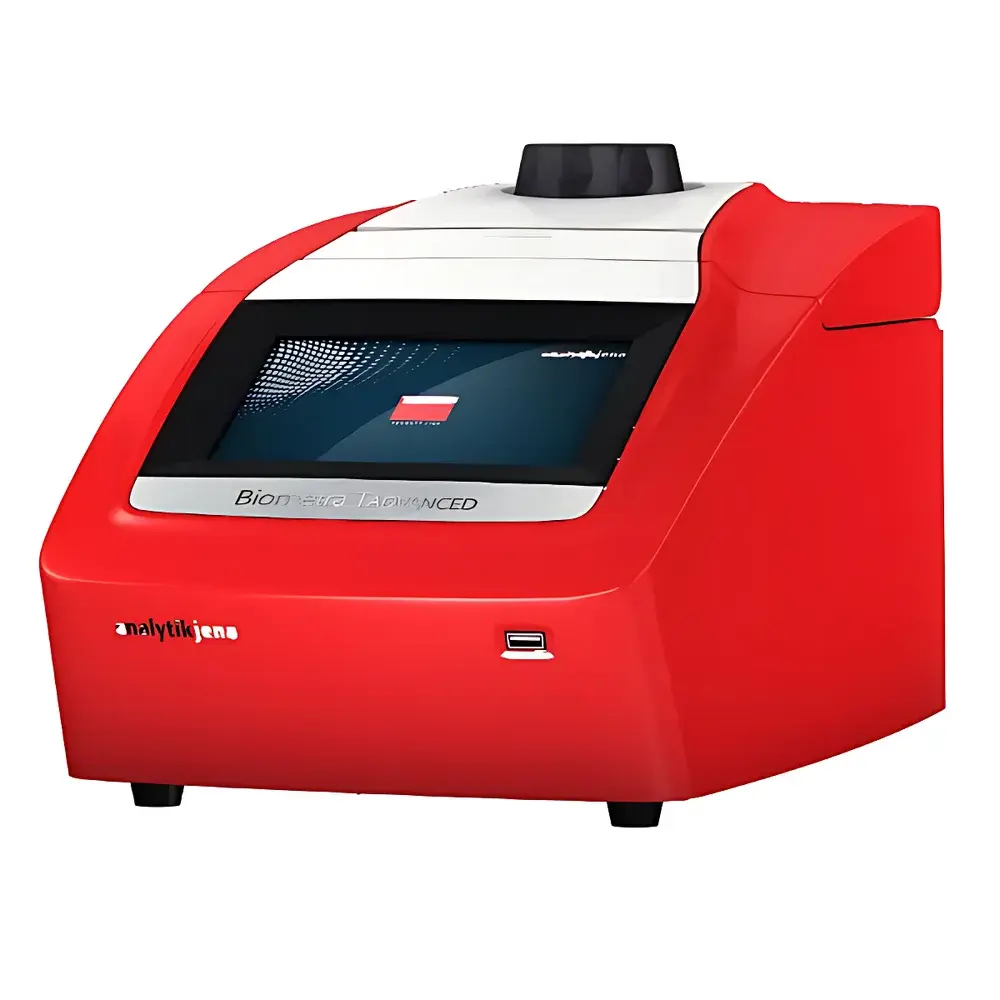
Analytik Jena Biometra TAdvanced 384G High-Throughput Thermal Cycler
| Brand | Analytik Jena |
|---|---|
| Origin | Germany |
| Manufacturer | Analytik Jena GmbH |
| Product Category | Imported Instrument |
| Model | Biometra TAdvanced 384G |
| Throughput | 384-well format |
| Heating Rate | 4 °C/s |
| Temperature Accuracy | ±0.1 °C |
| Well-to-Well Temperature Uniformity | ±0.15 °C |
Overview
The Analytik Jena Biometra TAdvanced 384G is a high-performance, fully programmable thermal cycler engineered for precision and reproducibility in high-throughput polymerase chain reaction (PCR) applications. Designed and manufactured in Jena, Germany, this instrument employs Peltier-based thermoelectric heating and cooling technology coupled with an advanced real-time adaptive control (RAC) algorithm to deliver exceptional thermal performance across all 384 wells simultaneously. Unlike conventional cyclers relying on open-loop or basic PID control, the RAC system continuously monitors and dynamically adjusts power delivery to eliminate temperature overshoot and undershoot—ensuring that the actual block temperature precisely tracks the programmed ramp profile at every stage of denaturation, annealing, and extension. This closed-loop architecture is critical for sensitive applications including multiplex PCR, qPCR assay development, and library amplification prior to next-generation sequencing (NGS), where minor thermal deviations can compromise specificity, yield, and inter-run reproducibility.
Key Features
- High-Density 384-Well Platform: Optimized aluminum heating block with gold-plated contact surfaces ensures rapid thermal transfer and long-term corrosion resistance under repeated thermal cycling.
- Linear Gradient Technology (LGT): Enables precise, user-defined temperature gradients across the block (spanning up to 24 °C), facilitating empirical optimization of annealing temperatures without iterative manual reprogramming.
- High-Performance Smart Lid (HPSL): Features a deep-recessed, pressure-regulated lid with integrated temperature control independent of the block. Maintains consistent contact force and minimizes evaporation—even during extended cycles—without requiring oil overlay or specialized tubes.
- Quiet Operation (WQT): Acoustic noise emission ≤45 dB(A) during operation, achieved via vibration-damped mounting, low-turbulence airflow design, and optimized fan speed modulation—suitable for shared lab environments and laminar flow hoods.
- Integrated Incubation Mode: Supports sustained isothermal incubation at temperatures ranging from 4 °C to 99 °C, enabling use as a metal-block incubator for enzyme reactions, ligation, or restriction digests without additional hardware.
- Advanced User Management (AUM): Role-based access control with up to 16 configurable user profiles, each supporting personalized program libraries, default settings, and audit-trail visibility—fully compliant with GLP/GMP documentation requirements.
Sample Compatibility & Compliance
The TAdvanced 384G accommodates standard 384-well PCR plates (full-skirted, semi-skirted, and non-skirted), low-profile plates, and compatible tube strips. All thermal specifications—including ±0.1 °C accuracy and ±0.15 °C well-to-well uniformity—are validated per ISO/IEC 17025-accredited protocols using NIST-traceable platinum resistance thermometers (PRTs). The system supports compliance with FDA 21 CFR Part 11 when used with optional instrument control software featuring electronic signatures, audit trails, and secure data export. It meets IEC 61010-1 safety standards and carries CE marking for in vitro diagnostic (IVD) use where applicable.
Software & Data Management
Controlled via a 7-inch capacitive color touchscreen with anti-glare, ergonomic tilt angle, and glove-compatible responsiveness, the onboard interface supports intuitive drag-and-drop protocol building, real-time temperature graphing, and instant recall of recently executed runs. Optional CyBio Control software enables remote scheduling, centralized fleet management, automated report generation (PDF/CSV), and integration with LIMS via HL7 or RESTful API. All run logs—including timestamps, temperature profiles, error codes, and user IDs—are stored locally with tamper-evident encryption and support full traceability for regulatory audits.
Applications
The TAdvanced 384G serves core workflows in academic research, clinical diagnostics, biopharma QC, and contract research organizations (CROs). Typical use cases include: high-throughput genotyping and SNP screening; preparation of Illumina and Ion Torrent NGS libraries; digital PCR template amplification; viral load quantification; CRISPR gRNA validation; and standardized assay validation per CLSI EP17-A2 guidelines. Its thermal fidelity makes it particularly suitable for assays involving GC-rich templates, AT-rich primers, or multi-step touchdown protocols requiring stringent ramp fidelity.
FAQ
Does the TAdvanced 384G support gradient PCR across the entire 384-well plate?
Yes—the Linear Gradient Tool (LGT) applies a continuous, user-defined temperature slope across all rows or columns, enabling simultaneous evaluation of up to 24 annealing conditions in a single run.
Can the instrument be validated for GxP environments?
Yes—when paired with CyBio Control software and appropriate IQ/OQ documentation packages, it supports full 21 CFR Part 11 compliance, including electronic signatures, change control, and audit trail retention.
Is the thermal block interchangeable with other Biometra models?
No—the 384-well block is mechanically and electrically specific to the TAdvanced 384G platform and not backward-compatible with TProfessional or TRobot systems.
What maintenance is required for long-term thermal accuracy?
Annual calibration verification using certified reference probes is recommended; no routine user-serviceable parts require replacement under normal operating conditions.
How does the HPSL lid prevent condensation during prolonged cycling?
The lid’s independently controlled heating element maintains surface temperature 5–10 °C above the highest block temperature, while its recessed geometry and uniform pressure distribution minimize air gaps and suppress convective moisture migration.
Related Products






