
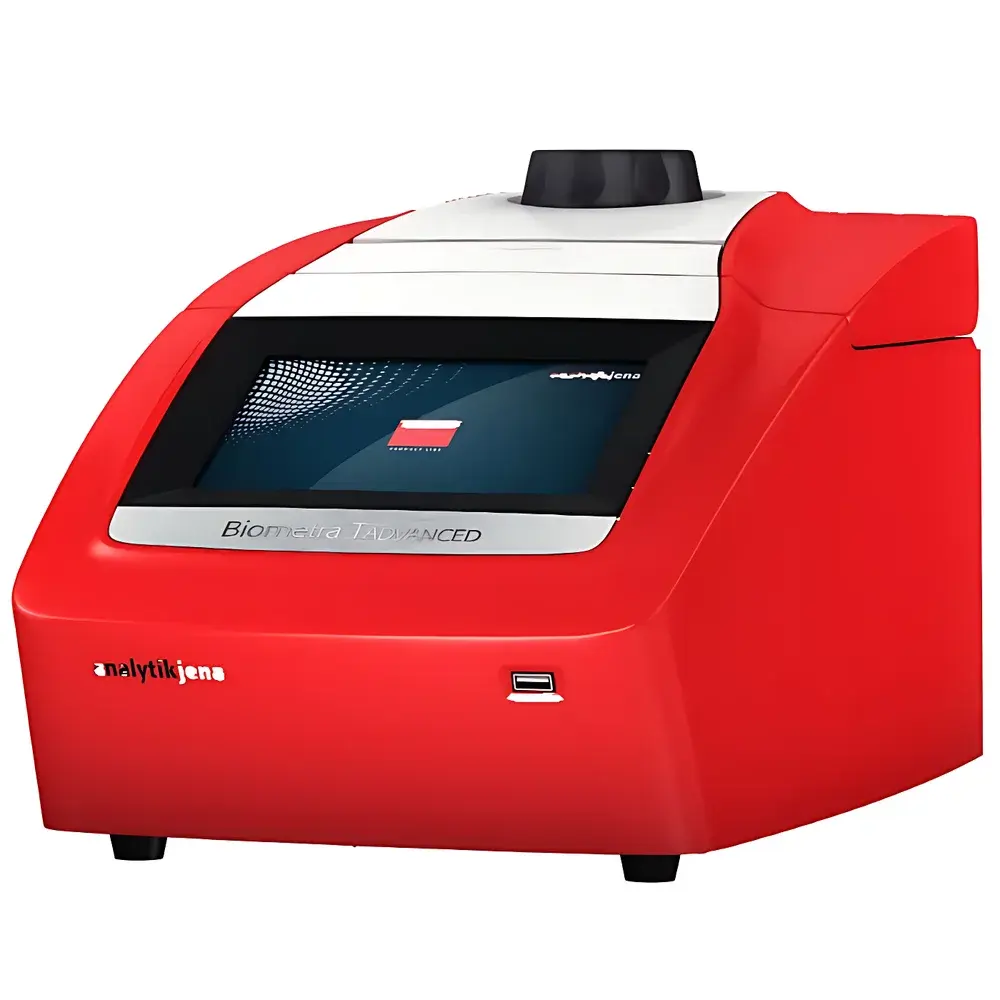
Analytik Jena Biometra TAdvanced 96 G Fast PCR Cycler
| Brand | Analytik Jena |
|---|---|
| Origin | Germany |
| Manufacturer | Analytik Jena AG |
| Product Type | Fast PCR Cycler |
| Sample Capacity | 96-well (0.2 mL tubes, 96-well plates, or 12×8 strip tubes) |
| Max Heating Rate | 6.0 °C/s |
| Temperature Accuracy | ±0.1 °C |
| Well-to-Well Uniformity | ±0.2 °C |
| Gradient Span | 0.1–30.0 °C (linear, per column) |
| Gradient Range | 20–99 °C |
| Block Temp Range | 3–99 °C |
| Lid Temp Range | 30–110 °C |
| Display | 7″ capacitive color touchscreen |
| Noise Level | ≤45 dB(A) |
| Power Consumption | 850 W |
| Dimensions (W×H×D) | 277 × 264 × 457 mm |
| Weight | 15 kg |
Overview
The Analytik Jena Biometra TAdvanced 96 G is a high-performance fast thermal cycler engineered for precision nucleic acid amplification under demanding laboratory conditions. It employs Peltier-based thermoelectric heating and cooling across a monolithic aluminum reaction block with a proprietary gold-alloy coating—designed to emulate the thermal conductivity of silver while ensuring long-term corrosion resistance and mechanical stability. The system implements real-time adaptive control (RAC) logic to eliminate thermal overshoot or undershoot during transitions, enabling reproducible ramping profiles critical for stringent applications such as high-fidelity PCR, qPCR assay development, and library preparation for next-generation sequencing. Its architecture supports rapid cycling kinetics without compromising temperature fidelity, making it suitable for laboratories requiring both speed and regulatory compliance in molecular diagnostics, clinical research, and academic genomics workflows.
Key Features
- High-Efficiency Thermal Block: Anodized aluminum block with electroplated gold-alloy surface ensures uniform heat transfer, rapid thermal response (6.0 °C/s max heating), and extended service life under repeated thermal stress.
- RAC Intelligent Temperature Control: Real-time adaptive control algorithm dynamically adjusts power delivery to maintain setpoint accuracy (±0.1 °C) and inter-well uniformity (±0.2 °C) across the full 96-well format.
- Linear Gradient Technology (LGT): Enables precise column-wise gradient programming from 20–99 °C with 0.1 °C resolution and up to 30 °C span—ideal for empirical optimization of annealing temperatures in primer validation and multiplex assay development.
- High-Performance Smart Lid (HPSL): Deeply recessed heated lid delivers consistent pressure and temperature (30–110 °C) across all well positions, minimizing evaporation even during extended protocols (>120 min) and eliminating the need for mineral oil overlay.
- Multi-Function Incubation Mode: Configurable as a metal-block incubator via independent control of block and lid temperatures—enabling post-PCR enzymatic reactions, restriction digests, or ligations without instrument reconfiguration.
- Quiet Operation & Ergonomic Design: Whisper-quiet operation (≤45 dB[A]) achieved via optimized fan placement and acoustic dampening; rear-and-bottom ventilation allows side-by-side benchtop installation without thermal interference.
Sample Compatibility & Compliance
The TAdvanced 96 G accommodates standard 96-well PCR plates (full-skirted, semi-skirted, unskirted), 0.2 mL individual tubes, and 12×8 strip tubes—compatible with most commercial master mixes and detection chemistries including SYBR Green, hydrolysis probes, and intercalating dyes. Its firmware and operational logs support audit-ready documentation aligned with GLP and ISO/IEC 17025 requirements. While not FDA-cleared as an IVD device, its design adheres to IEC 61010-1 safety standards and incorporates electronic calibration traceability for temperature verification. The system records SINF (System Information) logs—including thermal history, error events, and self-test outcomes—for internal quality assurance and maintenance planning.
Software & Data Management
The embedded operating system features a multi-tier user management framework (AUM), supporting three permission levels: Administrator, Operator, and Guest—with configurable access to method editing, parameter modification, and data export functions. Each user profile retains a personalized “Quick Launch” list of their five most recently executed protocols, accessible directly from the home screen. Temperature profiles can be visualized in tabular or graphical mode, including real-time gradient mapping. Firmware updates are performed securely over Ethernet or USB, with version rollback capability. All run data—including cycle-by-cycle temperature logs, gradient curves, and diagnostic timestamps—are exportable in CSV format for integration into LIMS or ELN platforms. No cloud dependency or vendor-hosted services are required.
Applications
- High-throughput genotyping and SNP screening in population genetics studies
- Optimization of multiplex PCR assays for pathogen detection panels
- Preparation of amplicon libraries for Illumina and Ion Torrent sequencing platforms
- Validation of CRISPR guide RNA efficiency via T7E1 or SURVEYOR assays
- Expression profiling using RT-PCR with reverse transcription integrated into thermal cycling protocols
- Quality control testing of oligonucleotide synthesis batches
FAQ
Does the TAdvanced 96 G support remote monitoring or control via network?
Yes—via built-in Ethernet interface, users can initiate runs, monitor progress in real time, and retrieve logs using a standard web browser on any local network-connected device.
Is gradient functionality available across all 96 wells simultaneously?
No—the linear gradient operates column-wise (12 columns × 8 rows), allowing independent temperature settings per column for systematic annealing optimization.
Can the instrument perform touchdown or step-down PCR protocols?
Yes—advanced protocol editor supports multi-stage ramping, variable hold times, and dynamic temperature adjustments within a single program.
What calibration documentation is provided with the instrument?
Each unit ships with a factory-verified temperature calibration certificate traceable to national standards (DKD/DAkkS-accredited lab), plus built-in self-test routines for periodic verification.
Is the touchscreen compatible with gloved operation?
Yes—the capacitive display responds reliably to standard nitrile and latex gloves, and its anti-reflective crystal surface maintains readability under overhead fluorescent or LED lighting.




