
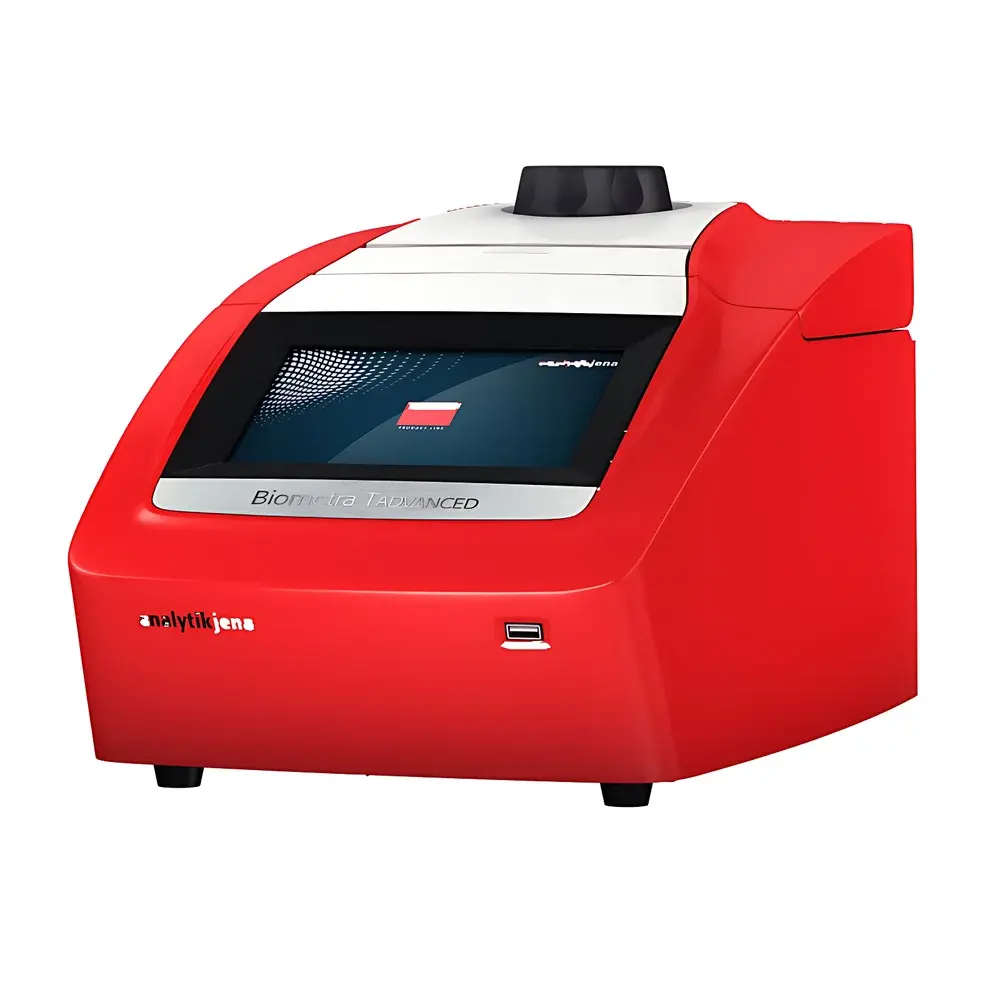
Analytik Jena Biometra TAdvanced 96SG High-Speed Gradient PCR Cycler
| Brand | Analytik Jena |
|---|---|
| Origin | Germany |
| Manufacturer Type | Original Equipment Manufacturer (OEM) |
| Product Category | Imported Instrument |
| Model | Biometra TAdvanced 96SG |
| Pricing | Upon Request |
Overview
The Analytik Jena Biometra TAdvanced 96SG is a high-performance, thermally optimized gradient thermal cycler engineered for rapid and reproducible polymerase chain reaction (PCR) amplification. Built upon over three decades of dedicated PCR instrument development in Jena, Germany, this system implements precise Peltier-based temperature control to deliver accelerated thermal ramping without compromising accuracy or uniformity across the 96-well sample block. Its core architecture leverages a gold-plated pure silver heating block — selected for exceptional thermal conductivity, long-term oxidative stability, and resistance to corrosion from repeated exposure to condensation and reagent vapors. The instrument operates on the fundamental principle of cyclic denaturation–annealing–extension, with real-time thermal profiling enabling rigorous validation of thermal homogeneity and kinetic fidelity — critical parameters for assay robustness in diagnostic, research, and quality control laboratories.
Key Features
- Ultra-fast thermal cycling: Maximum heating rate of 8 °C/s; average heating rate of 7 °C/s — significantly reducing total run time while maintaining DNA integrity.
- High-precision temperature control: Accuracy of ±0.1 °C and uniformity of ±0.15 °C across all 96 wells — validated per ISO/IEC 17025-compliant calibration protocols.
- Linear temperature gradient functionality: Programmable gradient range of 1–40 °C across the block, allowing empirical optimization of annealing temperatures in a single run.
- Intuitive human-machine interface: 7-inch full-color capacitive touchscreen with multi-level menu navigation, real-time temperature graphing, and customizable protocol templates.
- Acoustically optimized enclosure: Low-noise fan design and vibration-damped mounting ensure ambient sound pressure levels remain below 35 dB(A) during operation — suitable for open-lab environments.
- Efficient thermal management: Bottom-intake / rear-exhaust airflow architecture enables side-by-side installation with adjacent instrumentation without thermal cross-interference.
- Open-platform compatibility: Supports standard 96-well plates (full- and half-skirt), 0.2 mL skirted/unskirted tubes, and 8-tube strips — fully compliant with ANSI/SBS microplate standards.
Sample Compatibility & Compliance
The TAdvanced 96SG accommodates standard nucleic acid amplification workflows involving genomic DNA, cDNA, plasmid templates, and low-input clinical specimens. Its block geometry and thermal profile consistency meet requirements for applications governed by CLIA, CAP, and ISO 15189-accredited molecular pathology labs. The system supports GLP/GMP-aligned operation through user-accessible audit trail logs (date/time-stamped parameter changes, run start/stop events, and error notifications), and is compatible with 21 CFR Part 11-compliant electronic signature modules when integrated with validated LIMS or ELN platforms.
Software & Data Management
Instrument control and protocol management are handled via the proprietary TRIO software suite (v3.2+), which runs on Windows-based host PCs. TRIO provides version-controlled method storage, multi-user role assignment (administrator/operator/technician), export of raw thermal data in CSV and XML formats, and optional integration with laboratory information systems via HL7 or RESTful API extensions. All run data — including real-time thermal curves, cycle-by-cycle threshold detection (for endpoint PCR), and gradient mapping reports — are timestamped and stored with SHA-256 hash verification to support data integrity audits.
Applications
- High-throughput genotyping and SNP screening in population genetics studies
- Optimization of multiplex PCR assays requiring stringent annealing specificity
- Preparation of amplicons for next-generation sequencing library construction
- Routine pathogen detection in veterinary and food safety testing labs
- Validation of CRISPR guide efficiency and off-target assessment
- Teaching laboratory use — combining reliability, ease of training, and compliance-ready documentation
FAQ
What is the maximum ramp rate specification under full-load conditions?
The stated 8 °C/s heating rate is verified using an NIST-traceable thermocouple embedded at the center well position with a full 96-well plate loaded with 25 µL of water.
Does the system support remote monitoring or networked operation?
Yes — optional Ethernet connectivity enables centralized fleet management via Analytik Jena’s LabLink server platform, supporting SNMP-based status polling and scheduled firmware updates.
Is the gold-plated silver block serviceable or replaceable?
The block is factory-calibrated and field-replaceable as a complete assembly; replacement requires recalibration performed by an authorized service engineer per ISO/IEC 17025 procedures.
Can gradient profiles be saved and recalled as part of a protocol?
Yes — gradient settings (start/end temperatures, slope direction, and active row/column configuration) are embedded within each saved protocol file and restored automatically upon loading.
What regulatory documentation is supplied with the instrument?
Each unit ships with a Certificate of Conformance, Factory Calibration Report (including traceability to PTB standards), EU Declaration of Conformity (CE, RoHS, EMC), and a comprehensive technical manual compliant with IEC 61010-1 safety requirements.




