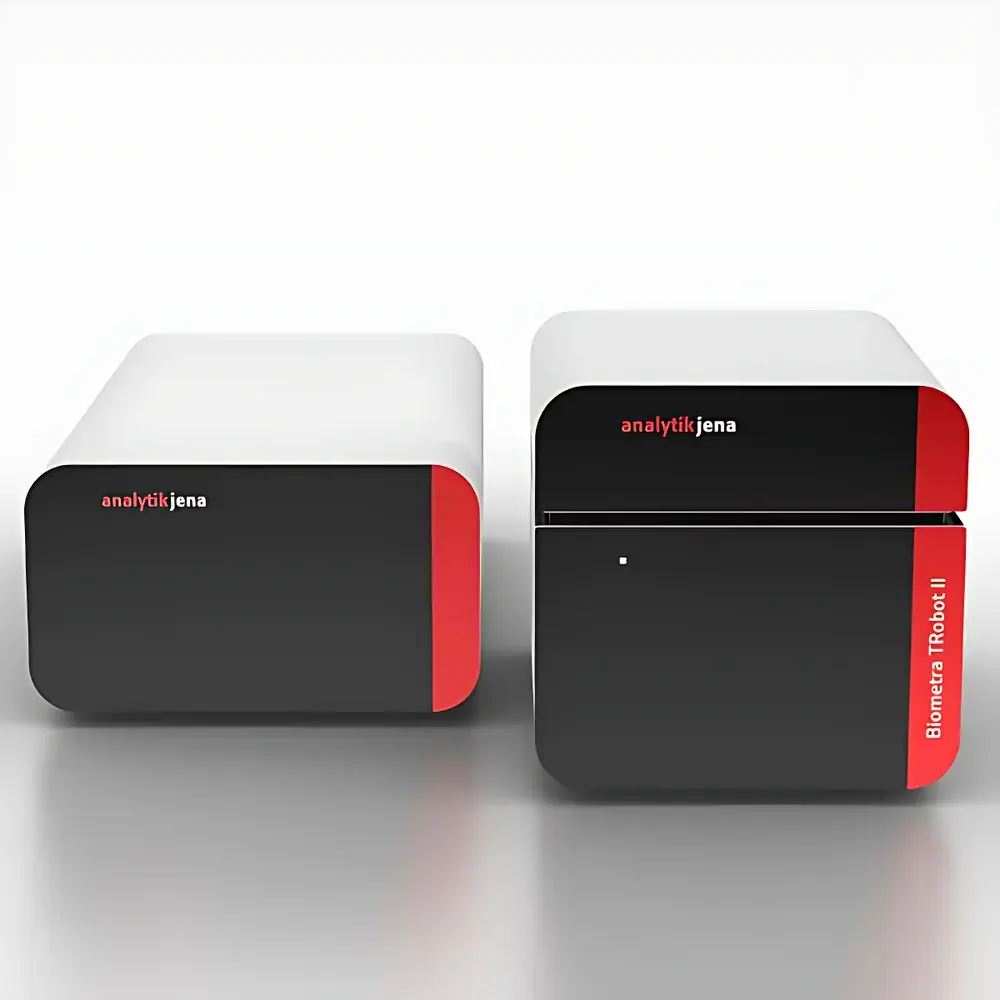
Analytik Jena Biometra TRobot II Automated PCR System
| Brand | Analytik Jena |
|---|---|
| Origin | Germany |
| Manufacturer Type | Original Equipment Manufacturer (OEM) |
| Product Origin | Imported |
| Model | Biometra TRobot II |
| Instrument Type | Fast-cycle PCR System |
| Sample Throughput | 96-well or 384-well format |
| Heating Rate | 5 °C/s |
| Temperature Accuracy | ±0.1 °C |
| Well-to-Well Temperature Uniformity | ±0.5 °C |
Overview
The Analytik Jena Biometra TRobot II Automated PCR System is a fully integrated, walk-away polymerase chain reaction platform engineered for high-throughput molecular biology laboratories requiring robust, GMP-aligned automation. Built upon over three decades of Analytik Jena’s expertise in thermal cyclers and laboratory automation, the TRobot II implements Peltier-based semiconductor temperature control to deliver precise, reproducible thermal cycling across 96- or 384-well microplates. Its core architecture supports unattended operation within end-to-end automated workflows—enabling seamless integration with liquid handlers, robotic arms, and sample storage systems. The system operates on the fundamental principle of controlled DNA denaturation, annealing, and extension cycles, with real-time thermal profiling ensuring fidelity in applications demanding high specificity and yield, such as NGS library amplification, genome-wide association studies (GWAS), high-throughput genotyping, and pharmaceutical target validation.
Key Features
- Three-sided access design: Fully open sample chamber after lid lift—enabling front, left, and right robotic plate handling without reorientation or mechanical constraint.
- Intelligent thermal lid: Motorized arc-lift mechanism with programmable downward pressure; contact force automatically adapts to plate height (standard, low-profile, or high-profile), eliminating evaporation while accommodating diverse consumables (full-skirted, semi-skirted, foil-sealed, silicone-gasketed, or rigid lid formats).
- Plate ejection mechanism: Integrated pneumatic lift module gently elevates the entire microplate prior to robotic retrieval—preventing adhesion-related mis-picks or damage after repeated thermal cycling.
- Safety-integrated lid actuation: Obstruction-sensing frame halts lid closure upon resistance detection, compliant with IEC 61000-6-2/6-4 electromagnetic compatibility and functional safety standards.
- Low-footprint chassis: Compact height and minimal bench space requirement facilitate installation into modular automation suites (e.g., Hamilton STAR, Tecan Fluent, Beckman Biomek i7).
- Self-diagnostics & recovery: Power-loss recovery protocol resumes interrupted runs from last completed cycle; built-in system self-test validates thermal calibration, lid actuation, and communication integrity at startup.
Sample Compatibility & Compliance
The TRobot II accepts all standard ANSI/SLAS-compliant 96-well and 384-well PCR plates—including those with variable skirt configurations, well depths, and sealing methods. No proprietary consumables are required. From a regulatory standpoint, the system supports audit-ready operations under GLP and GMP frameworks: full traceability of user actions, instrument states, and thermal profiles is maintained via timestamped, digitally signed log files. Data transmission between the instrument and host software (TSuite or third-party LIMS/ELN) employs TLS 1.2 encryption. User access adheres to 21 CFR Part 11 requirements through three-tier permission levels (Operator, Supervisor, Administrator), each with configurable privileges for method editing, run initiation, and log export.
Software & Data Management
Controlled via TSuite PC software (Windows-based), the TRobot II enables method development, scheduling, remote monitoring, and comprehensive reporting. TSuite generates PDF-formatted run reports containing cycle-by-cycle temperature logs, lid status history, error flags, and user audit trails. For enterprise integration, the system provides standardized driver interfaces (including RS232, Ethernet TCP/IP, and optional OPC UA) compatible with major laboratory automation platforms. All data—including raw thermal curves, event timestamps, and maintenance records—is stored locally in SQLite databases with SHA-256 checksum verification to ensure immutability and integrity.
Applications
This system is routinely deployed in core facilities supporting next-generation sequencing library preparation, large-scale population genomics (e.g., biobank-scale SNP screening), CRISPR gRNA validation, pharmacogenomic biomarker assays, and diagnostic assay development. Its fast ramp rates (5 °C/s) reduce nonspecific primer binding, enhancing amplicon specificity—particularly critical for multiplex PCR and long-range amplification. In regulated environments, its deterministic thermal performance and electronic recordkeeping support method validation per ISO/IEC 17025 and ASTM E2500-20 guidelines.
FAQ
Does the TRobot II require proprietary PCR plates?
No. It accepts any ANSI/SLAS-standard 96-well or 384-well plate, regardless of skirt type, well depth, or sealing method.
Can the instrument resume runs after unexpected power loss?
Yes. The system automatically detects interruption and resumes thermal cycling from the last completed cycle upon power restoration.
Is TSuite software mandatory for automation integration?
No. While TSuite enables standalone optimization and local control, the TRobot II provides documented communication protocols for direct integration into third-party automation orchestration layers.
How is temperature uniformity validated across the block?
Each unit undergoes factory calibration using NIST-traceable thermistors at ≥16 spatial points; certificate of conformance includes measured well-to-well deviation (±0.5 °C max) and absolute accuracy (±0.1 °C at 95 °C).
What safety certifications does the TRobot II hold?
It complies with IEC 61010-1 (Safety Requirements for Electrical Equipment), IEC 61326-1 (EMC for Laboratory Use), and carries CE marking under the EU Machinery Directive 2006/42/EC.
Related Products