
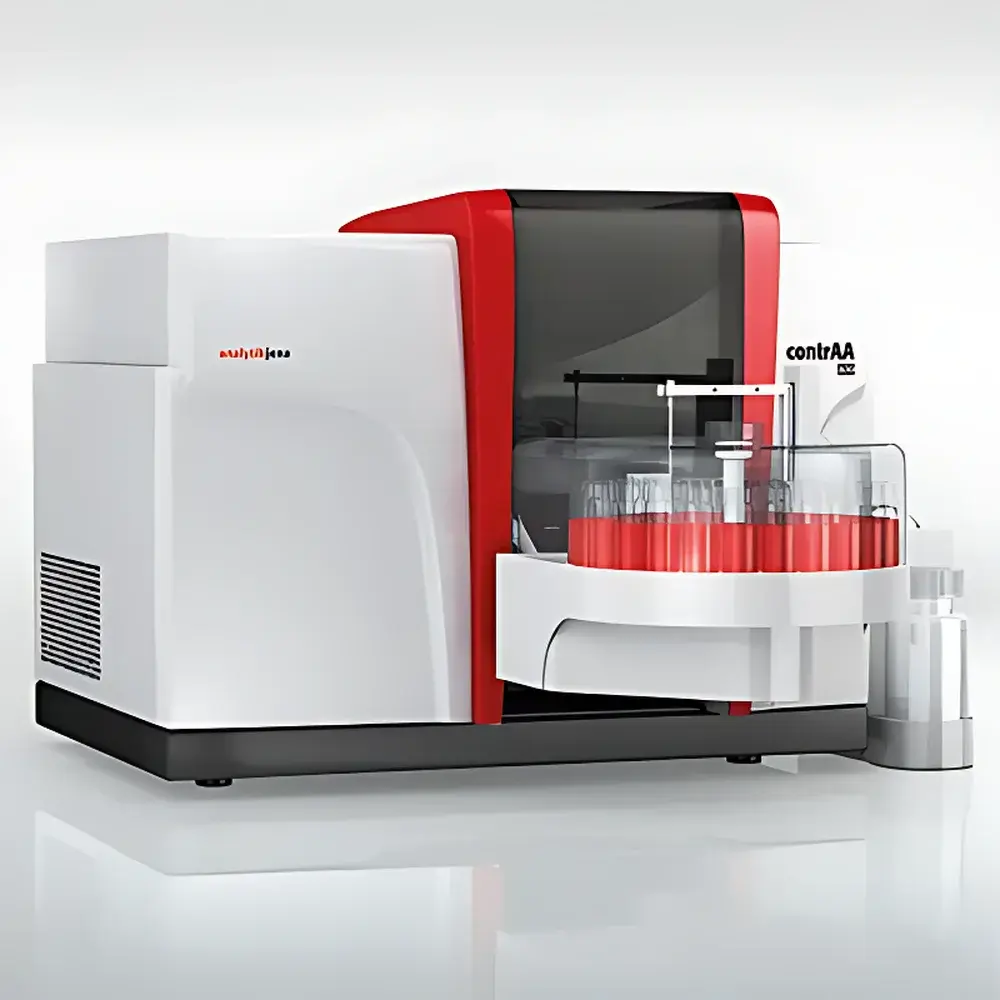
Analytik Jena contrAA 800 Continuum-Source Atomic Absorption Spectrometer
| Brand | Analytik Jena |
|---|---|
| Origin | Germany |
| Manufacturer | Analytik Jena AG |
| Instrument Type | Flame and Graphite Furnace AAS |
| Optical System | Dual-Beam |
| Monochromator | Echelle Grating with Quartz Prism Cross-Disperser |
| Detector | Solid-State CCD Array |
| Background Correction | Real-Time, Multi-Wavelength Simultaneous Correction |
| Wavelength Resolution | 0.002 nm |
| Light Source | High-Intensity Short-Arc Xenon Lamp (Continuum Source) |
| Measurement Mode | Sequential Multi-Element & Full-Spectrum Acquisition |
| Dynamic Linear Range | 5 Orders of Magnitude |
| Software Compliance | FDA 21 CFR Part 11 Ready, GLP/GMP Audit Trail Enabled |
Overview
The Analytik Jena contrAA 800 is a continuum-source atomic absorption spectrometer engineered for high-fidelity elemental quantification across complex matrices. Unlike conventional line-source AAS systems relying on discrete hollow-cathode lamps, the contrAA 800 employs a high-radiance short-arc xenon lamp emitting continuous UV–VIS radiation (185–900 nm), enabling full spectral acquisition at sub-picometer resolution. Coupled with a dual-stage echelle grating monochromator and quartz prism cross-disperser, the system delivers true spectroscopic capability—capturing complete absorption profiles rather than isolated analytical lines. This architecture supports both sequential multi-element analysis and simultaneous spectral interrogation, bridging functional gaps between conventional AAS and ICP-OES while retaining the matrix robustness and low detection sensitivity characteristic of graphite furnace and flame atomization techniques. Designed and manufactured in Jena, Germany, the instrument meets stringent ISO/IEC 17025-aligned design criteria and is validated for use in regulated environments requiring trace metal analysis per ASTM D5600, ISO 11885, USP , and EPA Method 200.7.
Key Features
- Continuum-source excitation: Eliminates lamp exchange, pre-warm-up delays, and element-specific calibration constraints—enabling immediate measurement of any element within the optical range.
- Echelle-based high-resolution optics: Achieves 0.002 nm spectral resolution via a thermally stabilized double-pass echelle grating and quartz prism cross-disperser, resolving adjacent atomic and molecular absorption features without interference.
- CCD array detector: Captures full wavelength windows (e.g., 200–400 nm) simultaneously with pixel-level intensity registration—supporting time-resolved, wavelength-resolved, and signal-intensity dimensionality (3D data cubes).
- Real-time background correction: Uses multi-line neon emission for dynamic wavelength referencing and simultaneous background subtraction across the entire spectrum—no separate deuterium or Zeeman hardware required.
- Dual-atomization platform: Integrated flame and electrothermal graphite furnace modules share identical optical path and software control—ensuring method transferability and inter-platform comparability.
- Dynamic linear response: Automatic gain switching and adaptive integration times extend quantitative range across five orders of magnitude (sub-pg to µg/mL), permitting major and ultra-trace elements to be quantified from a single sample aliquot.
Sample Compatibility & Compliance
The contrAA 800 accommodates aqueous solutions, digested environmental solids (EPA SW-846 Methods 3015A, 3050B), biological tissues (AOAC 999.10), petrochemical distillates (ASTM D5708), and pharmaceutical excipients (ICH Q2(R2)). Its graphite furnace module supports platform-stabilized temperature programming with integrated Zeeman-effect-free transverse heating—minimizing matrix-induced volatility artifacts. All hardware and firmware comply with CE marking requirements (2014/30/EU, 2011/65/EU), and the instrument’s software architecture conforms to FDA 21 CFR Part 11 for electronic records and signatures, including role-based access control, full audit trail logging, and electronic signature enforcement. It supports GLP/GMP-compliant workflows through automated calibration verification, drift monitoring, and QC sample bracketing protocols.
Software & Data Management
The instrument is operated via the ASpect software suite—a Windows-based application supporting method development, sequence definition, real-time spectral visualization, and automated report generation. Spectral libraries include NIST-certified line positions, molecular band references, and interference databases for over 70 elements. Data files are stored in vendor-neutral HDF5 format with embedded metadata (instrument parameters, calibration history, operator ID, timestamp). Export options include CSV, XML, and PDF with customizable templates compliant with LIMS interfaces (e.g., LabWare, STARLIMS). Software validation packages—including IQ/OQ documentation, test scripts, and UAT protocols—are available upon request for regulated laboratory deployment.
Applications
- Environmental testing labs: Quantification of Pb, Cd, As, Hg, and Cr(VI) in drinking water (ISO 17294-2), soil extracts (EN 12457), and airborne particulates (EN 14385).
- Clinical and toxicology laboratories: Trace metal profiling in whole blood, serum, and urine using GF-AAS—validated against CDC’s Environmental Health Laboratory standards.
- Pharmaceutical quality control: Elemental impurity screening per ICH Q3D guidelines, including catalyst residue analysis (Pd, Pt, Ni) in active pharmaceutical ingredients.
- Geochemical research: Multi-element determination in acid-digested rock samples with spectral interference correction for rare earth elements (e.g., Eu/Tb overlap).
- Food safety monitoring: Simultaneous detection of essential (Fe, Zn, Cu) and toxic (Al, Sn, Sb) metals in infant formula, cereals, and dietary supplements (AOAC 2013.06).
FAQ
How does the contrAA 800 differ from traditional line-source AAS instruments?
It replaces discrete hollow-cathode lamps with a broadband xenon continuum source and uses high-resolution echelle spectroscopy to isolate absorption features—enabling full-spectrum acquisition, interference identification, and post-acquisition reprocessing.
Can the system perform background correction without additional hardware?
Yes—real-time, multi-wavelength background correction is performed algorithmically using the same CCD detector and neon reference lines, eliminating the need for mechanical choppers or auxiliary lamps.
Is method validation support available for regulated industries?
Yes—Analytik Jena provides comprehensive IQ/OQ documentation, 21 CFR Part 11 configuration guides, and GxP implementation consulting services.
What sample introduction options are supported?
Standard configurations include autosampler-compatible flame nebulization (Meinhard-type), electrothermal graphite furnace (with integrated platform and argon purge), and optional hydride generation (As, Se, Sb) and cold vapor (Hg) modules.
Does the software allow retrospective spectral re-evaluation?
Yes—raw spectral data (wavelength × intensity × time) is permanently archived; users may re-integrate peaks, adjust baseline definitions, or apply alternate background models after acquisition.





